


Illegal migration from North Eastern Kenya toward Europe has reached a disturbing and deeply entrenched phase. What was once viewed by many young people as a risky but hopeful escape from poverty has transformed into a brutal system of exploitation, extortion, and loss. Across Garissa, Wajir, Mandera, and the Dadaab refugee camps, families are watching their children disappear into a transnational trafficking network that now operates with industrial efficiency.
This journey locally known as tahriib is no longer driven solely by individual ambition. It is the product of structural neglect, prolonged unemployment, climate-induced displacement, insecurity in Somalia, and a growing sense of exclusion among youth in North Eastern Kenya. For many, Europe is imagined as the final refuge from a life with limited opportunities. In reality, Libya has become the graveyard of that dream.
A Generation Pushed to the Brink
North Eastern Kenya continues to experience some of the highest youth unemployment rates in the country. For Somali youth many of whom are refugees or descendants of refugees the barriers are even steeper. Delays in issuing national identification documents lock thousands out of formal employment, higher education loans, and legal movement within Kenya. Climate shocks have further eroded livelihoods, especially pastoralism, leaving families with shrinking survival options.
This environment has created a perfect recruitment ground for trafficking syndicates. Young people are approached not only by strangers but increasingly by familiar faces friends, neighbors, former migrants, and in some cases trusted community members. Social media has amplified the reach of these recruiters. Carefully curated TikTok videos and WhatsApp messages showcase a fantasy of easy travel, quick employment, and guaranteed asylum in Europe. The risks are deliberately minimized or erased entirely.
What makes the current wave particularly dangerous is that migration is no longer organized informally. It is systematized, financed, and digitized.
Libya: The Bottleneck That Traps, Not Transits
Despite years of international warnings, Libya remains the central transit point for migrants attempting to reach Europe. Its fragmented governance, competing armed groups, and vast ungoverned desert regions have allowed smuggling networks to flourish unchecked.
For Somali youth arriving via Sudan or South Sudan, Libya is rarely a place of temporary passage. It is where movement stops. Many are intercepted almost immediately and transferred into detention-like facilities run by traffickers. Others are arrested during internal crackdowns and placed in state-controlled detention centers, where overcrowding, abuse, and uncertainty are widespread.
In early 2026, Libyan authorities intensified deportations, explicitly stating that Libya will not serve as a settlement country for irregular migrants. Somali nationals were among those deported from facilities such as Qanfuda. While these actions signal enforcement, they do little to dismantle the trafficking networks operating beyond official oversight.
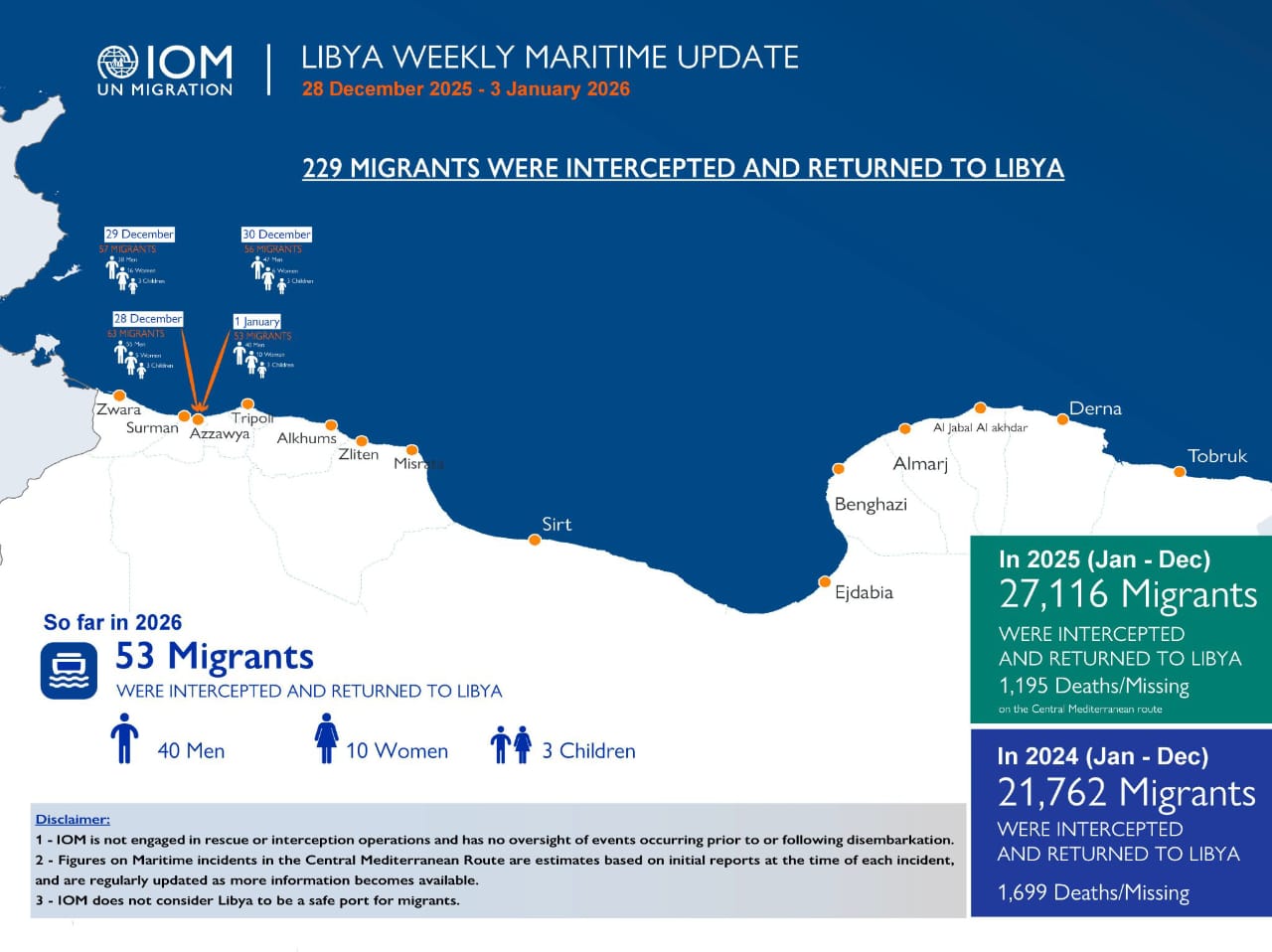
As of mid-2025, estimates placed more than 850,000 migrants and refugees inside Libya, thousands of them Somali. Many remain unaccounted for, trapped between smugglers, detention centers, and closed borders.
The Emergence of a Ransom-Based Migration Economy
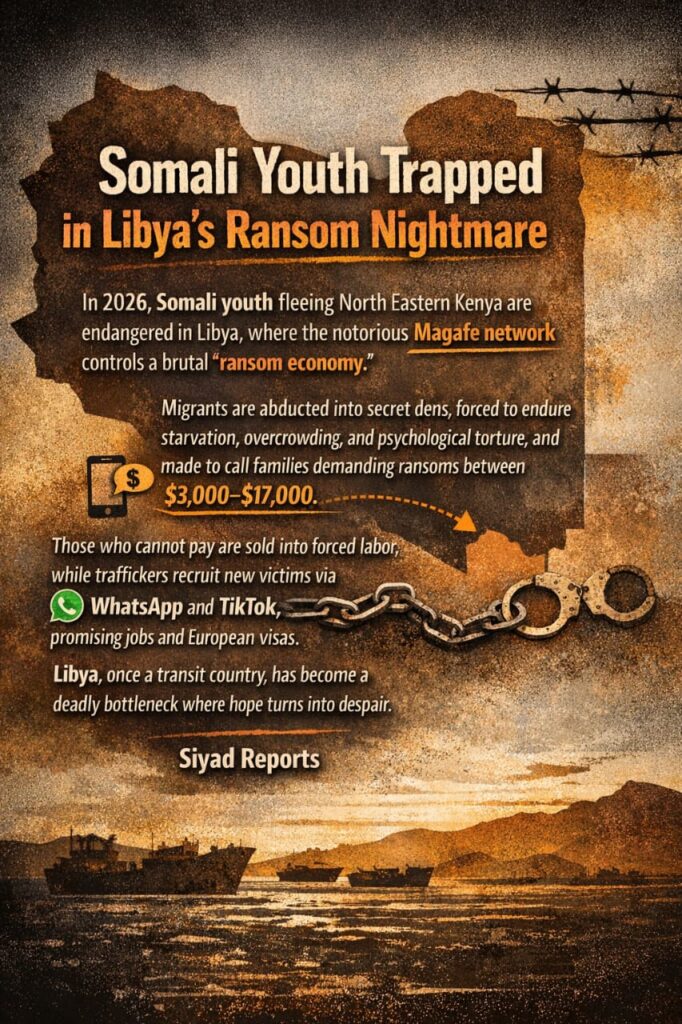
What distinguishes the Libya route today is the transformation of migration into a ransom-driven business model. Smuggling syndicates, commonly referred to by survivors as Magafe operate less like informal facilitators and more like organized criminal enterprises.
Once migrants are captured, their value is calculated not by their labor but by their families’ ability to pay. Ransoms demanded from Somali families have risen sharply, often exceeding those demanded from other nationalities. Entire households are plunged into financial ruin trying to secure the release of a single child.
Mohamed Adan, not his real name, recounts his journey from Eastleigh, Nairobi, to the deadly cells of Libya, where he fell into the hands of the notorious Magafe network. Lured by promises of work and a better life in Europe, he crossed Sudan and arrived in Libya, only to be abducted into overcrowded cells, deprived of basic needs, and forced to call his parents while the traffickers demanded a ransom of $10,000. His family, desperate to save him, organized a fundraising campaign with the help of local leaders, eventually meeting the traffickers’ demand. Mohamed was finally repatriated to Kenya, physically unharmed but deeply scarred by the experience. Reflecting on his ordeal, he says: “I thought I was chasing opportunity, but I ended up in the hands of people who see human lives as money.”
Digital technology has become central to this economy. Families are contacted directly, often through the victim’s own phone, and pressured to mobilize funds within days. The emotional toll is immense.
Communities in Rhamu, Mandera, and parts of Garissa report repeated emergency fundraising drives, property sales, and debt accumulation linked to Libya ransom demands.
This system has effectively outsourced enforcement to families themselves, forcing them to choose between financial collapse and the fate of their loved ones.
Routes, Middlemen, and the Kenyan Link
The journey from North Eastern Kenya to Libya is rarely direct. Traffickers move youth through multiple countries using well-established corridors that pass through Uganda, South Sudan, and Sudan. Nairobi’s Eastleigh suburb has emerged as a key logistical hub, where brokers coordinate payments, documents, and onward transfers.
Each stage of the journey represents a transaction. Young people are passed from one agent to another, with fees collected at every point. By the time a migrant reaches Libya, they are already deeply embedded in a chain designed to extract maximum profit.
For many, the journey ends long before reaching the Mediterranean.
Siyad Reports’ Chief Editor Abdihakim Siyad met Ilyas Adan in the outskirts of Wajir town to hear firsthand about his harrowing journey through illegal migration. Ilyas recounted how he left North Eastern Kenya, passing through Sudan, only to end up in the notorious Magafe network’s cells in Libya.
What he witnessed there went beyond captivity. Overcrowded dens, starvation, and the ruthless control of traffickers turned the place into a massacre of hope. Young migrants were reduced to mere commodities, subjected to extreme deprivation and psychological torment. His parents were forced to raise $10,000 through a community fundraising campaign, with the help of local leaders, to secure his release.
After months of suffering, Ilyas was finally repatriated to Kenya, physically unharmed but deeply scarred by the experience. Reflecting on his ordeal, he said:
“I went seeking a better life, but what I found in Libya was a massacre of youth, where human lives are nothing but commodities.”
He also shared a stern warning to other young people considering illegal migration:
“To the youth dreaming of Europe: do not risk your life. The journey is not worth it. What awaits you is suffering, captivity, and despair. Protect your life and your future by staying and building opportunities at home.”
Ilyas Adan’s story is a stark reminder of the dangers facing Somali youth from North Eastern Kenya and the deadly reality of illegal migration through Libya.
Europe’s Shrinking Door and the Cost of Failure
Even for those who escape captivity, the final crossing remains extraordinarily dangerous. The Central Mediterranean route continues to be the deadliest migration corridor in the world. European border enforcement has tightened significantly, reducing arrival success rates.
While some Somalis do reach Europe, their numbers remain small relative to the scale of movement. In 2025, Somalis accounted for a minor share of Mediterranean arrivals, and that proportion is expected to decline further.
For the majority, the outcome is detention, disappearance, death, or forced return.
Repatriation, Regret, and a Region in Distress
Through Voluntary Humanitarian Return programs, hundreds of Somali migrants were repatriated from Libya to Mogadishu in late 2025 and early 2026. While reintegration grants provide short-term relief, many return empty-handed, traumatized, and deeply disillusioned.
In North Eastern Kenya, parents are now openly demanding government intervention. What was once framed as a personal choice is increasingly recognized as a systemic failure. County officials have issued warnings, but without sustainable jobs, identity documentation, digital awareness, and cross-border enforcement, the exodus continues.
Illegal migration from North Eastern Kenya to Europe has mutated into a predatory system where desperation is monetized and youth are reduced to bargaining chips.
Libya stands at the center of this crisis not as a bridge to opportunity, but as the engine of a ransom economy built on human suffering.
Unless urgent structural solutions are implemented, the region risks losing an entire generation to a journey that promises everything and delivers nothing.