

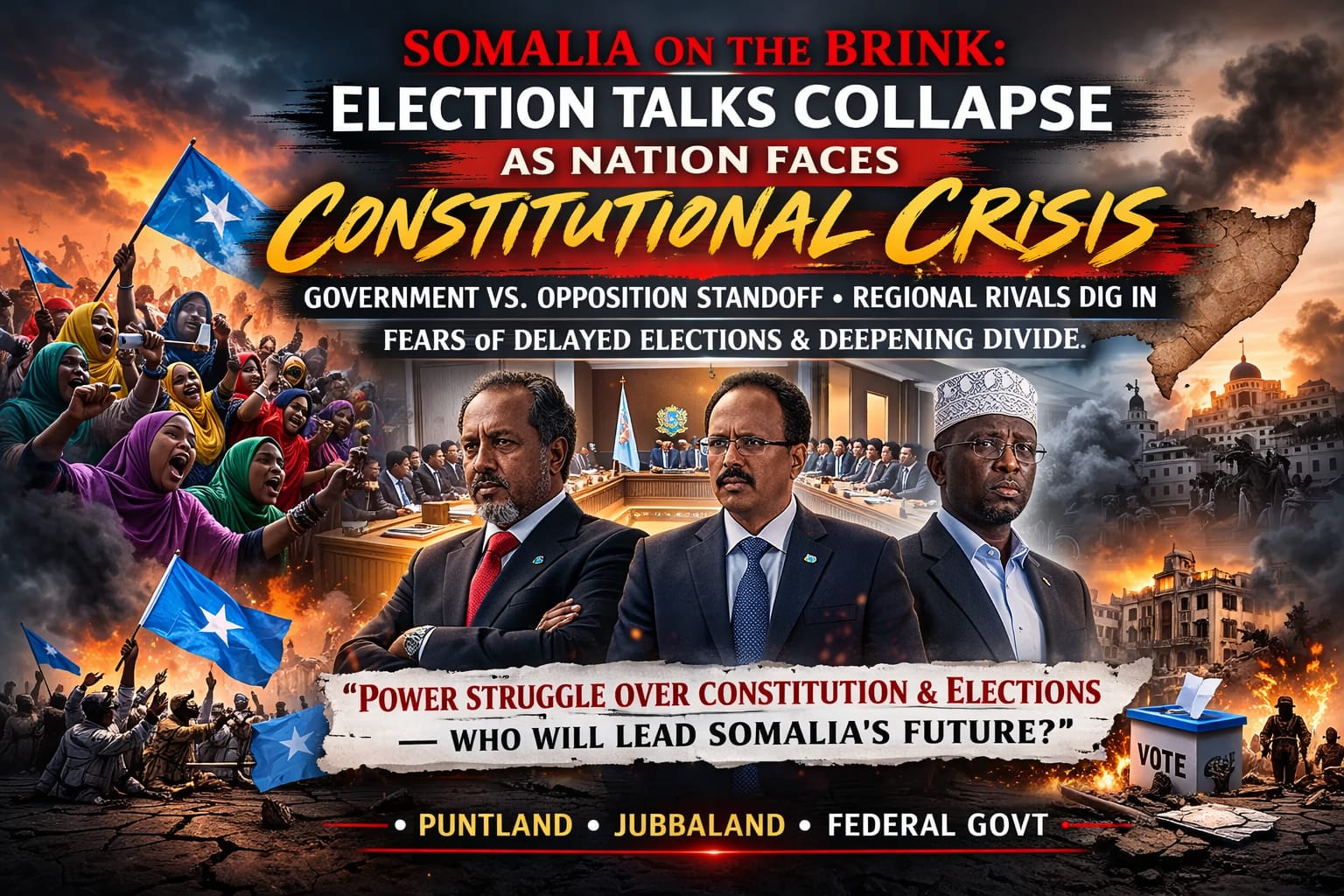
Somalia once again finds itself standing at a familiar and fragile crossroads. What began as structured dialogue between the Federal Government in Mogadishu and opposition leaders under the banner of the Somali Future Council has collapsed without agreement. The breakdown of talks has exposed deep political fractures over the electoral framework, constitutional amendments, and the future of federalism. But it is not only the collapse itself that has alarmed observers it is the rhetoric that followed.
Somalia’s Defense Minister, Ahmed Moalim Fiqi, reportedly warned that the government could confront political opponents in the same manner it confronts Al-Shabaab. Such language, in a country still recovering from decades of conflict, immediately raised tensions. In parallel, the United Kingdom signaled it was attempting to mediate between Somali stakeholders, urging compromise and dialogue.
Meanwhile, opposition leaders including former presidential contenders and federal member state leaders from Puntland and Jubbaland insisted that the 2012 Provisional Constitution remains the legitimate legal foundation of the state and that any amendments must be nationally consensual. The Federal Government, led by President Hassan Sheikh Mohamud, maintains it is implementing an electoral framework aligned with newly amended constitutional provisions.
This is not merely another political disagreement. It is a defining test of Somalia’s post-conflict democratic transition.
At stake is the credibility of constitutionalism, the future of federalism, the legitimacy of the next election cycle, and ultimately the stability of the Somali state itself.
A Familiar Cycle of Electoral Crisis
Somalia’s political calendar has repeatedly produced moments of high tension. Every electoral cycle since 2000 has been marked by disputes over mandates, delays, competing interpretations of constitutional clauses, and political brinkmanship.
The 2012 Provisional Constitution was meant to stabilize this cycle by providing a federal structure and institutional clarity. However, its “provisional” nature left room for interpretation and amendment. Successive administrations have sought to clarify or adjust it, but the process of amendment itself has often been politically contested.
Now, as the next election approaches, the argument centers on two competing visions:
The Federal Government’s claim that constitutional amendments passed through parliamentary procedures provide a new legal pathway for elections.
The opposition’s insistence that such amendments lack broad-based consensus and therefore cannot override the original 2012 framework without inclusive national agreement.
This dispute is not technical. It goes to the heart of legitimacy.
In fragile democracies, legality and legitimacy must move together. A process may be technically legal within parliamentary arithmetic but politically illegitimate if major stakeholders feel excluded. Conversely, a demand for consensus can become a tool to block necessary reform.
Somalia’s current crisis reflects this tension between procedural authority and political inclusivity.
The Dangerous Weight of Political Rhetoric
The most alarming dimension of this crisis is the language of confrontation.
When a defense minister publicly equates political opposition with an armed insurgent group, it changes the tone of national politics. Words matter in post-conflict societies. They shape perceptions, mobilize supporters, and can unintentionally escalate polarization.
Somalia is still fighting Al-Shabaab militarily. That fight is framed as a national security campaign against terrorism. To invoke similar language in the context of political opposition blurs the line between security threats and political dissent.
That distinction is fundamental to democratic governance.
Opposition politics is not rebellion. It is a structural component of democracy. If political disagreement is securitized framed as a threat rather than dissent it risks normalizing coercive responses where negotiation should prevail.
Even if the statement was rhetorical, its symbolism carries consequences. It signals that politics may shift from negotiation to confrontation. In a country with Somalia’s history, such signals can destabilize public confidence.
International Mediation and External Influence
The United Kingdom’s reported effort to mediate reflects a broader international concern. Somalia remains deeply interconnected with international partners politically, financially, and security-wise.
External actors often walk a delicate line: supporting stability without appearing to interfere in sovereignty. However, when domestic dialogue collapses, international mediation becomes both inevitable and controversial.
Some Somali lawmakers have accused leaders in Turkey and Djibouti of encouraging constitutional shortcuts. Whether such accusations are politically motivated or grounded in diplomatic reality, they highlight another recurring Somali debate: the role of external actors in shaping domestic politics.
Somalia’s state-building project has long been supported by international partners. Yet, heavy external involvement sometimes fuels suspicion among domestic actors who fear imposed solutions.
The deeper issue is not foreign influence itself, but domestic fragmentation that creates openings for external mediation. When Somali stakeholders cannot reach agreement internally, outside voices gain leverage.
Federalism Under Pressure
At the center of the crisis lies federalism.
Puntland and Jubbaland leaders insist that constitutional changes must involve federal member states through inclusive consensus. For them, the defense of the 2012 constitution is also a defense of federal autonomy.
The Federal Government, however, appears determined to move forward with reforms it considers legally adopted through parliamentary processes.
This tension reflects a broader structural challenge: Somalia’s federal system remains young and institutionally fragile. Trust between Mogadishu and federal member states has fluctuated over the years.
Whenever elections approach, that trust deficit resurfaces.
If federal states perceive constitutional amendments as centralizing power, they resist. If the center perceives states as obstructing reform, it pushes forward unilaterally.
The result is institutional gridlock.
Electoral Reform or Electoral Control?
Another sensitive allegation emerging from opposition voices is that the Federal Government seeks to design an electoral process it can control.
Whether this accusation is accurate or politically strategic, it resonates because of Somalia’s history. Past electoral disputes have revolved around who sets the rules, who selects delegates, and who oversees implementation.
In transitional democracies, rule-setting is power.
If one side defines the electoral architecture without broad consensus, the losing side is likely to reject the outcome before ballots are even cast.
The government insists it remains committed to a constitutional, democratic electoral path reflecting the will of the Somali people. It emphasizes that consultations with civil society, academics, and political actors have taken place since March 2025.
But opposition leaders argue that consultation is not the same as negotiated agreement.
This distinction will determine whether the next election becomes a stabilizing milestone or another chapter in Somalia’s cycle of crisis.
The Constitutional Question: Procedure vs. Consensus
The constitutional debate now shapes the entire political landscape.
The government’s position appears rooted in parliamentary procedure amendments passed through recognized legislative mechanisms.
The opposition’s position rests on inclusivity arguing that foundational changes require national consensus beyond simple parliamentary majorities.
Both claims contain elements of democratic reasoning.
However, the Somali constitution was deliberately designed as provisional to encourage broad-based agreement before finalization. The spirit of that design suggests that constitutional legitimacy depends heavily on inclusivity.
If either side hardens its stance, the constitutional question may transform from a legal dispute into a political standoff.
Public Fatigue and Democratic Legitimacy
Somalia’s citizens are watching.
After decades of conflict, displacement, and insecurity, ordinary Somalis seek stability, jobs, development, and institutional predictability. Recurrent electoral crises risk eroding public faith in political elites.
As opposition leader Abdirahman Abdishakur Warsame warned, Somalia seems to return to the same crossroads every four years.
The deeper problem may not be legal frameworks but political culture.
Democracy requires leaders willing to be constrained by institutions. If political actors treat rules as flexible instruments rather than binding commitments, crises become cyclical.
Public frustration could translate into apathy or worse, into radicalization if citizens lose faith in peaceful political competition.
Security Implications
The political crisis also intersects with national security.
Somalia continues military operations against Al-Shabaab. Political fragmentation at the center can weaken coordination, morale, and international support.
Armed groups often exploit political divisions. If opposition-government tensions escalate, security focus could shift inward rather than outward.
Stability requires political cohesion, especially during ongoing counterinsurgency operations.
The Road Ahead
Somalia now faces three potential trajectories:
Negotiated Compromise: Both sides soften rhetoric, international mediation supports dialogue, and an inclusive electoral agreement emerges.
Managed Unilateralism: The Federal Government proceeds with its framework, opposition resists politically but avoids escalation.
Escalatory Confrontation: Political rhetoric hardens, institutional paralysis deepens, and constitutional disputes trigger broader instability.
The first path offers stability but requires compromise. The second risks long-term legitimacy questions. The third could destabilize Somalia’s fragile progress.
At this moment, restraint is strategic wisdom.
Political actors must recognize that elections are not merely events they are tests of institutional maturity.
Somalia has made significant strides in rebuilding state institutions since 2012.
International debt relief, security reforms, and diplomatic normalization reflect real progress. But institutional strength is measured not in moments of agreement, but in moments of disagreement.
The true test of Somalia’s democratic evolution is whether it can manage political conflict without transforming it into national crisis.
If dialogue resumes and inclusive consensus emerges, this episode could become a turning point toward political maturity.
If confrontation replaces compromise, Somalia risks repeating the cycle it has struggled to escape. The crossroads is familiar. The choice, however, remains open.