


Mandera County is in the grip of yet another devastating drought, but this is not merely a natural disaster. It is the consequence of years of policy failure, weak prioritisation, and leadership that has normalised emergency as a mode of governance.
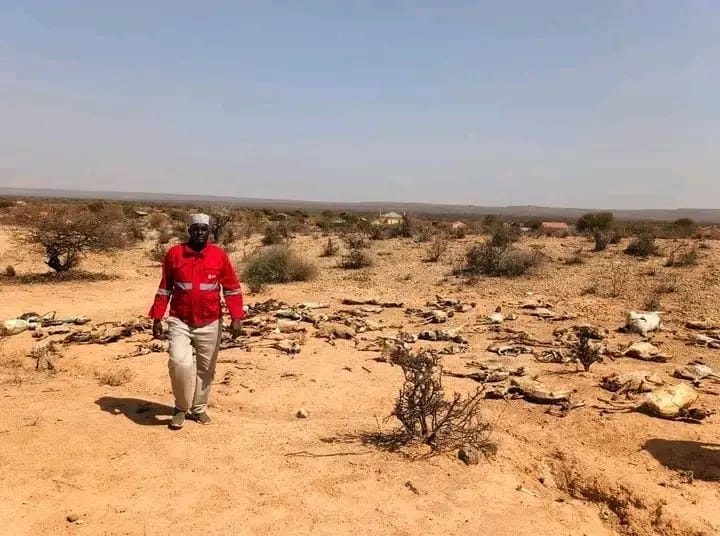
In Rhamu Sub-County, particularly Chabii Barr, the crisis is no longer abstract. Kenya Red Cross teams have documented over 70 dead livestock, a clear indicator of how deeply the drought has cut into pastoralist livelihoods. For families whose survival depends almost entirely on livestock, these deaths represent hunger, school dropouts, displacement, and the erosion of dignity.
Humanitarian agencies have stepped in to fill the gap left by the state. The Kenya Red Cross has delivered 28,000 litres of clean water, distributed 120 bags of fortified porridge to children under five, pregnant women, and lactating mothers, and deployed medical outreach teams to vulnerable households. While lifesaving, these interventions are temporary. Even the Red Cross warns that the situation remains critical.
This reality forces a difficult but necessary conversation: why is Mandera still this vulnerable?
Billions allocated, resilience missing
Mandera is not a county starved of resources. In the 2024/2025 financial year, it received an allocation of approximately KSh 14.38 billion, including an equitable share of KSh 13.75 billion and an Equalization Fund allocation of KSh 1.23 billion, alongside grants and levies. Since the start of devolution in 2013, Mandera County has received over KSh 170 billion in total allocations from the national government placing it among the most funded counties in Kenya over the last decade.
Yet, despite these vast sums, drought continues to dismantle lives with frightening ease. Water pans dry up completely, boreholes become overstretched, and communities depend on water trucking as a permanent solution rather than a last resort. This points to a deeper failure: the absence of long-term drought resilience planning.
In January 2026, Governor Mohamed Adan Khalif declared Mandera to be in the “alarm” phase after three consecutive failed rainy seasons. County data indicates that approximately 335,000 residents, about 35 percent of the population, now require urgent humanitarian assistance. More than 95 percent of surface water sources have dried up, and emergency water trucking needs are projected to exceed 250,000 people.
The county government announced a KSh 4.7 billion multi-sectoral response plan, including water trucking, borehole rehabilitation, food distribution, cash transfers, and livestock support. On paper, the response appears comprehensive. On the ground, however, residents say the impact is barely visible.
Criticism has intensified over what many describe as leadership that prioritises visibility over delivery. Senior county officials, including the governor, have conducted aerial assessments using helicopters while communities struggle for basic necessities. While assessments are important, they do not replace decisive action, nor do they explain why predictable drought cycles continue to catch the county unprepared.
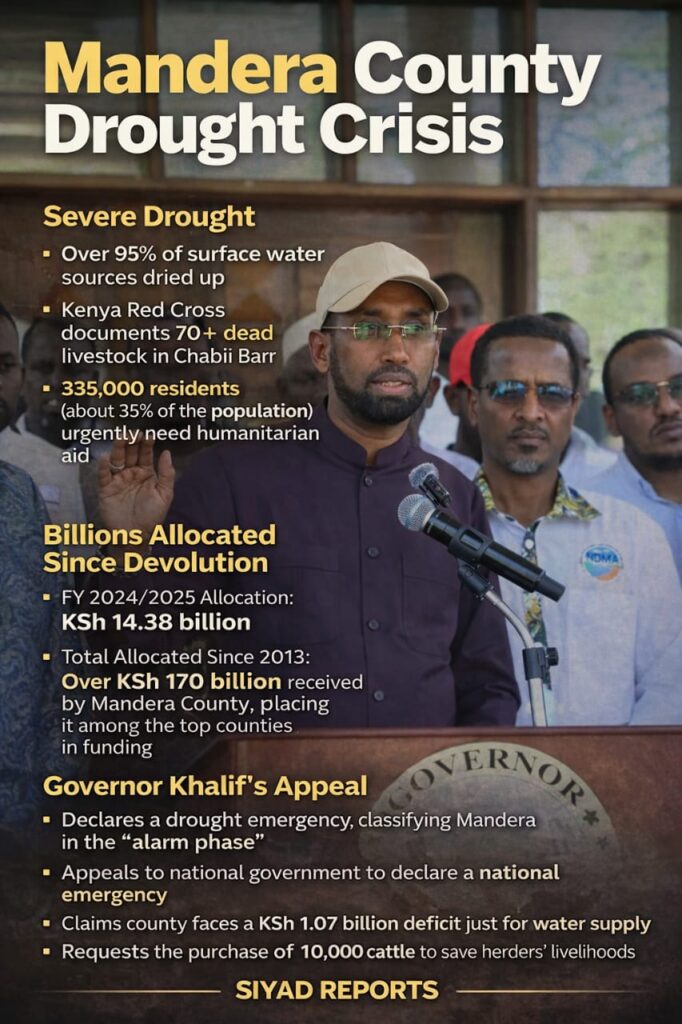
County leaders have repeatedly appealed to the national government and international partners to declare a national emergency and release more funds. While additional support is necessary, this narrative avoids a more uncomfortable truth: Mandera has had over a decade and billions of shillings to build resilience against drought.
Drought in Mandera is not new. It is cyclical, predictable, and well-documented. What should therefore exist by now are durable solutions strategic water infrastructure, properly maintained boreholes, rangeland management systems, livestock off-take programmes, and early response mechanisms that activate before animals begin to die.
Instead, Mandera lurches from one emergency to the next, increasingly dependent on humanitarian agencies. The county currently faces a reported KSh 1.07 billion funding gap for water interventions alone through March 2026, yet this gap sits alongside a historical inflow of more than KSh 170 billion since devolution began.
This is not simply a drought story. It is a story of accountability and governance. It raises serious questions about how public funds have been prioritised, whether drought preparedness has ever been treated as an emergency development issue, and who ultimately bears responsibility when predictable crises repeatedly turn catastrophic.
As livestock continue to die and families sink deeper into vulnerability, Mandera residents are left with a haunting question: if billions of shillings cannot protect people from a known and recurring drought, what exactly has devolution delivered for them?
Until this question is answered with transparency and measurable action, Mandera’s droughts will remain less about rain and more about leadership failure.