


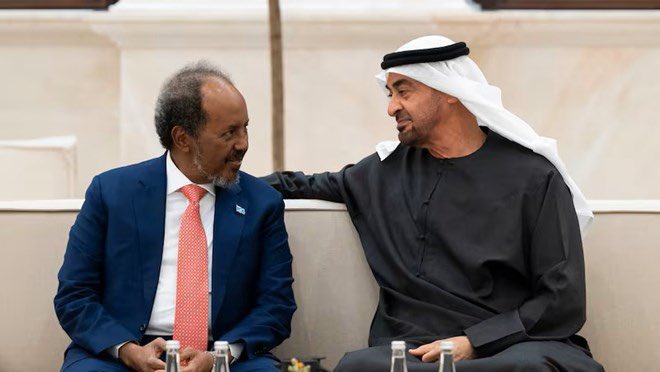
President Hassan Sheikh Mohamud’s yesterday’s address marks one of the most decisive foreign policy moments of his administration. In a firm and carefully worded speech, the Somali president publicly justified why his government annulled all cooperation agreements with the United Arab Emirates (UAE), citing violations of Somalia’s sovereignty, unity, and diplomatic norms.
This was not a sudden or emotional reaction. Rather, it was presented as the culmination of prolonged diplomatic frustration, repeated warnings, and what Mogadishu views as sustained interference by Abu Dhabi in Somalia’s internal affairs.
UAE–Somalia Relations: From Strategic Partnership to Diplomatic Breakdown
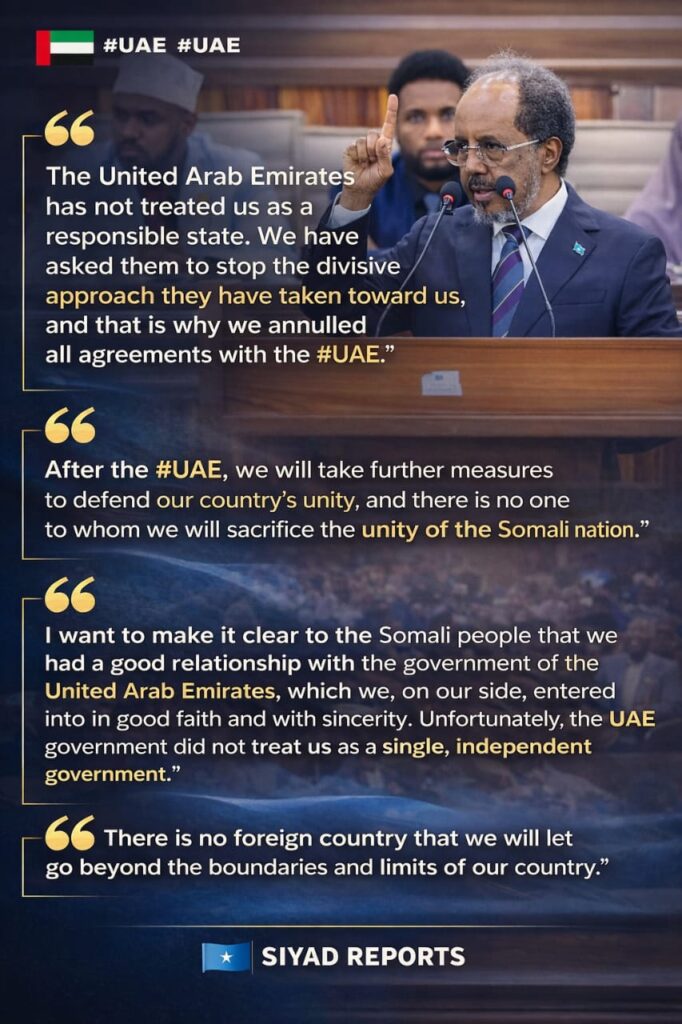
For years, the UAE positioned itself as a key regional partner to Somalia, engaging in security cooperation, development projects, port investments, and political engagement. President Hassan Sheikh emphasized that Somalia entered these agreements “in good faith and sincerity”, expecting a state-to-state relationship grounded in respect for Somalia’s federal authority.
However, according to the president, the core problem emerged when the UAE allegedly stopped treating Somalia as one sovereign state. Instead of engaging solely with the Federal Government of Somalia, Abu Dhabi is accused of adopting what the president described as a “divisive, bypassing diplomacy” directly engaging with regional administrations, operating through multiple channels, and undertaking activities without the knowledge or consent of the central government.
From Mogadishu’s perspective, this approach undermined the constitutional order of Somalia and weakened national cohesion at a time when the country is still rebuilding institutions after decades of conflict.
President Hassan Sheikh made it clear that Somalia repeatedly raised these concerns through diplomatic channels. The decision to annul agreements, therefore, was portrayed not as a first response, but as a last resort after warnings went unheeded.
Sovereignty, Unity, and the Red Line Somalia Refuses to Cross
At the heart of the president’s speech was a clear red line: Somalia’s unity is non-negotiable.
By accusing the UAE of entering Somalia “through different doors” and conducting activities unknown to the federal government, President Hassan Sheikh framed the issue as one of national dignity and sovereignty. He argued that no external partner regardless of financial or political influence has the right to undermine
Somalia’s unity or bypass its recognized leadership.
The president’s statement that “there is no one for whom we will sacrifice the unity of the Somali nation” was a direct message not only to the UAE but also to other regional and global actors watching Somalia’s political trajectory.
Importantly, this position aligns with Somalia’s long-standing sensitivity to foreign involvement that empowers regional entities at the expense of the center.
Given Somalia’s history of fragmentation, any external action perceived as encouraging parallel power structures is viewed as an existential threat.
The annulment of UAE agreements, therefore, signals a broader policy shift: Somalia is asserting itself as a state that demands equal diplomatic treatment, not patronage or selective engagement.
A Broader Regional Context and Strategic Implications
Although the president’s speech focused heavily on the UAE, it also carries broader regional implications. Somalia is sending a message that it intends to recalibrate its foreign partnerships based on respect for sovereignty, transparency, and centralized coordination.
The timing of the speech coming amid regional tensions, shifting alliances in the Horn of Africa, and controversies involving Somaliland suggests that Mogadishu is repositioning itself diplomatically. By publicly addressing the issue, President Hassan Sheikh also aimed to reassure the Somali public that key national decisions are being made deliberately, not under external pressure.
The reference to Somaliland and Israel recognition further reinforces Somalia’s concern about external actors engaging sub-national entities in ways that could legitimize fragmentation. In this context, the UAE decision is not isolated; it is part of a wider struggle over who defines Somalia’s future and who speaks for the Somali state internationally.
A Defining Test of Somalia’s Foreign Policy Doctrine
President Hassan Sheikh Mohamud’s speech was more than an explanation it was a declaration of principle. Somalia is asserting that partnerships must respect statehood, unity, and constitutional authority. The annulment of UAE agreements represents a calculated risk, but one the government believes is necessary to defend national dignity.
Whether this move strengthens Somalia’s position or leads to further diplomatic strain remains to be seen. What is clear, however, is that Somalia under Hassan Sheikh is signaling a tougher, more assertive foreign policy one that prioritizes unity over expediency and sovereignty over short-term alliances.
For Somalia, the message is simple and unequivocal: no partnership is worth the price of national fragmentation.