


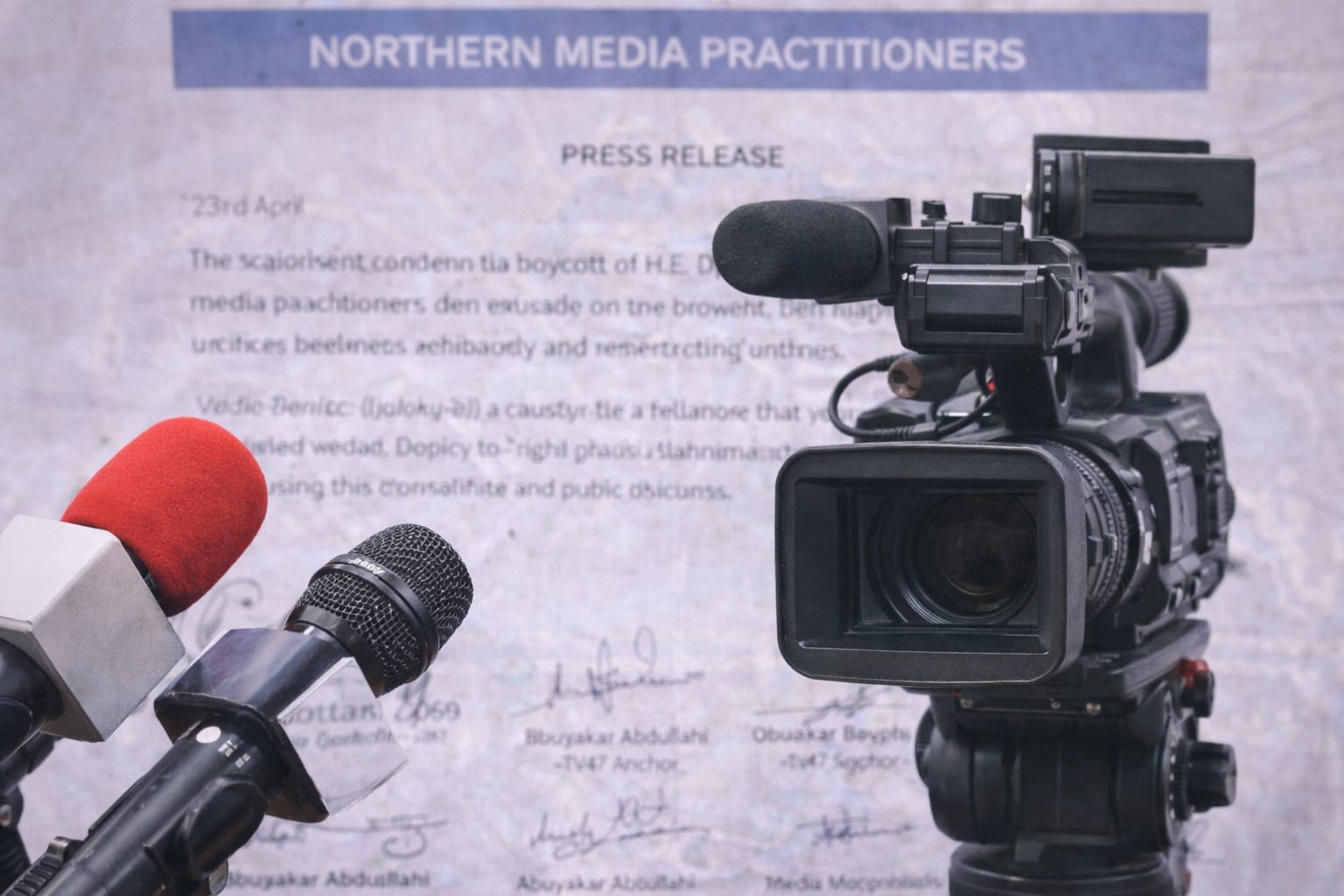
The last‑minute cancellation of a planned roundtable interview between Northern Kenya media outlets and former Deputy President Rigathi Gachagua has triggered a conversation that goes far beyond a single broadcast. At its core lies a difficult but necessary question: were the region’s media practitioners exercising principled editorial judgment, or did political pressure and caution shape their decision?
The interview, scheduled for Thursday evening, January 22, was meant to bring together multiple local radio stations and digital media platforms from Northern Kenya in a moderated discussion with Gachagua. Its abrupt cancellation, announced just hours before airtime, immediately drew attention not only because of who was involved, but because of what the withdrawal represents for journalism in a historically marginalised region.
Ethics, Unity, and the Limits of Harm Prevention
In a carefully worded statement, the umbrella body representing Northern Kenya media practitioners said the decision followed internal deliberations and was guided by principles of responsible journalism, national unity, and constructive public discourse. The statement cited concern over recent public remarks by Gachagua that were viewed as divisive, particularly those perceived to emphasise ethnic and regional divisions at a time when Kenya requires cohesion.
The practitioners further warned that the interview risked devolving into character attacks or the dissemination of unsubstantiated allegations without adequate evidence or balanced discussion. In their view, offering a platform under such circumstances would undermine ethical standards and potentially amplify harmful narratives.
From a professional standpoint, this justification is not without merit. Journalism is not merely about access, it is also about harm reduction, context, and public responsibility. Editors routinely weigh whether a platform will illuminate issues or inflame tensions and Northern Kenya, with its complex ethnic dynamics and history of political exclusion, is particularly sensitive terrain.
The context, however, complicates the decision. The withdrawal came against the backdrop of remarks previously made by Gachagua linking certain business activities in Nairobi’s Eastleigh area a neighbourhood predominantly inhabited by the Somali community to alleged economic crimes and illicit financial flows.
Also he has brought national attention to long-standing issues of corruption, mismanagement, and chronic underdevelopment in Northern Kenya, accusing sections of the political elite of looting public resources while the region continues to lag behind in basic services and infrastructure.
While the later clarified that his comments were not directed at the Somali community as a whole, the controversy lingered but merely the reality on the ground.
For media outlets serving largely Somali-populated counties, the stakes were high. Hosting the interview risked community backlash, accusations of enabling stereotyping, and potential social tension. At the same time, cancelling the interview raised questions about whether journalism was retreating from its duty to interrogate power directly.
This tension between protecting communities and confronting controversial leaders sits at the heart of the debate.
Media Independence in Northern Kenya: Reality Versus Ideal
Northern Kenya’s media ecosystem operates under conditions very different from those of major national outlets. Many stations rely on limited advertising revenue, often from political actors, county governments, NGOs, and development agencies. Institutional protections for journalists are weak, and access to power can determine a station’s financial survival.
In such environments, political pressure is rarely explicit. It often manifests subtly through anticipated consequences, community expectations, or the unspoken cost of upsetting powerful figures. This reality does not automatically invalidate the practitioners’ stated reasons, but it complicates any claim that editorial decisions are made in a vacuum.
The collective nature of the withdrawal added another layer. Acting as a bloc may have reduced individual exposure and signalled unity around ethical standards. However, it also obscured whether dissenting editorial voices existed within the group but were overridden by caution or consensus.
Critics Push Back: Journalism, Free Speech, and Accountability
The decision quickly attracted criticism from prominent national figures who framed the withdrawal not as ethics, but as avoidance.
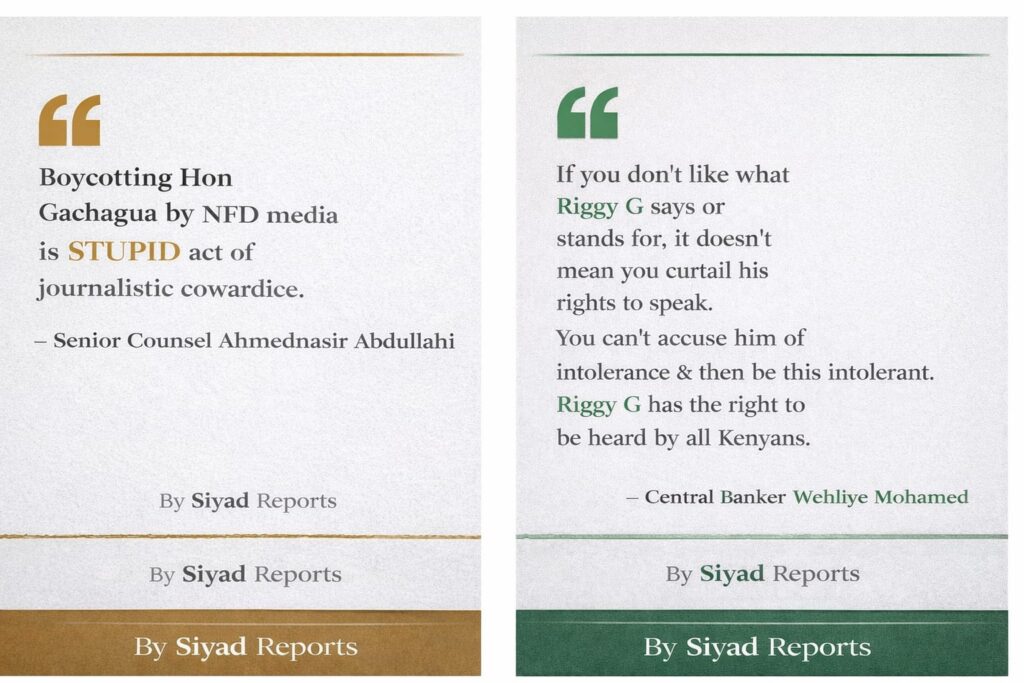
Senior Counsel Ahmednasir Abdullahi argued that disagreement with a political actor’s views should not justify denying them a platform. While acknowledging that he personally disagrees with many of Rigathi Gachagua’s positions, he maintained that the former Deputy President had, in recent weeks, raised legitimate national concerns about corruption, theft by political elites, and leadership failures in Northern Frontier counties.
Ahmednasir stated: “If you don’t like what Rigathi Gachagua says or stands for, it does not mean you curtail his right to speak. The media expresses an opinion only when rendering an editorial. This was a mere interview a question-and-answer session. They should have interviewed him and asked him all the hard and difficult questions they had in mind.”
Economist and central banker Wehliye Mohamed echoed a similar view, framing the issue as one of tolerance and democratic consistency. He warned against what he described as selective intolerance in public discourse.
Wehliye said: “If you accuse someone of intolerance and then deny them a platform to speak, you become intolerant yourself. Rigathi Gachagua has the right to be heard by all Kenyans, whether people agree with him or not.”
Northern Kenya media figure and TV47 news anchor Abubakar Abdullahi criticised the withdrawal, saying that denying a national leader the platform to address the North-Eastern audience is unprofessional and undermines journalism.
“To deny the Hon. Rigathi Gachagua, an opportunity to address the North-Eastern audience, is unprecedented and totally unprofessional. This is a mockery of journalism.”
The criticisms expose a central dilemma in modern journalism: when does platforming become complicity, and when does refusal become censorship?
Those defending the withdrawal argue that journalists are not obligated to host voices they believe will inflame tensions or spread unverified claims. Those opposing it counter that avoiding difficult interviews undermines journalism’s watchdog function and denies the public a chance to hear, question, and judge for themselves.
Both positions carry weight. What complicates the Northern Kenya case is the region’s history of marginalisation. Media outlets are not just information channels, they are community institutions, often expected to shield their audiences from narratives perceived as hostile or harmful. This expectation can collide with journalism’s adversarial role.
A Test for Northern Kenya Journalism
The cancelled Gachagua interview should be viewed less as a verdict on Northern Kenya media and more as a stress test. It has forced a necessary conversation about where journalism draws its red lines and who gets to decide where those lines fall.
As the region’s media sector continues to grow in influence, its credibility will depend not on avoiding controversy, but on demonstrating the ability to confront it responsibly, consistently, and without fear.
The hard question now is this: if journalism avoids controversial voices in the name of unity, who then holds power to account and who decides which voices are too dangerous for the public to hear?