


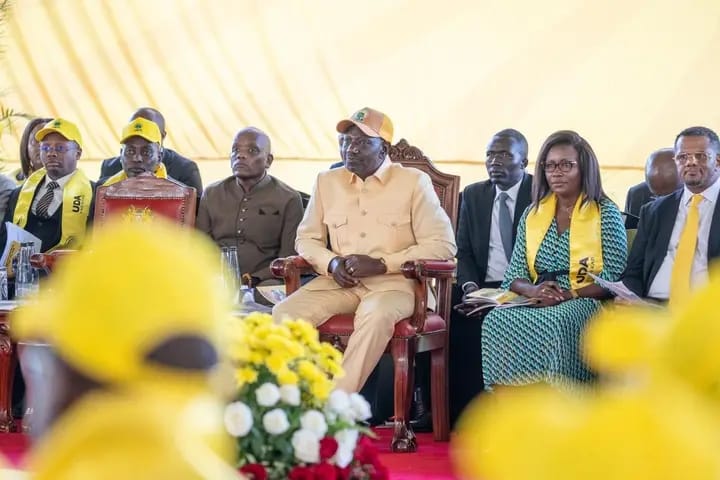
In Kenyan politics, nothing is said casually especially by a sitting president. Every word, every compliment, and every public endorsement carries political weight. In recent months, President William Samoei Ruto’s increasingly emphatic praise of his Deputy President, Kithure Kindiki, has attracted attention across the political divide. To the casual observer, it may appear as routine appreciation of a loyal deputy. But to the politically attentive mind, it signals something deeper: a carefully choreographed message aimed at shaping coalition negotiations ahead of the 2027 General Election.
President Ruto’s repeated references to Kindiki as a workaholic, an accomplished scholar, and a dependable partner in governance suggest more than goodwill. They reflect a deliberate effort to entrench the Deputy President’s position within the political architecture of his administration—well before serious coalition bargaining begins.
In Kenya’s coalition-driven politics, public praise often serves as political insurance. By consistently elevating Kindiki’s stature, Ruto is effectively ring-fencing the deputy presidency from future negotiations. The message to potential partners especially the Orange Democratic Movement (ODM) is subtle but unmistakable: the DP slot is not on the table.
Historically, coalition talks in Kenya revolve around power-sharing at the very top. The positions of president and deputy president are often the most contested. Ruto appears keenly aware of this history and is pre-emptively neutralizing any expectations that ODM or any other political force might harbor regarding the deputy presidency.
By framing Kindiki as indispensable to government delivery and stability, Ruto is conditioning both his supporters and potential allies to view continuity at the deputy level as essential for national progress.
ODM enters any coalition conversation from a complicated position. While it remains one of Kenya’s most influential political movements, its current internal state is far from cohesive. Emerging factions, divergent messaging, and competing ambitions within the party weaken its negotiating posture.
A fractured negotiating partner is easier to manage. President Ruto, a seasoned political tactician, understands this reality well. ODM’s lack of a unified voice diminishes its ability to demand high-stakes positions such as the deputy presidency. Instead, it is more likely to be offered institutional power spread across government rather than concentrated at the very top.
This imbalance gives Ruto stronger leverage at the negotiating table, allowing him to dictate terms rather than react to demands.
If the deputy presidency is effectively sealed, where does that leave ODM? The answer lies in alternative power centers within government.
One of the most probable concessions is the position of Prime Cabinet Secretary (PCS) a role that already carries significant coordination authority across government ministries. Elevating or redefining this office could provide ODM with executive influence without disrupting the president–deputy president axis.
Similarly, the Speaker of the National Assembly remains a powerful institutional role capable of shaping legislative priorities and national discourse. Control of Parliament can, in practice, rival executive influence, making it a valuable bargaining chip.
There is also growing speculation that the executive structure itself could be expanded to include two Deputy Prime Cabinet Secretary positions, creating additional space for political accommodation while preserving the current top leadership structure.
President Ruto has been explicit about his coalition ambitions. Speaking during a United Democratic Alliance (UDA) National Governing Council meeting at State House, Nairobi, he stated:
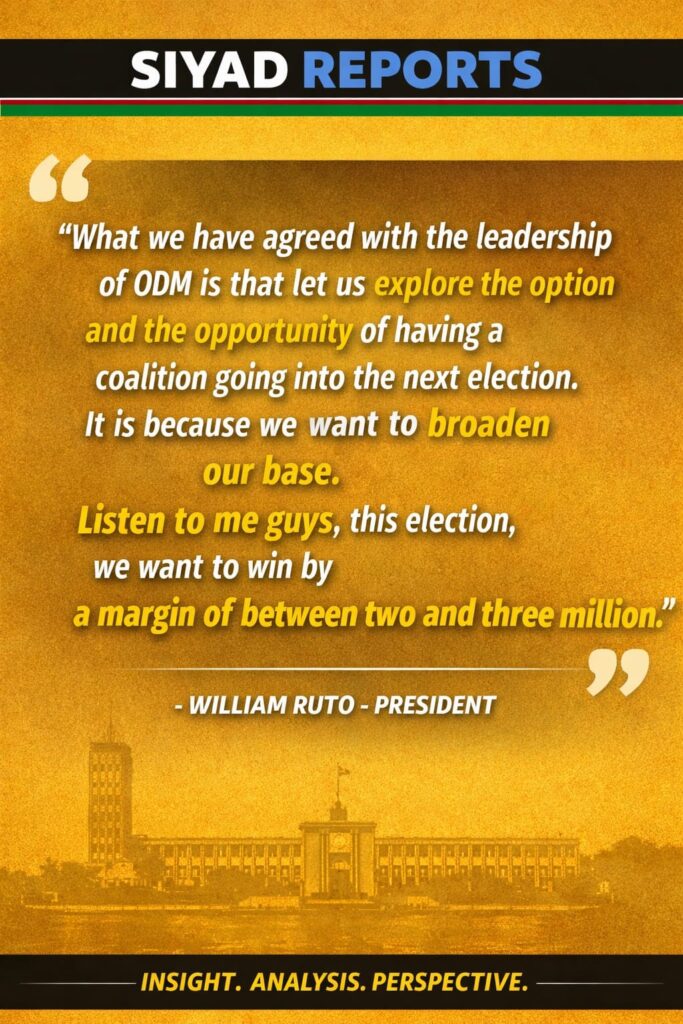
“What we have agreed with the leadership of ODM is that let us explore the option and the opportunity of having a coalition going into the next election. It is because we want to broaden our base. Listen to me guys, this election, we want to win by a margin of between two and three million.”
This statement is revealing. It frames coalition-building not as a necessity born of weakness, but as a strategic expansion designed to deliver a landslide victory. The language of confidence rather than compromise underscores Ruto’s dominant position in the talks.
In a separate remark, the President reinforced this vision:
“UDA’s coalition with ODM guarantees our resounding victory in 2027. We are building powerful national political parties whose philosophy, vision and understanding go beyond generations.”
What makes Ruto’s approach particularly effective is its non-confrontational nature. Rather than openly rejecting ODM’s ambitions, he is shaping the political environment in advance. By the time formal negotiations intensify, the boundaries will already be clear.
This strategy avoids public fallout while ensuring that any coalition formed operates within parameters favorable to the president. Praise, in this context, becomes a tool of power used to lock in allies, signal red lines, and manage expectations.
The 2027 Endgame Takes Shape
As Kenya inches closer to the 2027 General Election, the outlines of the political battlefield are becoming clearer. President Ruto’s consistent endorsement of Deputy President Kithure Kindiki is not mere rhetoric; it is a strategic declaration.
The message is simple but firm: continuity at the top is non-negotiable. Coalition partners are welcome but on clearly defined terms.
For ODM, the challenge will be to consolidate internally and negotiate from a position of clarity rather than fragmentation. For Ruto, the objective remains unmistakable: broaden the base, secure overwhelming victory, and retain firm control of the core executive.
In Kenyan politics, the real negotiations often begin long before leaders sit across the table. And in this case, the script appears to have already been written.