


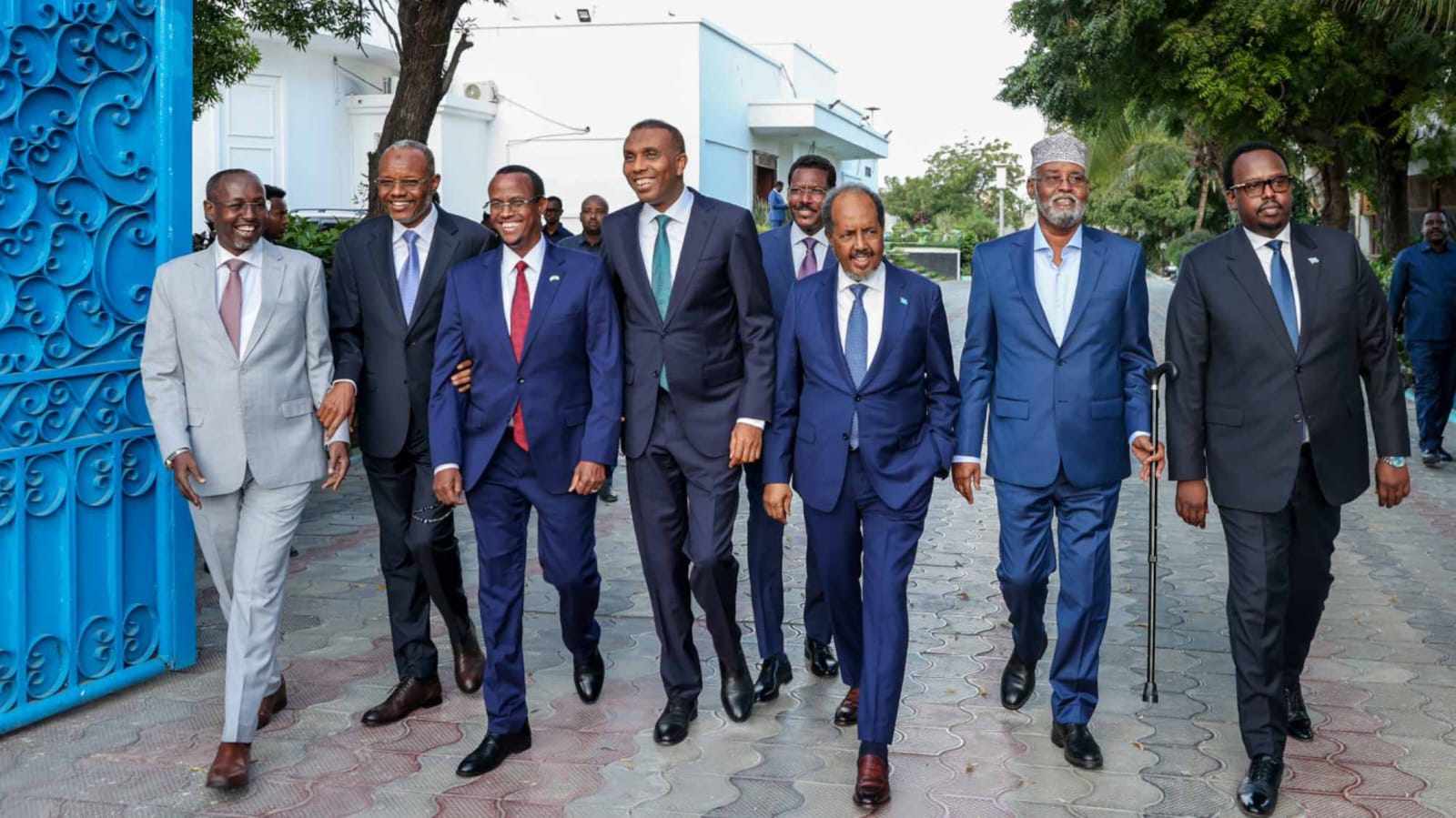
Under intense and sustained international pressure, Somalia’s President Hassan Sheikh Mohamud has taken a dramatic and politically consequential step by agreeing to allow heavily armed regional forces from Jubaland and Puntland to enter Mogadishu, a move that underscores both the depth of the country’s electoral crisis and the limits of federal authority in moments of acute political confrontation. The decision, which permits the two regional presidents to arrive in the capital accompanied by up to 40–50 armed guards each, with no clear restrictions on the weapons they may carry, represents a sharp reversal from the federal government’s position just a day earlier and exposes the fragile balance upon which Somalia’s political order currently rests.
Only hours before this concession, Villa Somalia had ordered two aircraft carrying advance presidential security teams from Jubaland and Puntland to turn back mid-air, citing security concerns and the symbolic implications of allowing armed regional forces to land in the capital. That decision was swiftly condemned by the leaders of the two federal member states, who accused the presidency of attempting to sabotage planned talks intended to address a protracted electoral dispute and an increasingly dangerous political standoff. In their view, blocking their security details was not merely a procedural issue, but a political signal designed to weaken their negotiating position and assert unilateral control over a process that, by its nature, demands consensus and trust.
At the time, the federal government defended its move by arguing that the arrival of heavily armed regional forces at Mogadishu’s airport would undermine the image of the capital as a secure and sovereign seat of national power. Officials maintained that such a spectacle would send the wrong message to both Somali citizens and international partners, suggesting that Mogadishu could not guarantee the safety of political leaders without the presence of parallel armed units. Yet within twenty-four hours, that argument gave way to a new reality. Faced with mounting pressure from international partners and the risk of a total collapse of dialogue, the presidency accepted the very arrangement it had rejected, allowing the armed guards to enter the city and clearing the way for talks to proceed.
This reversal is not merely a tactical adjustment; it is a revealing moment in Somalia’s long struggle to reconcile federalism, national authority, and political legitimacy. The agreement reached by both committees, allowing the Puntland and Jubaland leaders to bring 40–50 soldiers “equipped with sufficient weapons” while emphasizing that their numbers should not be excessive, is a compromise that reflects deep mistrust among Somalia’s political actors. It acknowledges, implicitly, that the leaders of federal member states do not fully trust the security guarantees of the federal government, even in the heart of the capital, and that the federal government, in turn, lacks the confidence or leverage to impose its will without risking broader instability.
Equally significant is the decision that the meeting will be held at Villa Somalia. This point has been one of the most contentious aspects of the standoff. President Hassan Sheikh Mohamud has reportedly insisted that the talks take place at the presidential palace, a venue that symbolizes constitutional authority and the primacy of the federal state. Opposition leaders, along with the presidents of Jubaland and Puntland, have previously demanded that the meeting be held at the Halane base, a highly secured compound hosting foreign diplomatic missions and protected by African Union peacekeepers. For them, Halane represents neutrality and international oversight, a space where they believe they can negotiate without fear of intimidation or political maneuvering.
By insisting on Villa Somalia as the venue and ultimately securing agreement on that point, the presidency has scored a symbolic victory. Yet the cost of that victory is evident in the concessions made on security and the broader implications for state authority. Allowing armed regional forces into the capital, even under agreed parameters, blurs the lines of command and raises uncomfortable questions about sovereignty, monopoly of force, and the precedent being set for future political disputes. It sends a message that in Somalia’s current political environment, trust in institutions remains so weak that leaders feel compelled to rely on their own armed protection even when engaging in national dialogue.
The international dimension of this episode cannot be overstated. International partners have played a decisive role in pushing all sides toward compromise, emphasizing the urgency of dialogue and warning of the consequences of continued deadlock. Their pressure reflects a growing concern that Somalia’s electoral impasse, if left unresolved, could unravel hard-won gains in security and state-building, and potentially create openings for extremist groups to exploit political paralysis. At the same time, the heavy involvement of external actors highlights a persistent dilemma: while international engagement is often necessary to prevent crisis escalation, it can also reinforce perceptions that key political decisions in Somalia are shaped, or even dictated, from outside.
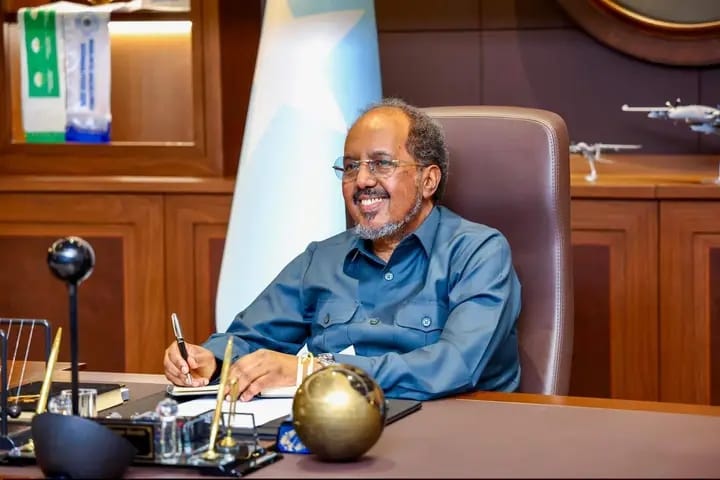
In reaffirming his government’s position, President Hassan Sheikh Mohamud sought to frame the agreement as a demonstration of statesmanship and commitment to the national interest. “The Somali government remains open to dialogue and national unity, guided by a shared commitment to rebuilding and strengthening Somalia,” he said, speaking on Monday. The agenda for the meeting, according to official statements, will focus on the Constitution, national unity, and the fight against terrorism. These are weighty and fundamental issues, touching on the very foundations of the Somali state and its future direction.
Yet the context in which these discussions will take place is fraught with tension and skepticism. The presence of armed guards, the unresolved dispute over electoral processes, and the lingering mistrust between the federal government and federal member states all threaten to overshadow substantive dialogue. For many Somalis, the spectacle of political leaders negotiating under armed protection is a sobering reminder of how far the country still has to go in consolidating a truly civilian and institutionalized political culture.
The electoral dispute at the heart of this crisis is not an isolated event, but part of a broader pattern of contested processes, delayed timelines, and competing interpretations of constitutional authority. Federal member states have long complained of marginalization and unilateral decision-making by the center, while the federal government has accused regional leaders of undermining national cohesion and pursuing parochial interests. These tensions are embedded in the federal system itself, which was designed to accommodate Somalia’s complex clan and regional dynamics but has often produced friction and ambiguity rather than clarity and cooperation.
Allowing armed regional forces into Mogadishu, even temporarily, risks normalizing a politics of coercion rather than consensus. It raises the question of whether future disagreements will also be settled through displays of force or threats thereof, rather than through institutions and legal frameworks. At the same time, refusing to accommodate the security concerns of regional leaders could have led to an outright collapse of talks, with potentially far more destabilizing consequences. The decision taken by President Hassan Sheikh Mohamud thus reflects a difficult balancing act between principle and pragmatism, authority and compromise.
As the talks convene at Villa Somalia, all eyes will be on whether Somalia’s leaders can move beyond procedural disputes and engage meaningfully with the substantive issues on the table. Discussions on the Constitution will require honesty about power-sharing, clarity on the roles and responsibilities of federal and regional authorities, and a willingness to address long-standing grievances. Conversations about national unity must go beyond rhetoric, confronting the political and social fractures that continue to undermine trust. The fight against terrorism, meanwhile, demands coordination and coherence, something that is impossible in an environment of political fragmentation and mutual suspicion.
The current standoff, and the agreement that has allowed it to de-escalate, underscores the fragility of Somalia’s political settlement. It reveals a system still heavily dependent on personalities, external mediation, and ad hoc compromises, rather than robust institutions and shared norms. Whether this moment becomes a turning point toward renewed dialogue and stability, or merely another chapter in a cycle of crisis and temporary fixes, will depend on what follows once the doors close and the talks begin.
For Somalia, the stakes could not be higher. The choices made in Mogadishu in the coming days will shape not only the trajectory of the electoral process, but the broader credibility of the federal project itself. In yielding to international pressure and allowing armed regional forces into the capital, President Hassan Sheikh Mohamud has bought time and preserved the possibility of dialogue. Whether that time will be used to bridge divides and strengthen the state, or merely postpone an inevitable reckoning, remains the defining question facing Somalia today.