


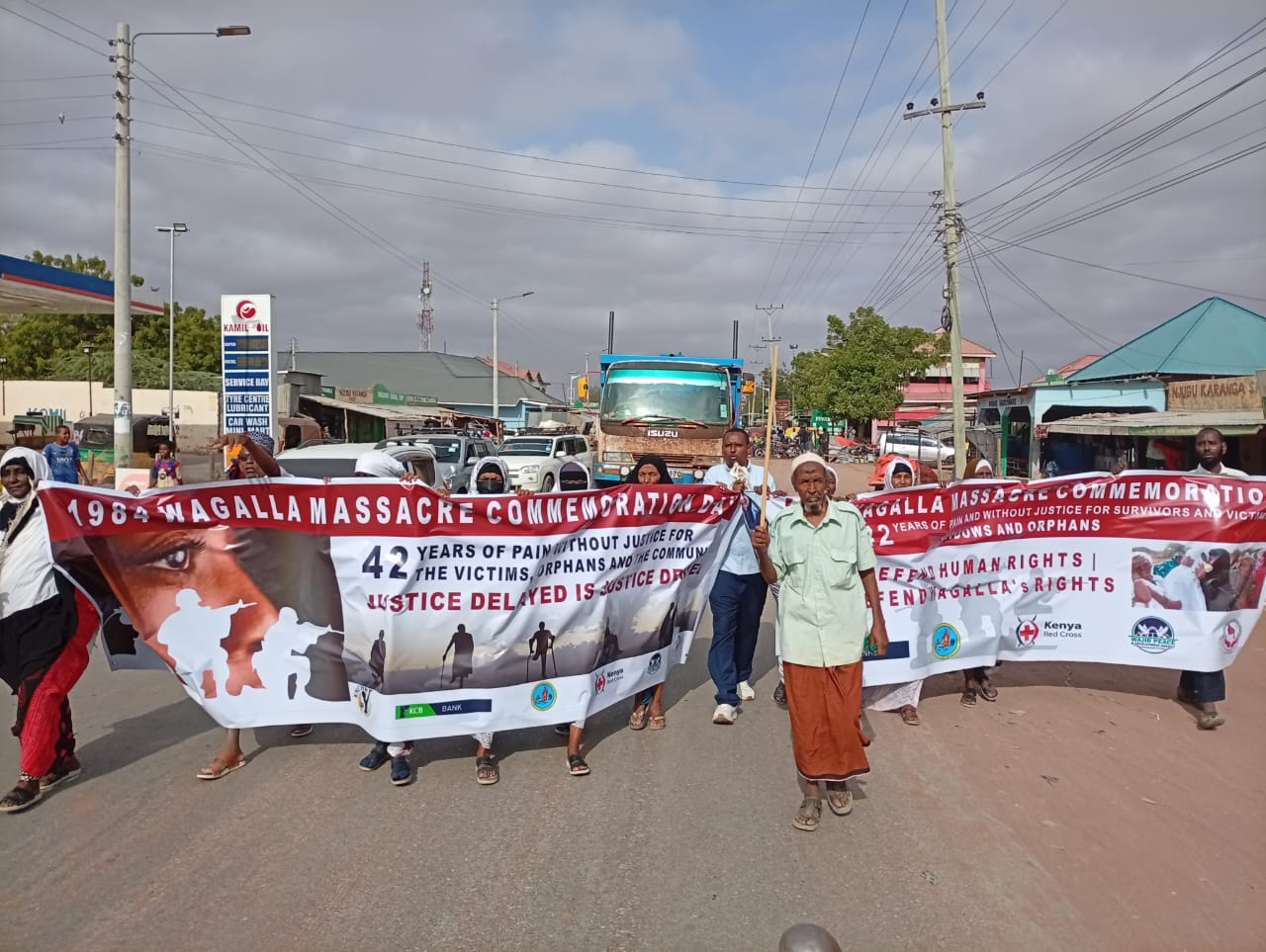
Residents of Wajir gathered in solemn reflection at Orahey Grounds to commemorate one of the darkest chapters in Kenya’s history the Wagalla Massacre. Forty-two years after the tragic events of February 1984, survivors, leaders, human rights defenders and families of victims came together not merely to remember, but to demand justice, truth and long-overdue compensation.
The atmosphere at Orahey Grounds was heavy with emotion. For many in attendance, this was not simply a historical remembrance. It was personal. It was about fathers who never returned home, mothers who carried the pain in silence, and families that continue to live with the scars of a brutal security operation that altered the course of their lives. The calls that rang out during the commemoration were consistent and urgent, justice delayed for 42 years is justice denied.
One of the central messages delivered during the event was a powerful reminder that the passage of time does not erase injustice. “Delayed for 42 years is justice denied. We must move beyond promises and establish a clear, time-bound framework for compensation and restorative justice,” said Professor Mohamed Yussuf Elmi
He further called for unity among leaders from North Eastern, saying: “This is not a partisan issue. It is a moral issue. Leaders must speak with one voice and tie their political support to the resolution of the Wagalla question. Our community deserves acknowledgment, reparations and institutional guarantees that such injustice will never happen again,” Professor Elmi stated as he challenged regional leaders to place justice for Wagalla victims at the center of their political agenda and negotiations at the national level.
This statement captured the frustration that has simmered for decades. Over the years, promises have been made by successive governments. Committees have been formed. Acknowledgments have occasionally surfaced. Yet survivors say little has translated into tangible compensation or institutional reform.
The call for a “clear, time-bound framework” signals a shift from symbolic recognition to structured action. It demands specific timelines, legal backing and budgetary allocations. Restorative justice, as emphasized, goes beyond financial compensation. It includes official acknowledgment of wrongdoing, public apologies, institutional safeguards and guarantees that such injustices will never be repeated. For survivors, justice is not abstract; it is measurable in actions taken and commitments fulfilled.
By framing it as a moral issue rather than a partisan one, Professor Elmi’s call challenges leaders to prioritize justice over party loyalties and electoral calculations.
Tying political support to the resolution of the Wagalla question suggests leveraging political influence to secure justice. It is a strategic appeal: that regional leaders use their collective bargaining power at the national level to ensure compensation and formal acknowledgment are not sidelined. The emphasis on “institutional guarantees” reflects deep-seated fears that without systemic reforms, history could repeat itself.
Ramadhan Jellow, author of Blood on the Runway a book chronicling the massacre and whose father died during the operation delivered one of the most emotional appeals of the day. “Forty-two years is too long,” Jellow said. “Leadership must rise above politics and ensure this issue is addressed decisively.” For Jellow, the issue is both historical and deeply personal. His work documents testimonies and memories that might otherwise fade. His statement highlights the intergenerational trauma carried by families and the urgency of resolution before more survivors pass away without seeing justice.
By stating that leadership must “rise above politics,” Jellow echoed the broader sentiment that the Wagalla Massacre should not be reduced to campaign rhetoric. Decisive action, as he suggested, requires courage, commitment and a break from cycles of promises without implementation. His words resonated strongly with the crowd, many of whom have attended similar commemorations for years with little change.
Local leaders also pledged legislative action led by Wagalla-Ganyurey MCA Hussein Ibrahim, popularly known as Bodaa, called on President William Ruto to consider the plight of Wagalla victims and prioritize compensation efforts. “We stand with the survivors,” he said. “I am ready to introduce a Bill to support and fast-track the compensation process.” This pledge represents a concrete step toward institutionalizing the compensation process. A Bill, if introduced and passed, could provide legal structure, define beneficiaries, outline compensation mechanisms and establish oversight frameworks.
Hussein Ibrahim also pledged to work with the Wagalla Massacre Foundation to document testimonies, warning that critical evidence risks being lost as survivors grow older. “Time is not on our side,” he added. “We must document these accounts before they fade with the passing generation.” This warning carries significant weight. As survivors age, firsthand testimonies risk disappearing. Documentation is not only a matter of historical record but also a crucial component of legal claims and advocacy efforts. Without documented evidence, future generations may struggle to pursue accountability.
Wagberi MCA Aden Blue echoed the call for legislative support, stressing that leaders from the region must unite to push for justice and economic assistance to affected families. His remarks reinforced the notion that justice is intertwined with economic redress. Many families reportedly lost breadwinners, livelihoods and opportunities. The economic ripple effects of the massacre are still felt today, with some families trapped in cycles of poverty linked to the tragedy.
Human rights officials from the Kenya Human Rights Commission were also present and acknowledged the urgent need for justice. They reaffirmed their commitment to supporting the affected community, noting that since the inception of the commission, they have worked closely with survivors through the Wagalla Massacre Foundation. Their presence added institutional weight to the commemoration, signaling that civil society remains engaged in the pursuit of accountability.
The officials challenged the community to seek justice collectively, citing examples of communities in West Pokot that have organized and pursued accountability through sustained legal and civic action. “Justice requires unity and persistence,” one official said. “When communities stand together with clear documentation and coordinated advocacy, meaningful progress becomes possible.” This statement shifts part of the responsibility to the community itself emphasizing organization, documentation and sustained advocacy as essential tools.
The example of West Pokot serves as a reminder that persistent civic engagement can yield results. It suggests that while government action is critical, community mobilization plays a decisive role in pushing issues onto the national agenda. The emphasis on coordinated advocacy reflects lessons learned from other justice movements across the country.
As speeches concluded and prayers were offered, one message became unmistakably clear: remembrance alone is no longer sufficient. For 42 years, survivors have carried memories of loss and trauma. Annual commemorations have kept the history alive. Yet survivors insist that acknowledgment must be accompanied by action.
Today’s commemoration at Orahey Grounds was not merely a ritual. It was a renewed political and moral statement. Leaders pledged unity. Legislators promised action. Human rights defenders reaffirmed support. Authors and survivors demanded courage. The collective call was for truth acknowledged, justice delivered and meaningful compensation provided before history claims more of those who lived through the events of 1984.
Forty-two years on, the Wagalla question remains unresolved. But if the tone and commitments expressed today are any indication, the push for justice is entering a new phase one defined not just by remembrance, but by organized advocacy, legislative proposals and unified political pressure.
For the people of Wajir, the commemoration was not about ceremony alone. It was about a renewed promise to ensure that respect for human dignity translates into action, accountability and lasting justice.