



The Orange Democratic Movement (ODM) is confronting one of the most defining internal crises in its history, with Sunday’s parallel political rallies in Kitengela and Mombasa laying bare deep ideological, generational and strategic divisions within the party. What began as a leadership disagreement has now evolved into a full-scale struggle over ODM’s identity, its relationship with state power, and its trajectory toward the 2027 General Election.
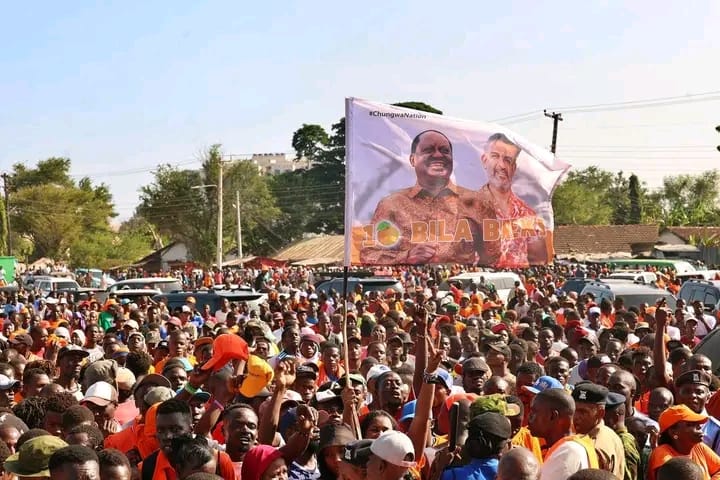
In Kitengela, Nairobi Senator Edwin Sifuna stood alongside Siaya Governor James Orengo and Embakasi East MP Babu Owino at a charged “Linda Mwananchi” rally that openly rejected any form of cooperation between ODM and the ruling United Democratic Alliance (UDA). The rally, attended by large crowds in Kajiado County, was disrupted after police lobbed teargas and fired shots into the air, forcing an abrupt end and triggering running battles in Kitengela town.
It was during that rally that Babu Owino delivered one of the most pointed attacks against the idea of rapprochement with President William Ruto’s administration.
“Wanasema hawataki maandamano, nini ilifanya Ruto akatafuta Raila? Nini itatoa Ruto Statehouse?” Babu Owino posed to the crowd, framing protest politics as the only effective tool for compelling power concessions and regime change.
His remarks encapsulated the ideological position of the Kitengela faction: that ODM must remain firmly in opposition, unapologetically confrontational, and resistant to what they describe as co-optation into a government they did not win.
Simultaneously, in Mombasa, ODM Deputy Party Leader Oburu Odinga presided over a “Linda Ground” rally at Tononoka Grounds. This faction has defended the “broad-based” government framework and signaled openness to a structured political arrangement that could see ODM secure the Deputy President slot in a 2027 power-sharing deal.
The symbolism of two rallies held on the same day under competing slogans cannot be overstated. “Linda Mwananchi” speaks to grassroots agitation and populist resistance. “Linda Ground” suggests consolidation, negotiation and strategic entrenchment within existing power structures. Together, they reveal a party divided not merely by personalities, but by philosophy.
At the center of the storm is the attempted removal of Sifuna as ODM Secretary General by the party’s National Executive Committee (NEC). The move has triggered legal action, public rebuttals and an internal legitimacy battle that now risks redefining ODM’s leadership hierarchy.
Oburu Odinga has maintained that Sifuna was not expelled but asked to step aside due to disciplinary concerns. He named Catherine Omanyo as the party’s Secretary-General while acknowledging that Sifuna remains the court-recognized SG. That duality has created a rare scenario in Kenyan party politics where political and legal recognition diverge.
Sifuna has since secured temporary relief from the Political Parties Disputes Tribunal (PPDT), which barred ODM from executing the NEC resolution pending further directions scheduled for February 26, 2026. His legal argument centers on procedural fairness, asserting that the decision violated the ODM constitution and internal disciplinary frameworks.
The tribunal’s eventual ruling will have implications far beyond the office of Secretary General. It will determine whether party organs can override internal dissent without due process and whether ODM’s institutional structures are robust enough to withstand factional strain.
Beyond the courtroom lies a deeper existential question: what is ODM’s political identity in a post-Raila era?
For decades, the party has been synonymous with reformist agitation and opposition politics. It has thrived on mobilizing discontent, championing constitutional reforms and positioning itself as a counterweight to state power. Its support base was cultivated through narratives of resistance and democratic struggle.
The Sifuna-Orengo-Owino axis appears determined to preserve that legacy. They argue that cooperation with the ruling establishment risks eroding the party’s ideological clarity and weakening its oversight role. From their perspective, ODM’s strength lies in its independence.
Conversely, the Oburu-led faction frames political pragmatism as strategic evolution. They argue that perpetual opposition without access to executive authority limits ODM’s ability to influence policy outcomes. In their calculation, proximity to power today could translate into structural advantage in 2027.
Complicating this political chess game is the visible rift within the Odinga family.
Mama Ida Odinga has publicly defended Sifuna, reportedly describing him as Raila Odinga’s “son” within the party and questioning the logic of expelling him. She emphasized that ODM must maintain independence, stating pointedly, “This is not our government.” Her intervention reportedly halted immediate attempts to formalize Sifuna’s removal.
Her stance contrasts sharply with that of Oburu Odinga and has exposed an unusual family divergence over ODM’s direction. The involvement of Winnie Odinga in backing Sifuna further underscores generational tensions surrounding the stewardship of the party’s legacy following the reduced frontline engagement of Raila Odinga.
This family dynamic is not merely symbolic. ODM has long been intertwined with the Odinga political brand, and any visible split within that nucleus inevitably reverberates across party structures and grassroots networks.
The Kitengela chaos has also injected a security dimension into the political contest. The dispersal of a rally organized by ODM leaders who oppose cooperation with the government strengthens their narrative of state hostility. It reinforces their claim that dissent remains unwelcome and that opposition politics still carries institutional resistance.
At the same time, it places ODM’s pro-cooperation faction in a delicate position: defending engagement with an administration whose security apparatus has just disrupted their party colleagues.
For President Ruto, the unfolding ODM drama offers both tactical relief and strategic uncertainty. A divided opposition reduces immediate electoral threat. Internal court cases and public family disagreements fragment focus and messaging.
Yet prolonged instability within ODM could also reignite opposition energy at the grassroots level. If the “Linda Mwananchi” faction consolidates public sympathy, it may reshape national discourse around resistance and accountability, complicating government calculations.
Sifuna’s apparent roadmap is threefold: defend his position legally, consolidate grassroots legitimacy, and potentially reposition himself as a central figure in ODM’s succession equation. By aligning with influential county leaders and MPs, he signals that his camp is not marginal but structurally embedded within the party.
For Oburu’s faction, the objective appears to be institutional consolidation asserting control through party organs while framing their approach as mature statecraft rather than rebellion.
The risk, however, is that ODM may slide into a protracted legitimacy contest, where parallel authority structures coexist uneasily. Kenyan political history shows that parties under succession pressure often fracture when ideological disputes merge with personality conflicts.
What ODM faces now is not simply a disagreement over one office. It is a referendum on strategy, identity and future leadership. Whether it chooses confrontation or accommodation, protest or negotiation, will determine not just its 2027 prospects but its long-term survival as a coherent political force.
The coming weeks particularly the tribunal proceedings and subsequent grassroots mobilization will shape the balance of power within the party. ODM stands at a defining moment, navigating between unity and fragmentation, ideology and pragmatism, legacy and transition.
How it resolves this confrontation will reverberate across Kenya’s broader political landscape.