


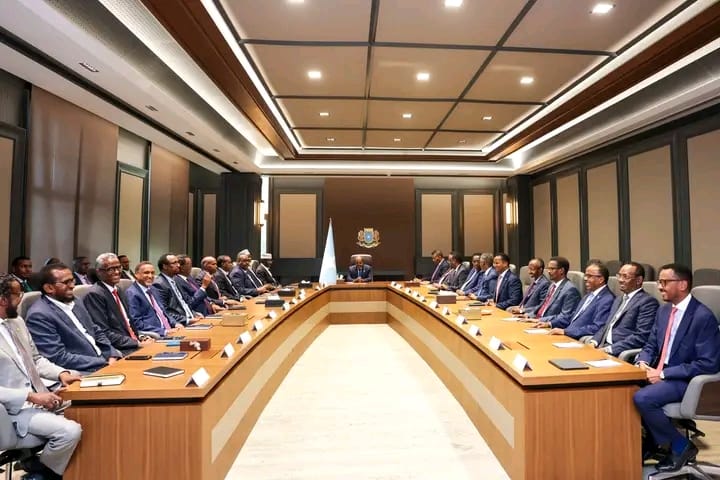
The political temperature in Mogadishu shifted noticeably today as President Hassan Sheikh Mohamud convened what many observers now describe as one of the most consequential dialogues of his second term. Inside Villa Somalia, Somalia’s federal leadership sat face-to-face with members of the Somalia Future Council an opposition alliance that includes the leaders of Puntland and Jubaland, alongside former president Sharif Sheikh Ahmed in a high-stakes attempt to break a deepening deadlock over elections and constitutional reform ahead of the 2026 vote.
This was not an ordinary political meeting. It was a calculated reset after months of escalating rhetoric, regional withdrawals of recognition, and mounting international concern over Somalia’s political trajectory. The symbolism alone was significant: leaders who had openly questioned the federal government’s legitimacy returned to the State House for structured negotiations. That alone signals a fragile but important opening.
To understand the gravity of the moment, one must revisit the last serious engagement at Villa Somalia between these camps. Previous encounters were often characterized by mistrust and competing narratives rather than structured compromise. Puntland had withdrawn recognition of federal institutions. Jubaland maintained strained ties with Mogadishu. The opposition bloc accused the federal government of unilateralism in pushing electoral reforms. Meanwhile, Villa Somalia framed its reform agenda as historic and necessary to finally move Somalia beyond the indirect clan-based system.
At the heart of the dispute lies the proposal for a one-person, one-vote (1P1V) electoral system a long-promised democratic milestone for Somalia. President Hassan Sheikh Mohamud has positioned 1P1V as the defining reform of his tenure, arguing that Somalia cannot indefinitely rely on indirect selection models if it seeks political maturity and national cohesion. However, the Future Council counters with a pragmatic objection: implementing universal suffrage within the remaining months of the current government’s mandate is logistically and legally unrealistic.
This is not merely a technical disagreement. It is a clash of timelines, trust, and constitutional interpretation.
The president’s camp believes that political courage now could cement Somalia’s democratic transformation. The opposition fears that rushing into a poorly prepared electoral experiment could destabilize the fragile federal system and potentially extend mandates under the guise of reform. In Somalia’s political history, delays and extensions have often triggered instability. That historical memory hangs heavily over these talks.
Day One of the Villa Somalia dialogue ended without a sweeping agreement, but it did not collapse and that, in itself, matters. Reports indicate partial understandings on agenda-setting and procedural frameworks, with elections dominating the discussions. No final breakthrough was announced. The Somali-language summary captured the mood bluntly: the meeting dispersed without a specific agreement except the decision to reconvene. Yet even that agreement to return signals that both sides recognize the costs of deadlock.
International pressure also looms large in this equation. Somalia’s security transition, ongoing operations against Al-Shabaab, and donor-backed state-building programs are deeply intertwined with political stability. External partners have consistently emphasized the importance of timely and transparent elections. Behind closed doors, diplomats have reportedly encouraged compromise to avoid another cycle of uncertainty like previous transitional crises.
However, what makes this round of talks distinct from earlier episodes is the alignment of political urgency with a narrowing constitutional clock. The federal government’s four-year term ends in May 2026. That timeline compresses options. If consensus is not achieved soon, Somalia risks entering the familiar terrain of contested mandates and parallel political processes.
President Hassan Sheikh Mohamud’s strategy appears twofold: assert reformist ambition while inviting dialogue to avoid the perception of unilateral action. By hosting the Future Council at Villa Somalia, he reclaims the initiative and projects openness. For the opposition alliance, participation allows them to influence the framework rather than merely criticize it from outside.
The inclusion of Puntland and Jubaland leaders is especially significant. Federal member states are central pillars of Somalia’s governance model. Any electoral or constitutional change without their buy-in would face implementation challenges on the ground. Their presence signals that the dispute has shifted from boycott to bargaining.
Yet fundamental questions remain unresolved. Can Somalia realistically prepare voter registration, constituency demarcation, security arrangements, and an independent electoral framework within months? Would a transitional hybrid model be considered? Could the sides agree on phased reforms rather than a full immediate shift? These are the technical layers beneath the political theater.
Tomorrow’s resumption of talks will likely test whether both sides are negotiating from fixed positions or exploring middle ground. The president may push for a structured roadmap with clear benchmarks toward 1P1V, even if full implementation extends beyond the immediate cycle. The Future Council may seek guarantees against mandate extensions and demand inclusive constitutional consultation before any electoral overhaul.
Another dimension is public perception. Somali citizens have grown accustomed to elite negotiations determining political outcomes. A transparent communication strategy will be crucial if these talks are to restore confidence rather than deepen cynicism. The narrative of “historic breakthrough” must eventually be matched by concrete deliverables.
Security considerations also frame the urgency. Somalia continues major operations against Al-Shabaab, and political fragmentation could distract from security consolidation. Historically, political crises have provided breathing space for insurgent groups. Stability at the top directly influences coherence in security planning.
From a constitutional standpoint, the debate reflects a broader tension between federalism and central authority. Puntland’s earlier withdrawal of recognition was rooted in concerns about constitutional amendments perceived as centralizing power. The current dialogue must therefore balance democratic reform with federal safeguards.
What distinguishes this moment from previous standoffs is that neither side appears eager to escalate. The tone, at least publicly, has shifted from confrontation to cautious engagement. That does not guarantee compromise, but it reduces the immediate risk of rupture.
If the talks succeed, they could establish a shared electoral roadmap, reaffirm the constitutional review process, and set mechanisms for dispute resolution.
If they fail, Somalia may face parallel political mobilizations, renewed regional resistance, and intensified international mediation.
In many ways, Villa Somalia has once again become the arena where Somalia’s political future is negotiated. The building itself symbolizes the federal state; what happens inside it over the next 48 hours may shape the country’s trajectory beyond 2026.
This is more than a meeting. It is a test of whether Somalia’s political class can prioritize institutional stability over tactical advantage. The decision to reconvene tomorrow keeps the door open. Whether that door leads to compromise or confrontation will depend on how much flexibility each camp is willing to show when the talks resume.
For President Hassan Sheikh Mohamud, the stakes are historic: to be remembered as the leader who transitioned Somalia toward universal suffrage, or as one who presided over another contested electoral cycle. For the Future Council, the challenge is to balance principled opposition with constructive engagement.
Somalia stands at a familiar crossroads but perhaps with a rarer opportunity for consensus.
The coming sessions at Villa Somalia will determine whether this week marks the beginning of a genuine political breakthrough or simply another chapter in Somalia’s long negotiation with its democratic future.