


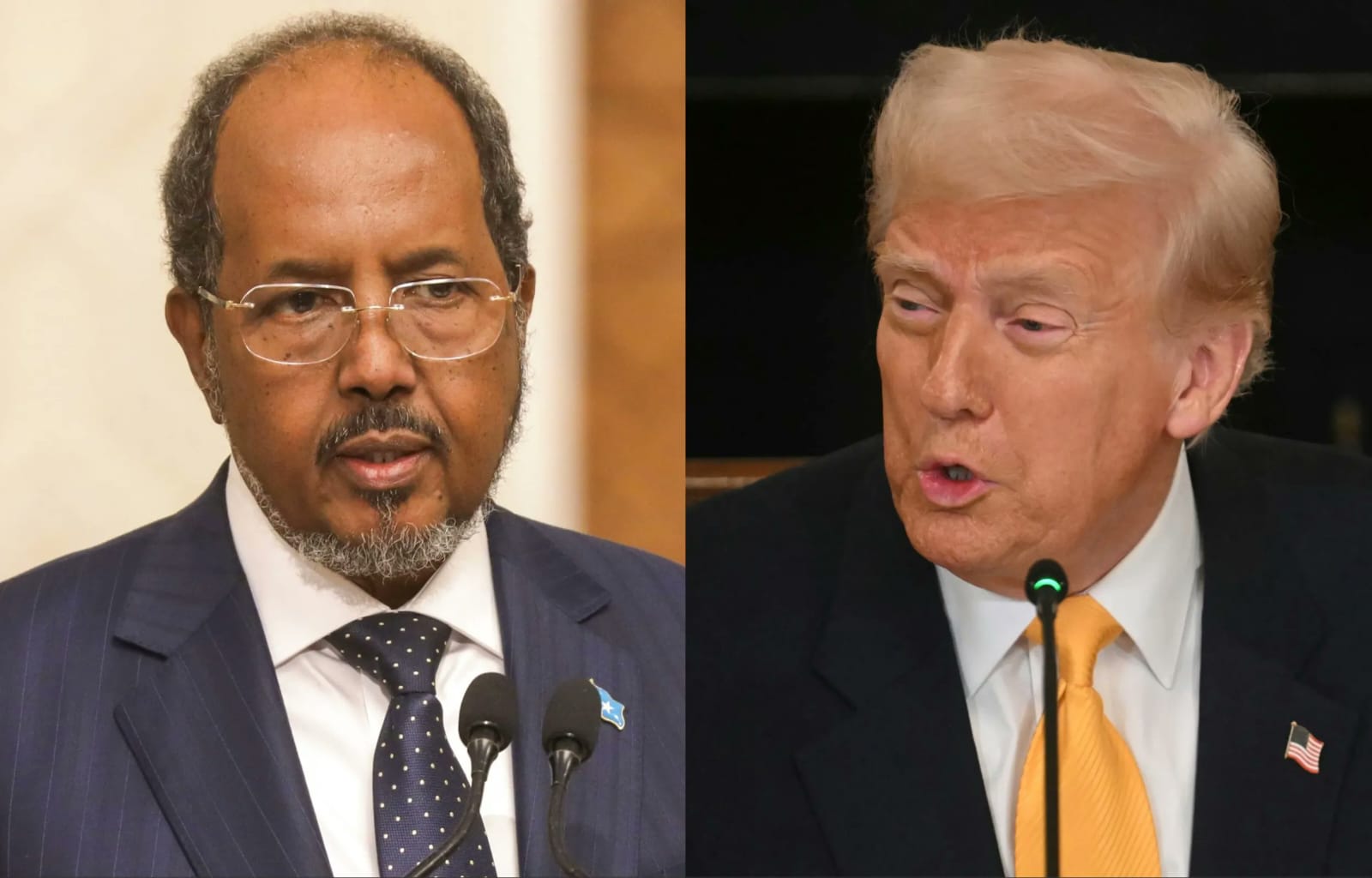
The Federal Government of Somalia has moved to revive its 1980 military cooperation agreement with the United States, signalling a renewed geopolitical push to ensure that all foreign security partnerships are conducted through official federal channels.
The proposal comes at a time of rising diplomatic competition between Mogadishu and the self-declared state of Somaliland, which recently expressed willingness to offer American forces military bases and exclusive access to natural resources in exchange for possible diplomatic recognition.
According to Somalia’s Deputy Minister of Foreign Affairs Ali Omar Balcad, the federal government is seeking to re-establish the historical pact first signed during the era of former Somali leader Siad Barre.
The 1980 agreement allowed American forces strategic access to Somali ports and airports during the Cold War geopolitical rivalry. In return, Somalia received military equipment, financial assistance, and broader security cooperation that supported the country’s armed forces during a period of regional tension following the Somalia–Ethiopia conflict of the late 1970s.
The renewed interest in the pact reflects Mogadishu’s current security and diplomatic priorities, including counterterrorism operations, maritime security, and strengthening central government authority over foreign military presence.
The original military cooperation framework between Somalia and the United States was born out of the geopolitical realignment that followed the Somalia–Ethiopia war of 1977–1978.
During that period, Somalia shifted its international alliances from the Soviet Union toward the Western bloc after relations with Moscow deteriorated.
Under the leadership of former president Siad Barre, Somalia sought military modernization and external security guarantees. The United States, driven by Cold War strategic calculations, viewed Somalia’s Red Sea proximity as geopolitically valuable.
The agreement allowed American forces to use selected Somali ports and airfields for logistics, surveillance, and military operations. In return, Washington provided Somalia with military hardware, training programs, and economic assistance.
However, the partnership gradually weakened toward the late 1980s as Somalia descended into internal political instability. By the early 1990s, the collapse of the central government ended most structured military cooperation.
Today, the revival proposal is framed not as a return to Cold War alignment but as a modern security partnership focused on counterterrorism and regional stability.
Government officials in Mogadishu argue that any future foreign military presence must operate under the authority of the federal state rather than through regional or breakaway authorities.
The renewed Somali diplomatic initiative appears to be a direct response to statements emerging from Somaliland leadership.
Officials from Somaliland have publicly signalled readiness to provide the United States with strategic advantages, including military basing opportunities and resource concessions.
Khadar Hussein Abdi, a minister in the Somaliland presidency, stated that the region is open to negotiating security and economic arrangements with Washington.
“We are willing to give exclusive access to our minerals to the United States. Also, we are open to offer military bases to the United States. We believe that we will agree on something with the United States,” he said during a recent interview.
These remarks are part of Somaliland’s long-standing diplomatic strategy to seek international recognition as an independent state, despite lacking widespread global acceptance.
Mogadishu views such proposals as a challenge to Somalia’s territorial integrity and constitutional authority.
Federal officials argue that allowing separate military negotiations by regional entities could undermine national sovereignty and create parallel security structures.
The rivalry reflects deeper political disagreements between Somalia’s federal government and Somaliland’s autonomous administration.
While Somaliland maintains relative internal stability and conducts independent governance, the international community continues to recognize it as part of Somalia’s sovereign territory.
Inside the presidential compound of Villa Somalia, strategic discussions are reportedly ongoing regarding the future of foreign military cooperation.
Officials describe the negotiations as centred on three fundamental pillars: power management, constitutional authority, and political transition mechanisms.
The phrase “power, constitution and the ballot” has emerged as a summary of the government’s diplomatic posture, reflecting Somalia’s broader transition agenda.
Government sources indicate that any renewed U.S.–Somalia military agreement would likely include counterterrorism cooperation against militant groups operating in parts of the country, maritime surveillance support along the Indian Ocean and Red Sea corridors, training and capacity building for Somali security forces, and controlled access to selected military and logistical facilities.
Security analysts believe Somalia’s proposal is partly motivated by the persistent threat posed by insurgent movements linked to extremist organizations operating in rural regions.
The government hopes that a structured partnership with Washington could strengthen intelligence sharing and operational capabilities.
Somalia occupies one of the world’s most strategically sensitive maritime corridors.
The country sits near the entrance to the Red Sea and the Gulf of Aden, a route through which a significant portion of global commercial shipping passes.
Somalia also possesses rare earth minerals a group of critical elements essential for modern technology, renewable energy systems, and advanced defense industries. These minerals are used in the production of electric vehicles, wind turbines, smartphones, satellite systems and precision military equipment. As global demand for rare earth elements intensifies, countries with such deposits are gaining heightened geopolitical significance. In this context, Somalia’s rare earth potential adds another strategic dimension to its natural resource portfolio, positioning the country within the wider global competition for critical minerals that are shaping the future of technology and energy security.
Control or influence over security infrastructure along this coastline provides major advantages for maritime surveillance and anti-piracy operations.
In recent years, international naval forces have operated in the region to combat piracy and protect global shipping routes.
Washington’s potential interest in renewed cooperation may therefore be tied to broader Indo-Pacific and Middle East security considerations.
For Somalia, the partnership could bring financial investment, security technology, and international political leverage.
However, critics warn that allowing foreign military bases could expose the country to geopolitical pressure or internal political controversy.
Somaliland’s proposal to offer military bases and mineral concessions reflects its long-term diplomatic objective of gaining international recognition.
The region has maintained relative administrative independence since declaring separation from Somalia in 1991 following the collapse of the central government.
Although Somaliland has established functioning institutions, currency control, and security structures, it has struggled to obtain formal recognition from major global powers.
By offering strategic incentives, Somaliland leadership hopes to increase its international visibility.
Resource diplomacy is central to this strategy, particularly given the region’s potential mineral and energy reserves.
Nevertheless, Mogadishu maintains that any foreign agreements concerning Somali territory must be negotiated through the federal government.
The United States has not issued an official public response to the renewed Somalia proposal.
Diplomatic observers suggest Washington may approach the issue cautiously, balancing security interests with regional political sensitivities.
American foreign policy in the Horn of Africa traditionally focuses on counterterrorism, maritime security, and stabilization initiatives.
Engaging simultaneously with both Somalia’s federal government and Somaliland could complicate diplomatic relations and raise sovereignty questions.
Some analysts believe Washington may prefer security cooperation agreements that avoid explicit endorsement of political disputes.
Regional security experts warn that competing foreign military offers could reshape strategic balances in the Horn of Africa.
If multiple local authorities seek external military partnerships, the region could experience increased geopolitical fragmentation.
On the other hand, structured international security cooperation might help stabilize conflict-prone areas.
Somalia’s government insists that centralized negotiation is essential to avoid parallel military arrangements that could weaken national command structures.
The possibility of renewing the 1980 agreement remains uncertain, but the diplomatic signal is clear.
Mogadishu is attempting to reposition itself as the legitimate gateway for international security cooperation in Somali territory.
The strategy reflects broader ambitions to consolidate federal authority, attract strategic investment, and counter competing regional diplomacy.
For the United States, any decision will likely depend on assessments of security benefits, political risks, and long-term regional stability.
The competition between Somalia and Somaliland for international strategic engagement marks a new phase in Horn of Africa geopolitics.
At the centre of the contest is not only military access but also questions of sovereignty, recognition, and resource control.
The proposed revival of the 1980 military agreement symbolizes Somalia’s effort to reclaim centralized diplomatic authority while navigating complex regional rivalries.
Whether Washington chooses to revive the historical partnership or pursue a more cautious security engagement remains one of the most closely watched diplomatic questions in the region.
What is clear is that the battle for strategic influence in Somalia is no longer confined to local politics but has expanded into the broader arena of global geopolitics.