

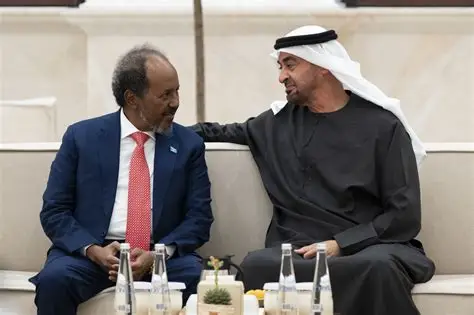
Somali President Hassan Sheikh Mohamud has delivered one of the strongest and most consequential speeches of his presidency on Somalia’s foreign relations, launching an extraordinary attack against the United Arab Emirates (UAE) and accusing Abu Dhabi of pursuing policies that threaten Somalia’s sovereignty, territorial integrity, political independence and national unity.
In a televised address to the Somali people on Tuesday, 17 November 2026, the President moved beyond diplomatic criticism and presented what he described as a pattern of interference by the UAE, ranging from political influence and financial support to regional administrations to the establishment of military bases and security structures outside the authority of Somalia’s Federal Government.
His accusations were particularly significant because they came from the highest office in the Somali state, against a country that has historically maintained substantial economic, security and political interests in Somalia.
The President’s central argument was that a country Somalia considered a brotherly partner had allegedly become involved in activities that undermine the very foundations of the Somali state.
Recalling the historical relationship between the two countries, Hassan Sheikh acknowledged the UAE’s role in hosting thousands of Somalis during the years of state collapse, providing economic opportunities and facilitating Somali businesses and remittances.
But he argued that historical friendship should not be used to justify actions against Somalia’s national interests.
“We saw them as brothers. We opened our doors to them. We trusted them greatly,” he said.
He then delivered one of the most striking statements of the address: “A brother does not burn your house. A brother does not buy your property without your knowledge. A brother does not divide your family.”
That statement was more than an expression of diplomatic disappointment. It was a direct accusation that Abu Dhabi had allegedly taken advantage of a relationship built on historical, religious, commercial and cultural connections.
The President’s remarks raise a fundamental question about the nature of foreign partnerships in Somalia: can a country be considered a strategic friend while simultaneously pursuing arrangements that the Federal Government considers a threat to its national authority?
At the centre of the dispute are three strategic ports: Berbera, Bosaso and Kismayo.
Hassan Sheikh accused the UAE of entering into agreements concerning these ports directly with regional administrations without obtaining approval from the Federal Government in Mogadishu.
He insisted that these facilities are national assets belonging to all Somalis and that decisions concerning strategic national infrastructure cannot be made independently of the country’s federal institutions.
“Those ports are not property owned by particular regional administrations. They are national property owned jointly by the Somali people,” he argued.
This is perhaps one of the most politically sensitive aspects of the confrontation.
The UAE has developed significant commercial and strategic interests across the Somali coastline, particularly through its involvement in port infrastructure. DP World, for example, operates under a long-term concession at Berbera, while Emirati interests have also been associated with Bosaso.
However, the disagreement cannot be understood exclusively as a commercial dispute. It exposes the deeper constitutional and political tensions within Somalia’s federal arrangement.
Somalia’s federal system has struggled with disagreements over the distribution of powers between Mogadishu and federal member states. Puntland and Jubaland have, at different times, challenged decisions taken by the central government, while Somaliland maintains its own self-declared independence and rejects Mogadishu’s authority.
Consequently, the question of who has the authority to negotiate strategic agreements involving ports, security and national infrastructure remains politically explosive.
For Mogadishu, foreign governments dealing directly with regional administrations on matters of national strategic importance risk weakening the Federal Government. For the regional administrations, however, their relationships with foreign partners are also connected to their economic interests and political autonomy.
This is precisely why the UAE dispute has the potential to become much bigger than a disagreement between two governments.
The President went further, accusing Abu Dhabi of establishing military bases and supporting armed formations operating outside Somalia’s national security command.
He argued that the existence of security structures outside the national command undermines the country’s military institutions at a time when Somalia is fighting al-Shabaab and other security threats.
His warning was particularly significant: “A force that does not take orders from the national command weakens the power and unity of the country’s security institutions.”
The accusation raises serious questions about Somalia’s security architecture. A country fighting an insurgency cannot afford competing military command structures, divided loyalties or security arrangements that weaken national coordination.
Somalia needs a unified security architecture, accountable to constitutional institutions and capable of protecting the entire country.
At the same time, this confrontation exposes the fragility of the relationship between Mogadishu and regional administrations. National security cannot be strengthened while political disagreements continue to undermine cooperation between the federal government and the regions.
Another major accusation concerned financial and political interference.
Hassan Sheikh alleged that the UAE had provided political and economic support to certain regional administrations, encouraging confrontation with Mogadishu and deepening divisions within Somali society.
This allegation touches on one of Somalia’s most persistent vulnerabilities: the intersection between domestic political rivalries and foreign influence.
When political actors begin relying on external financial or diplomatic support to strengthen their positions against national institutions, domestic disagreements can become internationalised.
Foreign governments gain influence, local political actors acquire external leverage, and national consensus becomes increasingly difficult to achieve.
But the deeper question is why Somalia continues to provide opportunities for external actors to influence its internal political arrangements. The country’s unresolved federal disagreements, competing political interests and persistent mistrust between Mogadishu and regional administrations have created an environment in which foreign influence can become a powerful political instrument.
The President then expanded his accusations beyond Somalia, drawing comparisons with Libya, Yemen and Sudan.
He warned that Somalia could experience similar fragmentation if the country failed to protect its unity.
“The UAE government went to Libya and left it divided. It also went to Yemen and left it divided. Today, this is what they want for Sudan and Somalia,” he said.
He followed this with a direct warning to Somali political actors seeking Abu Dhabi’s support: “Let those who are turning to them for help today learn the lessons of that history.”
These comparisons were among the most politically consequential parts of the address.
Libya has experienced years of competing political and military authorities. Yemen remains divided by armed conflict and competing centres of power. Sudan is enduring a devastating war that has displaced millions and shattered state institutions.
By invoking these countries, Hassan Sheikh was presenting Somalia’s confrontation with the UAE as part of a wider regional struggle over sovereignty, political independence and the influence of external powers.
His message was clear: Somalia must not become another arena for competing foreign interests.
The President also made a particularly sensitive allegation concerning Israel’s recognition of Somaliland.
He accused the UAE of playing a significant role in facilitating Israel’s recognition of the self-declared republic, which Mogadishu considers an integral part of Somalia.
He also criticised Abu Dhabi for refusing to join Arab and Muslim countries in issuing statements condemning the recognition as a violation of Somalia’s territorial integrity.
This accusation introduces another dimension to the diplomatic confrontation.
Somaliland’s international status has remained one of the most sensitive issues in Somali politics. For Mogadishu, any foreign involvement that strengthens Somaliland’s international recognition represents a direct challenge to the country’s territorial unity.
The alleged Emirati role, if established, would further complicate relations between Somalia and a Gulf country that has invested heavily in the region.
Perhaps one of the most extraordinary moments of the address concerned the Yemeni separatist leader Aidarous al-Zubaidi.
Hassan Sheikh accused the UAE of facilitating the movement of the Southern Transitional Council leader through Somali territory in January 2026 without the Federal Government’s knowledge or authorisation.
The incident generated controversy after Saudi Arabia’s military coalition said al-Zubaidi had travelled from Yemen to Somaliland’s Berbera port before boarding an aircraft that passed through Mogadishu and continued towards Abu Dhabi.
The President returned to the incident to underline what he described as a violation of Somalia’s sovereignty.
“Somali land is not a road to be crossed illegally; it is not a commodity to be bought; and it is not a place to enter whenever one pleases!” he declared.
The significance of this accusation goes beyond the identity of one Yemeni political figure. It concerns whether Somalia’s territory and airspace can be used for sensitive international movements without the knowledge and consent of its government.
For a sovereign country, control over its borders, airports and airspace is fundamental.
The President also defended his government’s decision of 12 January 2026 to annul all agreements with the UAE, including economic, security and defence arrangements, and restrict Emirati military and cargo aircraft from Somali airspace.
He said Somalia had exercised patience, pursued diplomatic engagement and attempted to resolve the disagreement before taking action.
Ten months after that decision, however, he argued that the underlying problems remained unresolved.
His warning to Abu Dhabi was unmistakable: “Today’s Somalia is not the Somalia of yesterday, which was thought to be weak.”
He maintained that Somalia would defend its sovereignty, territorial integrity and national unity through measures permitted under Somali law and international law.
Yet, despite the severity of his accusations, the President did not close the door to diplomacy. He emphasised that Somalia remained prepared to restore relations based on mutual respect, equality and recognition of its sovereignty.
He also made an important distinction between the Emirati government and its citizens, insisting that Somalia’s disagreement was with government policies, not the people of the UAE or Somalis living there.
This distinction matters because diplomatic disagreements should not become hostility towards ordinary citizens or communities.
But perhaps the most important part of the President’s address was not directed at Abu Dhabi. It was directed at Somalis themselves.
Hassan Sheikh argued that internal division remains the greatest opportunity available to foreign actors seeking influence over the country.
He warned that those seeking to weaken Somalia begin by dividing its people along clan, regional and political lines.
His message to Somaliland, Puntland and Jubaland was that political disagreements should be resolved through Somali-led dialogue rather than external intervention.
This is where the President’s speech deserves its strongest political analysis.
It is easy for national leaders to accuse foreign governments of exploiting divisions. The more difficult task is building the political consensus necessary to prevent those divisions from recurring.
Somalia’s federal system cannot survive on suspicion and confrontation between Mogadishu and regional administrations. The country needs a political settlement that defines the responsibilities of federal and regional institutions while ensuring that national interests are protected.
The relationship between the central government and regional administrations must not become a permanent contest for political authority in which foreign partnerships are used as instruments of domestic rivalry.
Puntland, Jubaland and Somaliland represent different political realities, but their disagreements with Mogadishu cannot be resolved through external power struggles. Somalia’s future requires political dialogue, compromise and a shared understanding of national interests.
The confrontation between Mogadishu and Abu Dhabi is therefore no longer simply a disagreement over commercial interests or diplomatic relations. It has become a much broader struggle over sovereignty, regional influence, control of strategic infrastructure and the future of Somalia’s federal system.
Hassan Sheikh’s message is that Somalia will no longer accept foreign involvement that, in his government’s view, undermines its national institutions or threatens its territorial unity.
For Abu Dhabi, the accusations raise serious questions about the limits of its strategic engagement in the Horn of Africa and the consequences of maintaining relationships with competing political authorities.
For Somalia, the challenge is to turn the President’s declaration into a stronger national political arrangement in which sovereignty is respected, strategic resources are protected and national institutions command the confidence of all its people.
Ultimately, Somalia does not need another political confrontation that leaves its institutions weaker and its people more divided.
It needs a country whose sovereignty is respected, whose strategic resources are protected and whose national institutions command the confidence of all its people.
The President concluded with a declaration that captured the central message of his address:
“Somalia is one, it has always been one, and it will remain one forever, God willing.”
That declaration may sound familiar, but its political significance is enormous at a time when Somalia faces internal disagreements, regional rivalries and growing competition among foreign powers.
The question now is whether Mogadishu and Abu Dhabi can find a diplomatic way out of this confrontation, and whether Somali leaders across the political spectrum can put national interests above competing political calculations.
Because the sovereignty of Somalia is not merely a matter of diplomatic statements. It is about who makes decisions on behalf of the country, who controls its strategic resources, who commands its security institutions and who determines its future.
And that is precisely the battle Hassan Sheikh Mohamud has placed at the centre of Somalia’s relationship with the UAE.