

Somali President Hassan Sheikh Mohamud has said that “what is missing between Somalia and Israel is an official diplomatic relationship,” signalling a possible future diplomatic relations toward Israel at a time when Mogadishu is reacting to Israel’s decision to recognise Somaliland and regaining diplomatic support.
Speaking in a detailed interview aired by Al Jazeera Arabic, President Hassan Sheikh confirmed that Somalia recognises Israel as a state because it is a member of the United Nations even though the two countries do not have formal ties.
His remarks have sparked major debate inside Somalia and the wider Horn of Africa.
Is Mogadishu Opening the Door to Tel Aviv?
Hints of Possible Engagement
In the interview, the President suggested that Somalia is not completely rejecting engagement with Israel or having a possible relations saying the key difference today is that there is no formal diplomatic framework.
This appears to weaken arguments by those who oppose Israel’s recognition of Somaliland on the basis that Somalia rejects any relationship with Israel.
Analysts and political pundits say the President’s comments indicate that Somalia may one day consider diplomatic contact, especially under international or regional pressure.
Abraham Accords Connection
President Hassan Sheikh also hinted that Somalia is not fully opposed to the Abraham Accords, the US-backed initiative begun under US President Donald Trump that encourages Muslim-majority countries to normalise relations with Israel.
He confirmed that he had previously been approached during his visit in New York city about Somalia joining the Accords, and although he said he rejected the proposal at that time, the tone of his Al Jazeera interview showed a softer position than before meaning he may reconsider it one day.
This raises new questions about Somalia’s long-term foreign policy direction.
Message to Israel: Engagement Should Go Through Mogadishu
The President also appeared to warn that Israel must work with Somalia’s Federal Government not Somaliland.
His position suggests that any recognition or agreement should involve Mogadishu, which holds international legitimacy.
This mirrors how his government responded to the Ethiopia–Somaliland agreement early in 2024, when Somalia launched a diplomatic campaign that eventually saw Turkey mediate between Mogadishu and Addis Ababa. However, Ethiopia has recently signaled renewed interest in Somaliland, possibly influenced by Israel’s regional security outreach and it’s recognition to Somaliland.
Regional Diplomatic Pressure and Israel’s Horn Strategy
Sources in Addis Ababa say Israel has long been working to expand influence in the Horn of Africa including Ethiopia as part of wider security cooperation related to the Gaza conflict and the war against Houthi. This has reportedly included discussions about joint security activity and troop deployment ideas.
Such developments increase pressure on Mogadishu as it searches for ways to limit Israel’s growing direct links with Somaliland.
Key Question: What Can Somalia Offer Israel?
Analysts argue that Somalia faces a difficult test:
Can Mogadishu offer Israel more than Somaliland already has?
So far, Somalia’s strongest card remains international legitimacy meaning any agreement signed with the Federal Government carries global legal weight.
Morocco and Sudan have both used the Abraham Accords to secure political advantages from the US and allies. Somalia may face similar pressure if it considers such a path but that would raise internal political and public-opinion challenges, particularly concerning Somaliland’s political question and legitimacy.
Criticism Over Slow Response Strategy
Nearly a week after Israel recognised Somaliland, opposition figures and civil society groups have criticised Villa Somalia for lacking a clear response plan.
They say the government has relied too heavily on international statements supporting Somalia’s territorial integrity instead of setting out a firm national diplomatic strategy.
Some opposition leaders even said after meeting President Hassan that he did not show strong concern about the domestic political divisions caused by the crisis.
Meanwhile, Somaliland President Abdirahman Cirro claimed that more countries are preparing to recognise Somaliland alongside Israel.
Explosive Intelligence Claims
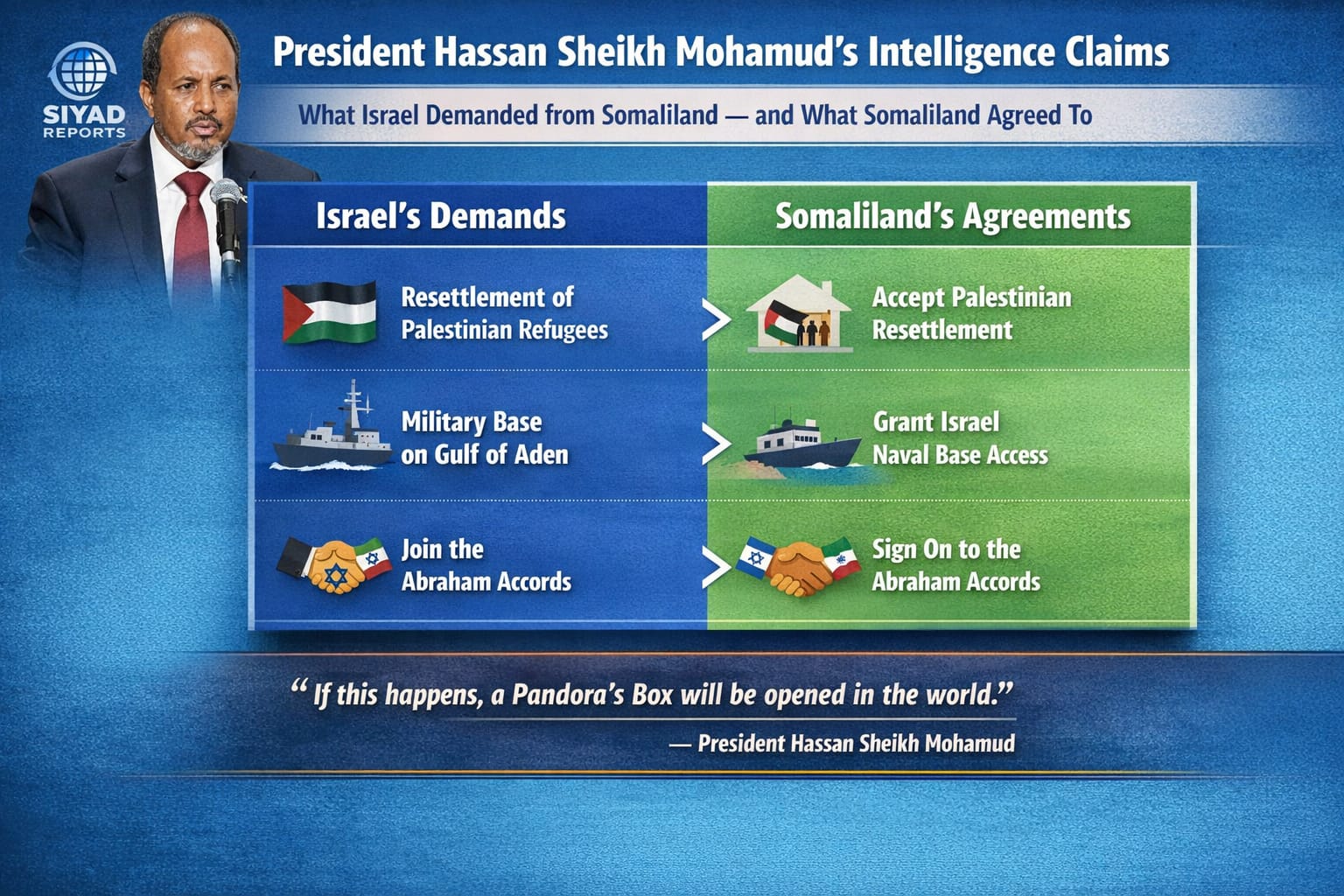
During the interview with Al-Jazeera on Wednesday President Hassan Sheikh revealed that he received intelligence findings alleging that Somaliland agreed to three major demands from Israel:
1️⃣ Resettling Palestinian refugees in Somaliland
2️⃣ Granting Israel a military base on the Gulf of Aden coast
3️⃣ Joining the Abraham Accords
He warned that if these steps go ahead:
“A Pandora’s Box will be opened in the world.” Meaning it would trigger endless instability, with unpredictable consequences for the Horn of Africa and beyond.
Balancing Diplomacy and Public Opinion
The President now faces a complex balancing act:
✔ defending Somalia’s territorial integrity
✔ managing internal political divisions
✔ responding to Israeli recognition of Somaliland
✔ while leaving space for future diplomatic flexibility
His Al Jazeera interview makes one thing clear:
Somalia is no longer speaking in absolute rejectionist terms about Israel, and that marks a major shift in tone.
This story remains developing as Somalia shapes its response to Israel’s recognition of Somaliland.