

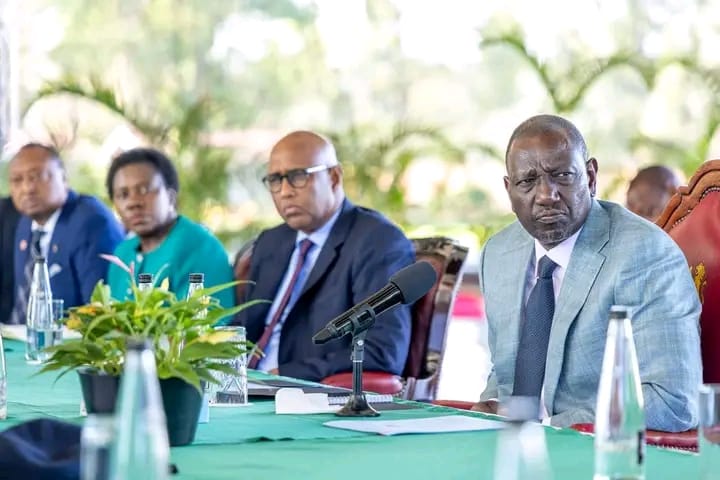
Kenyan President William Ruto has intensified his administration’s war on drug and alcohol abuse, convening a high-level multi-agency meeting to accelerate a nationwide response just days after declaring the crisis a national development and security emergency.
Earlier this month, President Ruto framed drug and alcohol abuse as an existential threat to Kenya’s future, warning that it risks wiping out the country’s “most productive generation.” His remarks were backed by alarming statistics, an estimated five million Kenyans aged between 15 and 65 are currently abusing alcohol or narcotics, meaning one in six citizens in this age bracket is affected. Among young adults aged 25 to 35, the rate rises to one in five.
Ruto has vowed to respond with the same seriousness applied to counter-terrorism efforts, signalling the beginning of one of the most aggressive anti-drug campaigns in Kenya’s history.
A Whole-of-Government War on Trafficking, Illicit Alcohol and Addiction
During the multi-agency meeting, President Ruto confirmed that the government is finalising a new legal and institutional framework to strengthen coordination, enforcement and accountability across security, border control and public health systems. Additional officers are being deployed to a revamped Anti-Narcotics Unit with enhanced training, logistics and paramilitary-style capability, mirroring the structure of the Anti-Terrorism Police Unit.
To choke trafficking networks, multi-agency teams will also be stationed at five key border points identified as major drug transit routes.
But the war is not limited to narcotics. Illicit alcohol will now be treated as organised crime, while the government is also preparing tougher regulations for the gambling sector, which Ruto says has devastated families socially and financially. Public servants found colluding with criminal networks will face immediate dismissal and prosecution.
One of the most controversial proposals is a push to amend Kenya’s narcotics law so that trafficking hard drugs such as cocaine and heroin becomes a capital offence punishable by death. Ruto argues current fines are too weak to deter powerful trafficking cartels.
The government also plans sweeping asset seizure powers to confiscate vehicles and properties used to facilitate trafficking or black-market alcohol production.
Expanding Treatment, Rehabilitation and Recovery Nationwide
While enforcement remains central, the President stressed that rehabilitation and recovery are equally critical pillars of the response. The government will establish drug and alcohol rehabilitation centres in all 47 counties in partnership with county governments and NACADA. National referral hospitals will also scale up treatment capacity, supported by enhanced coverage through the Social Health Authority.
This marks a major shift toward recognising addiction not only as a law-enforcement issue, but also a public-health challenge affecting families, youth and community stability.
Ruto said the government’s strategy will integrate prevention, enforcement, treatment and recovery to safeguard national security and protect Kenya’s human capital.
What This Means for Kenya and the Region
The President’s war on drugs signals a new era of hardline policy, with Kenya moving dramatically closer to zero-tolerance enforcement. Supporters believe the approach may finally break entrenched trafficking networks and criminal economies preying on vulnerable communities.
However, critics warn of potential human-rights concerns especially around the proposed death penalty and expanded policing powers and stress the need for strong safeguards to ensure fairness, accountability and due process.
Regionally, the shift places Kenya at the forefront of East Africa’s anti-narcotics battle, with implications for border security, regional policing cooperation and cross-border trafficking dynamics.
What remains clear is that the government views the crisis not simply as a social problem but as a national security emergency requiring unprecedented mobilisation of the state.