

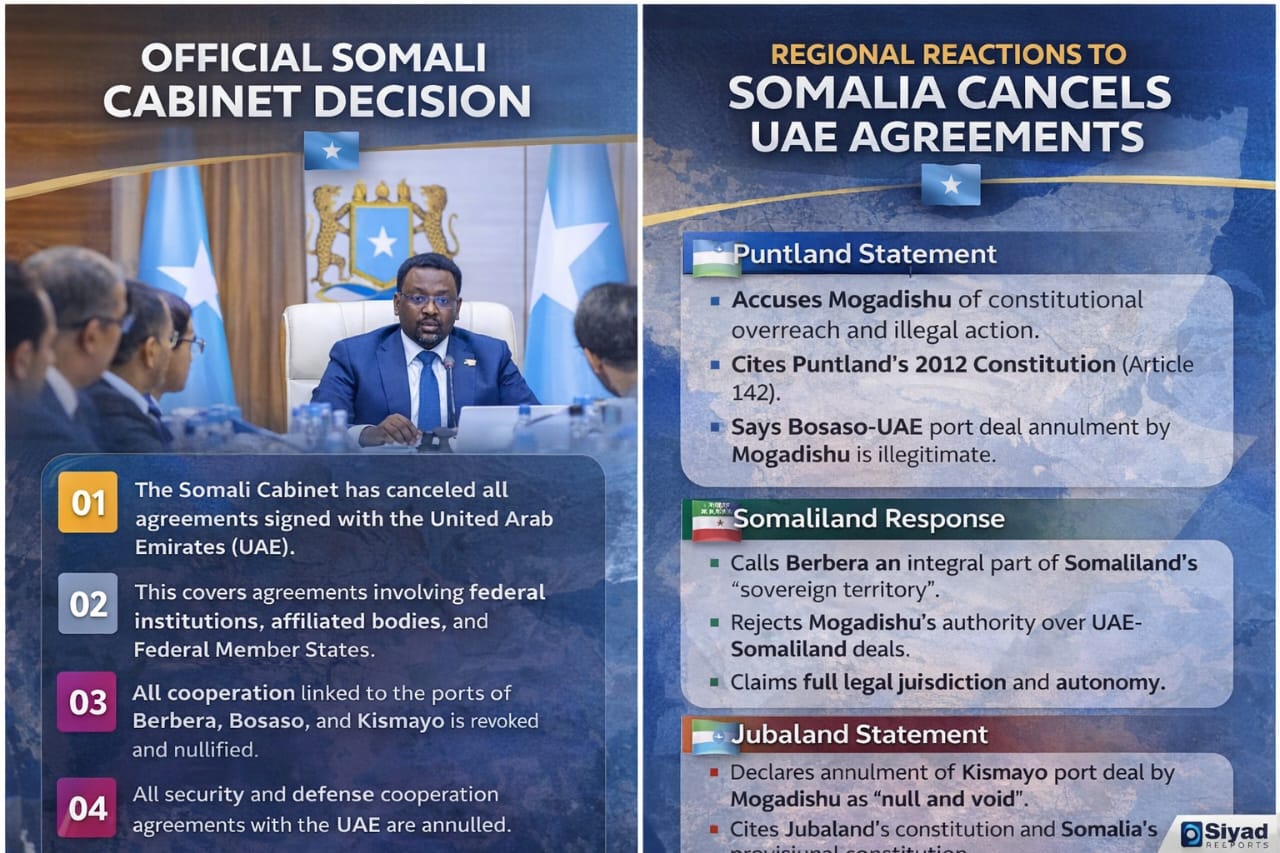
On January 12, 2026, the Federal Government of Somalia made one of the most consequential foreign policy decisions since the adoption of the provisional constitution, the complete annulment of all bilateral agreements with the United Arab Emirates (UAE). The decision, approved by the Council of Ministers and chaired by Deputy Prime Minister Salah Ahmed Jama, covers security, defense, military, commercial, and port-management agreements, including those involving Berbera, Bosaso, and Kismayo.
According to the Somali cabinet, the move followed “strong evidence” that UAE actions were undermining Somalia’s sovereignty, territorial integrity, national unity, and political independence. Mogadishu framed the decision not as a diplomatic dispute, but as a constitutional and existential defense of the Somali state.
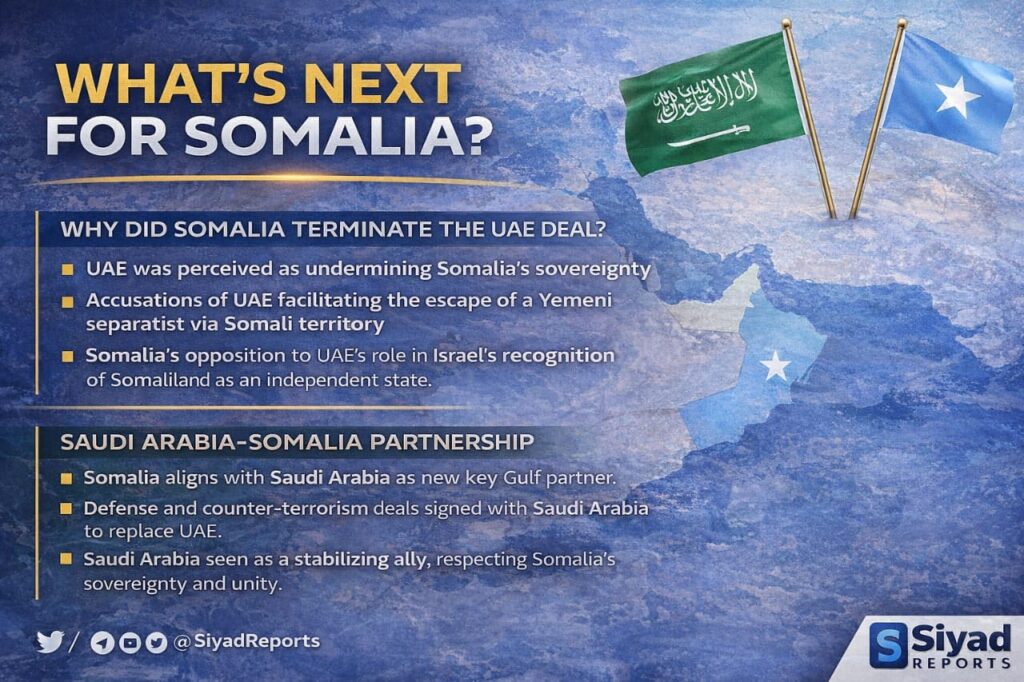
Central to the rupture is Somalia’s accusation that the UAE played a key behind-the-scenes role in Israel’s December 2025 recognition of Somaliland, a self-declared breakaway region.
From Mogadishu’s perspective, UAE investments in Berbera port and military cooperation in northern Somalia formed the economic and security scaffolding that emboldened Somaliland’s push for international recognition.
Tensions escalated further following reports that the UAE allegedly used Somali airspace and territory to facilitate the escape of Aidarous al-Zubaidi, leader of Yemen’s Southern Transitional Council, to Abu Dhabi in January 2026. Somali authorities described subsequent unauthorized landings by UAE military and cargo aircraft as a direct violation of national airspace, crossing a red line in bilateral relations.
Simultaneously, the cabinet approved a new Sovereignty Protection Law, explicitly banning federal member states and private entities from entering foreign agreements without prior federal approval and oversight. The law is designed to reassert Mogadishu’s constitutional authority over ports, airspace, security, and foreign relations areas long contested within Somalia’s fragile federal system.
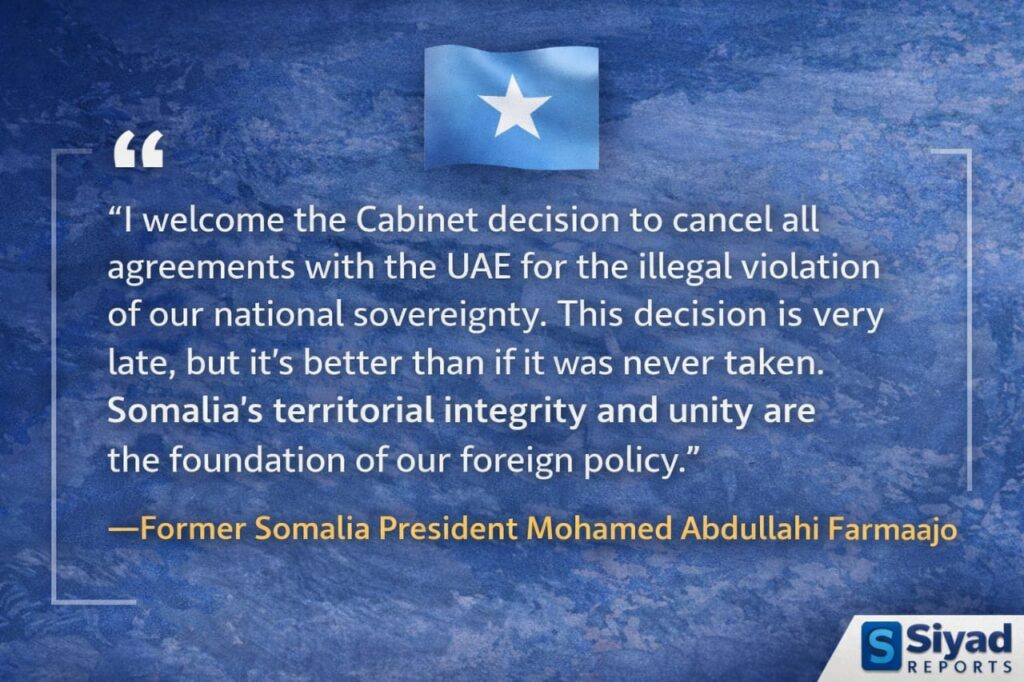
Federal Authority vs Regional Defiance: A Constitutional Flashpoint
The federal government’s decision immediately triggered resistance from Somalia’s regional administrations, exposing the deep structural fault lines within the country’s federal model.
Somaliland outright rejected the decision, declaring Berbera an integral part of its “sovereign territory” and dismissing Mogadishu’s move as irrelevant.
Hargeisa reaffirmed its partnership with the UAE, describing Abu Dhabi as a “trusted friend” and insisting that federal institutions have no jurisdiction over its agreements.
Puntland echoed similar sentiments, calling the cabinet’s decision unconstitutional and warning that interference in Bosaso port arrangements threatens security cooperation against Al-Shabaab and ISIS. Puntland argues that its agreements with the UAE are lawful and essential to regional stability.
Jubaland, meanwhile, declared the cancellation of the Kismayo port deal “null and void,” citing both its own constitution and Somalia’s provisional constitution to assert authority over trade, investment, and infrastructure.
These reactions underscore the core dilemma Somalia now faces:
Can a federal government enforce national sovereignty when regional administrations possess entrenched foreign partnerships, security arrangements, and revenue streams?
From Mogadishu’s viewpoint, the UAE’s long-standing strategy of bypassing the central government to deal directly with regions has weakened state cohesion, encouraged parallel foreign policies, and hollowed out federal authority. The cancellation of UAE agreements is therefore not just about Abu Dhabi it is about recentralizing power and redefining the rules of Somalia’s federalism.
Geopolitical Realignment: Saudi Arabia Steps In, the UAE Steps Back
The fallout with the UAE has accelerated a major geopolitical realignment in the Horn of Africa. In the wake of the cancellation, Somalia has moved decisively closer to Saudi Arabia, positioning Riyadh as its primary Gulf ally.
Saudi Arabia has emerged as a vocal defender of Somalia’s unity, leading a coalition of over 20 countries, including Egypt, in a joint statement reaffirming support for Somalia’s territorial integrity. Somali officials have openly praised Riyadh for respecting state sovereignty, in contrast to what they describe as the UAE’s “proxy-based” regional strategy.
Security cooperation is also shifting. The termination of UAE military training programs once central to Somalia’s fight against Al-Shabaab has created a temporary security vacuum, particularly in Puntland. However, Mogadishu expects this gap to be filled by Saudi Arabia, Turkey, and Qatar, all of whom maintain close ties with the federal government and operate through state institutions rather than regional power brokers.
Strategically, Somalia’s pivot places it firmly within a Saudi-Egyptian-Qatari axis that prioritizes existing borders and centralized authority. This alignment also reflects broader Red Sea geopolitics, where rivalry between Riyadh and Abu Dhabi particularly over Yemen has spilled into the Horn of Africa.
By cancelling UAE agreements and passing new sovereignty laws, Somalia is attempting to “unplug” foreign influence from sub-state actors, reassert control over its ports and airspace, and reset its role as a unified actor in regional diplomacy. Whether the federal government can enforce these decisions on the ground remains uncertain, but politically, the message is clear: Somalia is reclaiming the language and the practice of sovereignty.