

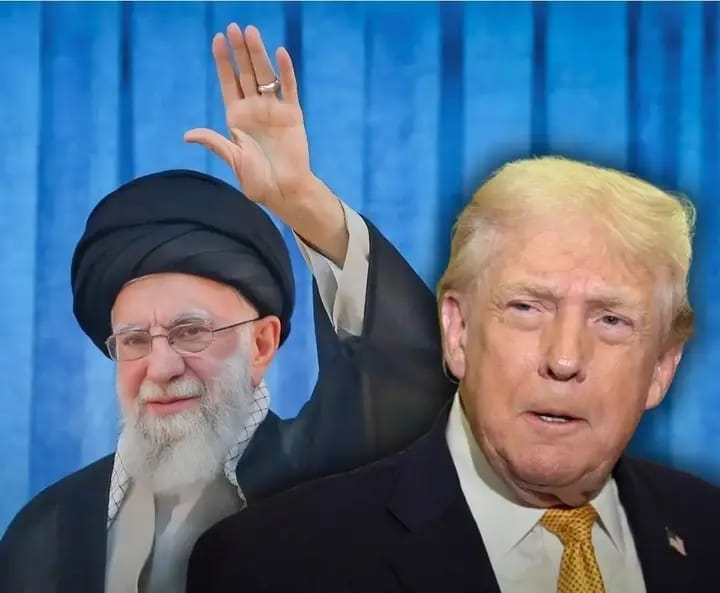
The Middle East is once again standing at the edge of a historical rupture, one where a single miscalculation could ignite a chain reaction far beyond the region. What is unfolding is not merely a military standoff between the United States and Iran, but a convergence of unresolved power struggles, alliance anxieties, domestic political calculations, and a collapsing international restraint system.
At the center of this storm is President Donald Trump, weighing what his own advisers describe as a “cooling war” with Iran a phrase that dangerously understates the reality that once such a conflict begins, it will not cool, pause, or remain contained.
Why Iran, Why Now
Trump’s posture toward Iran is rooted in a long-standing objective of U.S. strategic doctrine: preventing Iran from emerging as an independent regional power capable of shaping the Middle East outside American and Israeli control. Iran’s missile program, its network of allied forces across Iraq, Syria, Lebanon, and Yemen, and its geographic leverage over the Strait of Hormuz have long placed it at the center of U.S. containment efforts.
Yet what makes this moment uniquely dangerous is not capability, but timing. Diplomatic off-ramps are narrowing, while military signaling is accelerating. Iran has publicly stated that it offered dialogue and de-escalation offers Washington appears to have sidelined in favor of coercive leverage.
Initially, the U.S. administration floated humanitarian justifications tied to internal unrest in Iran. But Trump’s own recent admission that alleged killings have ceased and that there is no confirmed plan of executions has effectively dismantled that rationale. What remains is a strategic gamble: force compliance through intimidation, while hoping escalation rarely is.remains controllable. History suggests it
“There Is No Neutrality in Extinction”
It is here that Professor Abdiwahab Sheikh Abdisamad, a respected Horn of Africa and geopolitical analyst, offers a stark and unsettling framework for understanding what is at stake.
In his assessment, a U.S.-Israel strike on Iran would not represent a contained military operation, but the fracture point of the global order. He warns that one miscalculation would trigger missiles answering missiles, drones hunting cities, proxy forces igniting borders, and oil chokepoints slamming shut. Markets would convulse, infrastructure would fail, and civilians , not armies would pay the price first.
According to Abdiwahab,modern wars no longer move toward victory; they spiral toward loss of control. Leaders lose command faster than escalation feeds itself. Misread signals, retaliatory doctrines, and fear-driven decisions replace strategy. There are no brakes, no reset buttons only cascading retaliation until the damage becomes irreversible.
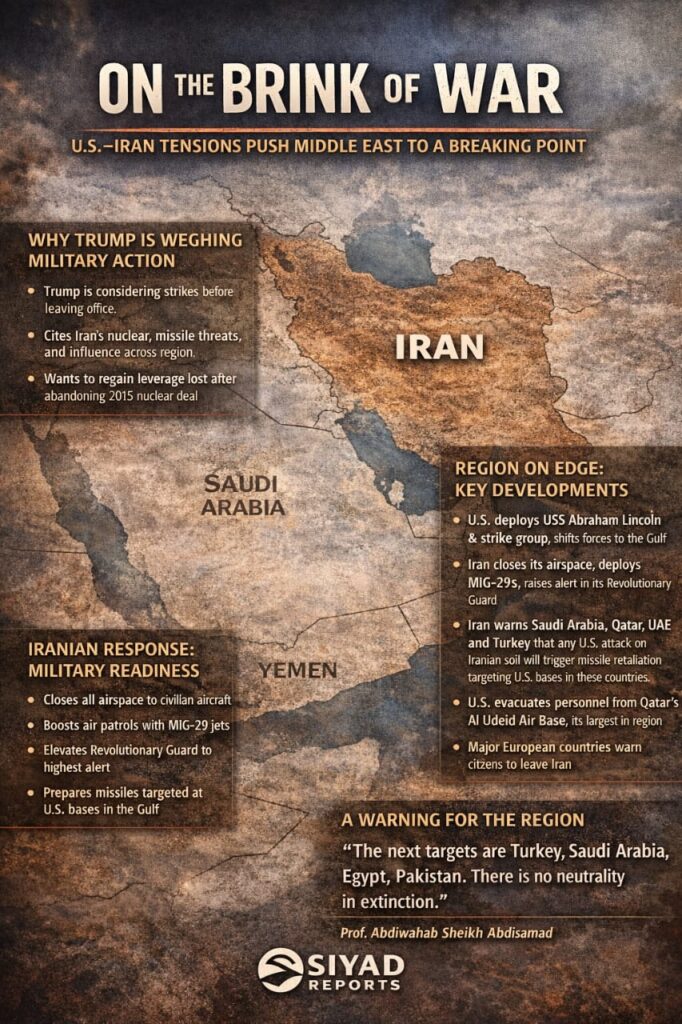
Most critically, he rejects the illusion of neutrality. In his words, “There is no neutrality in extinction.” Silence, alliances, and borders do not shield states once the precedent of regime destruction is normalized.
Military Signals and the Logic of Escalation
The facts on the ground now reinforce this warning. The redeployment of the USS Abraham Lincoln strike group, the evacuation of U.S. personnel from Al Udeid Air Base in Qatar, and heightened alerts across American installations in the region indicate that contingency planning has moved beyond theory.
Iran’s response has been swift and calculated. Its airspace has been closed. Fighter jets are patrolling. The Revolutionary Guard is on high alert. Ports along the Persian Gulf have been partially evacuated, with dozens of commercial vessels holding offshore amid fears of strikes on oil and logistics infrastructure.
More consequentially, Iran has formally warned Saudi Arabia, Qatar, the UAE, and Turkey that any U.S. attack launched from bases on their soil will trigger direct missile retaliation. This transforms the conflict into a regional entanglement where neighboring states become unwilling participants regardless of intent.
Behind the scenes, even Iran and Israel adversaries by doctrine have reportedly exchanged indirect assurances via Russian mediation, indicating that neither seeks to strike first unless the United States initiates hostilities. This alone exposes the fragility of the situation: regional actors appear more cautious than the external power contemplating intervention.
The Execution List Does Not End With Iran
Professor Abdiwahab’s second and more unsettling argument extends beyond the battlefield. He warns that if Iran falls or is decisively broken, the logic of power projection will not stop there.
In his analysis, the next targets are not hypothetical: Turkey, Saudi Arabia, Egypt, and Pakistan all represent states whose size, influence, or strategic autonomy could eventually place them at odds with an order that tolerates no independent poles of power. The tools may differ sanctions, economic strangulation, political destabilization, or military pressure but the objective remains the same: compliance or collapse.
Borders will not save them. Alliances will not save them. Waiting quietly will not save them.
History, Abdisamad argues, does not punish those who resist first — it punishes those who wait their turn.
A World Holding Its Breath
The diplomatic evacuations from Tehran, security warnings issued to American citizens in Israel, and intelligence assessments suggesting a possible strike within hours all point to a world bracing for a decision whose consequences cannot be recalled.
Trump’s own rhetoric oscillating between reassurance and ambiguity reflects an administration aware that once the first strike lands, control evaporates. War, at that point, ceases to be a policy tool and becomes a force of its own.
This crisis is no longer about winning. It is about preventing a loss so vast that no side can credibly claim recovery. A war on Iran would not stabilize the Middle East; it would fracture it, shatter already strained alliances, and accelerate global economic and political breakdown.
History will not judge this moment by who struck first, but by who failed to stop the night from unfolding.