

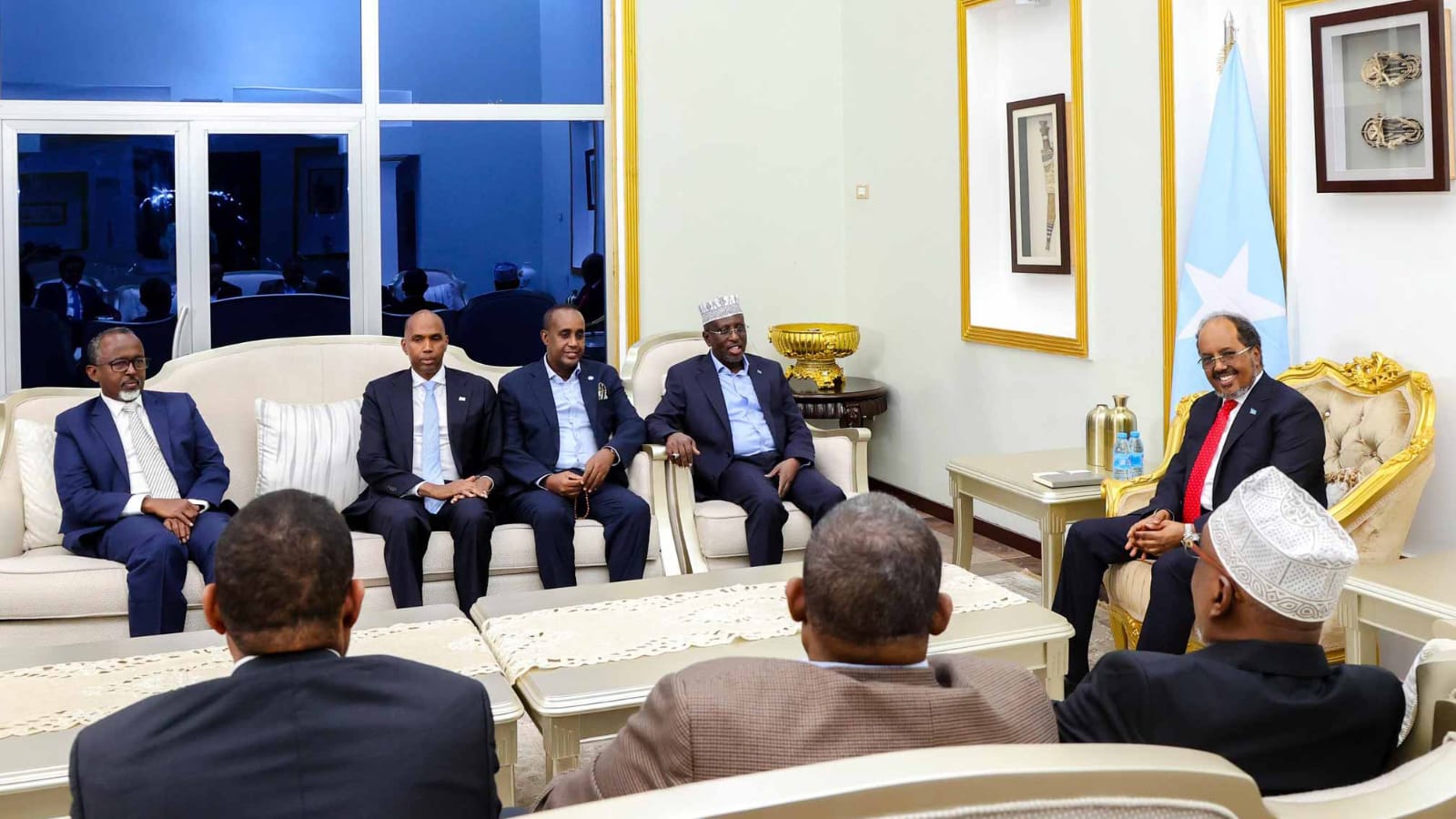
The Federal Government of Somalia (FGS) has formally invited the Somali Future Council a political bloc bringing together Puntland, Jubaland, and the Salvation Council to attend a National Consultative Conference scheduled to begin on February 1, 2026, in Mogadishu. The invitation, issued through the Office of Prime Minister Hamza Abdi Barre, follows a recommendation by President Hassan Sheikh Mohamud and is framed as a renewed effort to restore political consensus, national unity, and constructive dialogue.
In a press release dated January 19, 2026, the government stated that the conference aims to strengthen cohesion, promote a consultative and compromise-based democratic process, and address outstanding political disagreements. Preparations for the summit have been entrusted to a ministerial committee chaired by the Minister of Justice and Constitutional Affairs, Hassan Macallin Mohamud Sheikh Ali. The Somali Future Council has also been asked to appoint representatives to jointly finalize the agenda, signaling an attempt to ensure shared ownership of the process.
A Renewed Attempt After Failed Talks
This invitation comes against the backdrop of earlier talks between the federal government and opposition actors that failed to yield consensus. Previous meetings, held amid escalating political tensions over electoral processes, federal-state relations, and governance reforms, ended without agreement. Mutual distrust, disagreements over procedures, and the absence of key stakeholders undermined those efforts.
The current initiative appears to be an attempt by Villa Somalia to reset the process this time through a broader, nationally framed consultative conference rather than closed-door negotiations. By explicitly referencing unity, compromise, and Article 6 of the Somali Future Council’s own communiqué, the government is seeking to present the summit as inclusive and responsive to opposition demands.
However, whether this renewed effort will succeed where previous ones failed remains uncertain.
The Puntland and Jubaland Question: Attendance and Venue Dilemma
A central uncertainty surrounding the February 1 summit is whether Puntland and Jubaland two influential federal member states aligned with the Somali Future Council will attend, and if they do, whether they will accept Mogadishu as the venue.
Both administrations have previously expressed reservations about political processes convened in Mogadishu, citing concerns over neutrality, security, and political balance.
Puntland, in particular, has often advocated for talks to be held in a mutually agreed neutral location, while Jubaland has raised objections linked to federal overreach and unresolved disputes with the central government.
Their absence would significantly weaken the legitimacy and impact of the conference, reinforcing perceptions of a divided political landscape. Conversely, their participation would mark a major breakthrough, potentially reopening space for compromise on elections, constitutional reforms, and intergovernmental relations.
At this stage, the government’s call for the Somali Future Council to co-design the agenda could be interpreted as an olive branch an attempt to address these long-standing concerns. Still, skepticism remains high, and opposition leaders may wait for concrete guarantees before committing to attend.
High Stakes for Somalia’s Political Trajectory
The proposed consultative summit comes at a critical moment for Somalia. With political polarization deepening and trust between the federal government and some member states strained, the outcome of this initiative could shape the country’s political direction in the months ahead.
If successful, the conference could help de-escalate tensions, rebuild confidence, and lay the groundwork for a more inclusive political process. Failure, however especially if key actors boycott the talks would further entrench divisions and raise questions about the federal government’s ability to convene genuinely national dialogue.
As February 1 approaches, attention will remain fixed on Puntland and Jubaland’s response. Their decision will not only determine the fate of the conference but also signal whether Somalia’s political actors are prepared to move from confrontation toward compromise.