

The political temperature around North Eastern Kenya rose sharply after former Deputy President Rigathi Gachagua publicly questioned the performance, integrity, and accountability of leaders from the region. His remarks touching on underdevelopment, misuse of public funds, and leadership failure came at a time when North Eastern continues to grapple with devastating drought, fragile health systems, and decades-old infrastructure gaps.
Gachagua’s argument, stripped of politics, rested on two claims: that despite devolution and billions allocated to counties, North Eastern Kenya remains underdevelope, and that regional leaders must be held accountable for this reality.
These statements resonated with some national figures and sections of the public, who view devolution as having failed to transform the region.
But for leaders from North Eastern Kenya, the remarks were not merely critical they were provocative, historically dishonest, and delivered by a man they say lacks the moral authority to lecture others on integrity. What followed was a rare, united, and forceful pushback from senior political figures, laying bare not just anger, but a long-suppressed narrative of marginalisation.
“We Are Ready for Accountability, But Don’t Rewrite History”
Hon. Adan Keynan Wehliye was among the first to respond, striking a tone that rejected Gachagua’s authority while embracing the principle of accountability itself.
“We have chased that man from the position of the Deputy President and he has no moral authority to lecture us. At the same time, we must hold ourselves accountable of the billions of money that came with devolution.”
Keynan’s response was strategic. He refused to allow Gachagua to monopolise the accountability debate, while making it clear that North Eastern leaders are not afraid of scrutiny.
“Accountability must happen in North Eastern, lazima kila mtu awajibike. I’m ready to be held accountable for what I have done in Eldas, and I invite all the people to join me by June of this year and see what is happening in Eldas.”
His challenge reframed the discussion from abstract accusations to verifiable facts on the ground.
Health Cabinet Secretary Aden Duale, speaking in Garissa County, offered a more nuanced intervention. While openly expressing his dislike for Gachagua, Duale acknowledged that some of the issues raised cannot be dismissed outright.
“There is some truth in the talks about Northern Kenya. Even though the man saying it (Gachagua) is bad, there is truth in it.”
Duale pointed directly to the humanitarian crisis gripping the region:
“There is a devastating drought in the region and the leaders are going for Umrah. And the sheikhs why are you not talking about this?”. Yet even as he admitted internal shortcomings, Duale rejected political opportunism and called for introspection rooted in values:
“Even though I don’t like the man saying it, I didn’t expect that from him… he said some truth. We need to talk as people from this region going forward, and in the coming election we should elect leaders who fear Allah.”
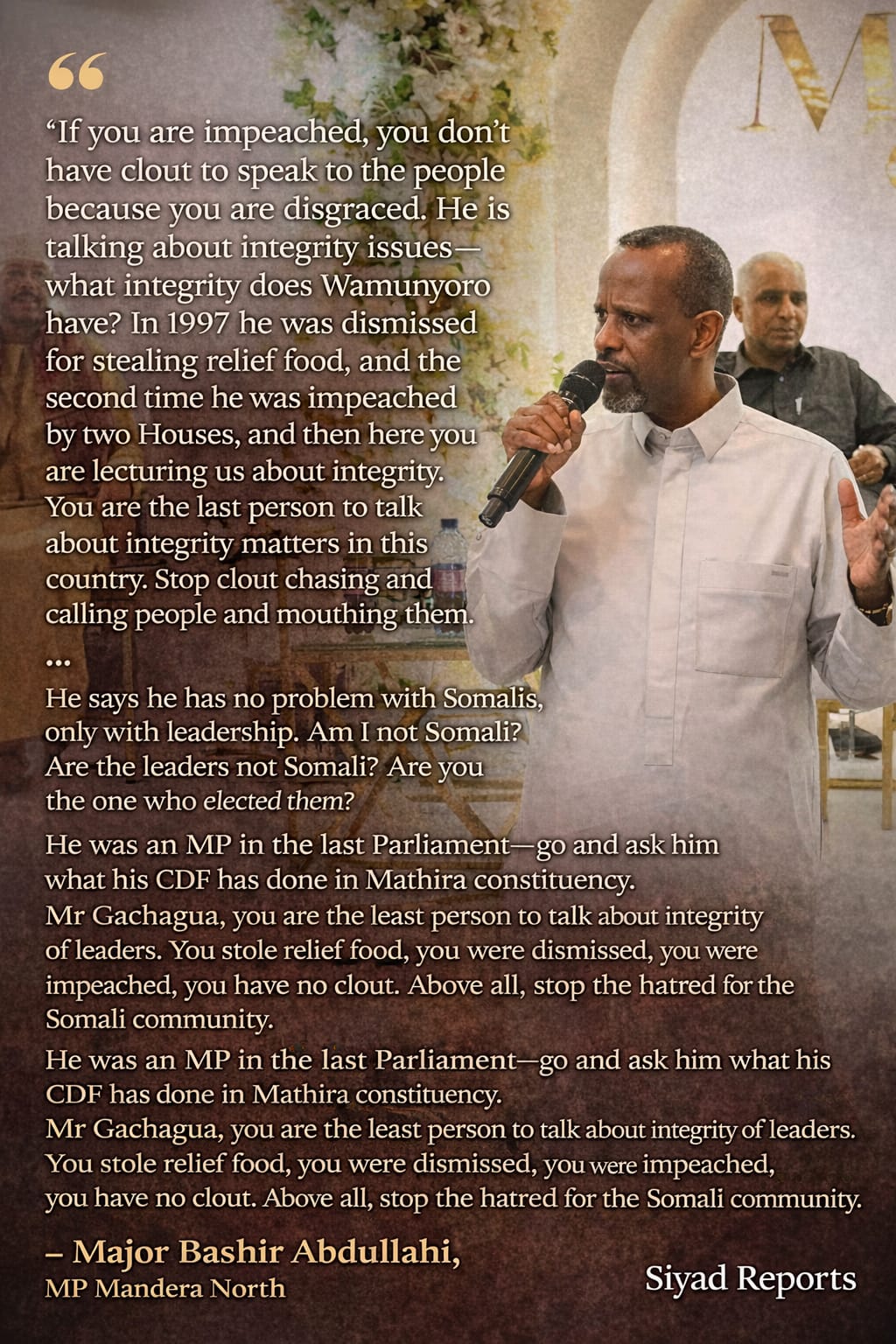
The strongest and most detailed rebuttal came from Mandera North MP Major Bashir Abdullahi, who dismantled Gachagua’s argument point by point starting with the misuse of CDF and devolution as benchmarks for national development.
“You expect my CDF money to build roads or Level V hospitals in Mandera North? Did you build roads in your constituencies using CDF money?”
Major Bashir reminded the country that most developed regions enjoyed state investment long before devolution existed.
“Were the roads of Kiambu, Central Kenya and other parts of the country done by CDF or devolution? No. They were done way before.”
Marginalisation, Integrity Politics, and the Weight of the Past
At the heart of Major Bashir’s argument was history specifically, the deliberate classification of North Eastern Kenya as a “low potential area” after independence.
“It’s you and your ilk who termed Northern Kenya a low potential area and deliberately marginalised our people.”
This designation, he argued, shaped decades of exclusion from national budgets, infrastructure planning, and economic investment.
“High potential areas were receiving large amounts of money, while low potential areas including North Eastern were receiving less.”
Against this backdrop, demands that MPs and governors single-handedly deliver mega infrastructure projects using CDF or county allocations appear unrealistic and dishonest.
“Do you expect my CDF to build a Level Five hospital in Mandera North? To tarmac roads from Wajir to Mandera to Garissa?”
Major Bashir also turned the integrity debate back on Gachagua himself, questioning whether a leader who has faced impeachment can credibly lecture others.
“If you are impeached, you don’t have clout to speak to the people because you are disgraced.”
He went further, invoking past allegations,
“In 1997 he was dismissed for stealing relief food, and later impeached by two Houses now he is lecturing us on integrity.”
The MP also accused Gachagua of masking ethnic hostility behind leadership criticism:
“Above all, there is hatred for the Somali community you included, myself included and you are clapping.”
Responding to claims that the criticism targets leadership rather than ethnicity, he asked:
“Am I not Somali? Are the leaders not Somali? Are you the one who elected them?”
The controversy widened further when former Vice President Kalonzo Musyoka appeared to endorse Gachagua’s remarks. Major Bashir questioned Kalonzo’s record bluntly:
“You have served government for forty years. Did you remember North Eastern when you were minister or Vice President?”
He added:
“Even your own Ukambani had no roads. This government, under President Ruto, is giving tarmac for the first time.”
The debate was further complicated by comments from Senior Counsel Ahmednassir Abdullahi, who publicly aligned himself with Rigathi Gachagua’s critique of North Eastern political leadership. Speaking during a well-attended Nikah ceremony in Nairobi, Ahmednassir dismissed the responses from Mandera North MP Major Bashir Abdullahi and other regional leaders, arguing that they had failed to meaningfully rebut the substance of Gachagua’s accusations. “There is a Senior Counsel who is defending Gachagua and who has been defending corrupt people in courts,” the MP for Mandera North had remarked earlier. In response, Ahmednassir maintained that the criticism directed at North Eastern elites was valid, stating, “The problem with the political elites in North Kenya was aptly expounded upon by Hon Rigathi Gachagua and I have nothing useful to add.” He echoed Gachagua’s claims that leaders spend more time attending Nikah ceremonies in Nairobi than engaging their constituents back home, adding that “the schools in their constituencies are mostly conducted under trees and their CDF can’t be traced on the ground.” Ahmednassir’s intervention injected a sharper internal critique into the debate, shifting the focus from historical marginalisation to questions of elite responsibility and leadership presence on the ground.
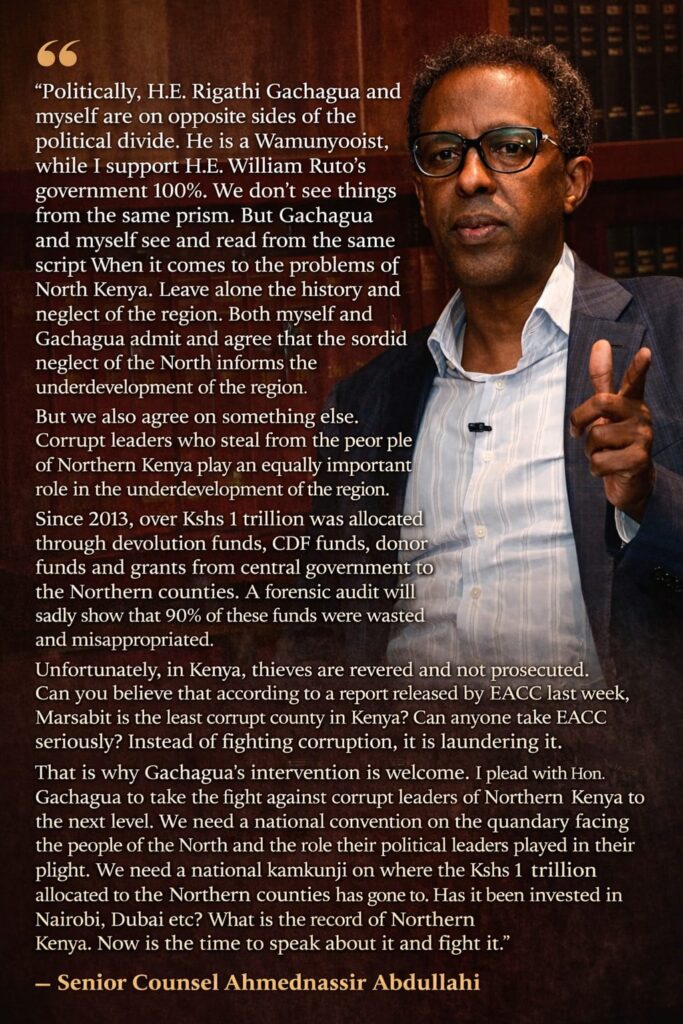
Ahmednassir Abdullahi further deepened the debate by offering a rare political convergence with Rigathi Gachagua on the crisis facing North Eastern Kenya, despite being on opposing sides of the political divide. In a detailed statement, Ahmednassir acknowledged their ideological differences, noting, “Politically, H.E Rigathi Gachagua and myself are on opposite sides of the political divide. He is a Wamunyoroist, while I support H.E William Ruto’s government 100%. We don’t see things from the same prism.” However, he argued that both leaders arrive at the same conclusions regarding Northern Kenya, stating that while historical neglect has shaped underdevelopment, corrupt local leadership has played an equally destructive role. Ahmednassir claimed that since 2013, “over Kshs 1 TRILLION was allocated through devolution funds, CDF funds, donor funds and grants from central government to the Northern counties,” asserting that a forensic audit would reveal that “90% of these funds were wasted and misappropriated.” He sharply criticised Kenya’s anti-corruption architecture, questioning the credibility of oversight institutions and accusing them of enabling corruption rather than confronting it, adding, “In Kenya, thieves are revered and not prosecuted… Is EACC an active accomplice of the larceny that is visited on the poor people of Northern Kenya?” Framing Gachagua’s remarks as a necessary intervention rather than political opportunism, Ahmednassir called for a national reckoning, urging the convening of a “national kamkunji” to account for the missing funds and demanding that the government of President Ruto take ownership of the issue, warning that “we can no longer remain silent on this corruption genocide of Northern Kenya.”
North Eastern Kenya, Between Truth, History and Political Convenience
What this unfolding debate reveals is not a simple disagreement between leaders, but a deeper national struggle over how Kenya talks about development, responsibility, and historical truth. Rigathi Gachagua’s remarks have forced an uncomfortable conversation into the open one that many Kenyans have whispered about but rarely addressed honestly. The reality is that North Eastern Kenya continues to suffer from underdevelopment, recurrent droughts, weak health systems, and fragile infrastructure. These are facts that no leader from the region can deny, and indeed, figures like Aden Duale and Adan Keynan have openly acknowledged that accountability must exist and that internal reflection is necessary.
However, the fury from North Eastern leaders is rooted not in denial, but in context. Their argument is simple yet profound: you cannot discuss accountability in isolation from history. You cannot demand equal outcomes without acknowledging unequal starting points. You cannot lecture regions that were deliberately excluded from national planning for decades, then pretend devolution alone was meant to erase sixty years of marginalisation.
What Major Bashir Abdullahi articulated with force is what many in the region feel that the Kenyan state, long before devolution, invested heavily in so-called “high potential areas” while branding Northern Kenya a low potential zone, undeserving of roads, hospitals, electricity, or economic focus. When today’s leaders are asked why they have not delivered mega infrastructure using CDF or county budgets, they see it not as accountability, but as a distortion of reality. Roads from Kiambu to Nyeri were not built through CDF. Level Five hospitals in Central Kenya were not delivered through devolution. They were products of a state that chose who mattered and who did not.
At the same time, leaders like Adan Keynan have made it clear that North Eastern Kenya is not seeking exemption from scrutiny. Calls such as “lazima kila mtu awajibike” reflect a willingness to be judged but judged fairly, honestly, and with historical awareness. Aden Duale’s admission that some truths were spoken, even by a man he does not respect, underscores another reality: internal failures, silence in the face of drought, and leadership complacency must also be confronted if the region is to move forward.
Yet the credibility of the messenger matters. For many in North Eastern Kenya, Gachagua’s impeachment, past controversies, and political posture strip him of the moral authority to speak as an arbiter of integrity. When his remarks are accompanied by language that leaders perceive as hostile or dismissive toward the Somali community, the debate shifts from accountability to identity, from policy to pain.
This is why the response has been so sharp, so emotional, and so unified. It is not merely about defending leaders; it is about defending a region’s dignity, history, and lived experience. North Eastern Kenya is tired of being remembered only during crises, blamed during elections, and used as a rhetorical tool by politicians seeking relevance.
The national conversation, therefore, must mature. Kenya must learn to hold leaders accountable without erasing history, to demand results without weaponising marginalisation, and to critique governance without inflaming ethnic fault lines. Anything less risks deepening mistrust and entrenching the very inequalities the country claims to be fighting.
And so the hard question remains one Kenya must answer honestly,
Can this country truly demand accountability from regions it deliberately underdeveloped, without first owning up to the injustices that shaped their present reality, or will North Eastern Kenya continue to carry the burden of a past it did not create while being judged by standards it was never allowed to meet?