

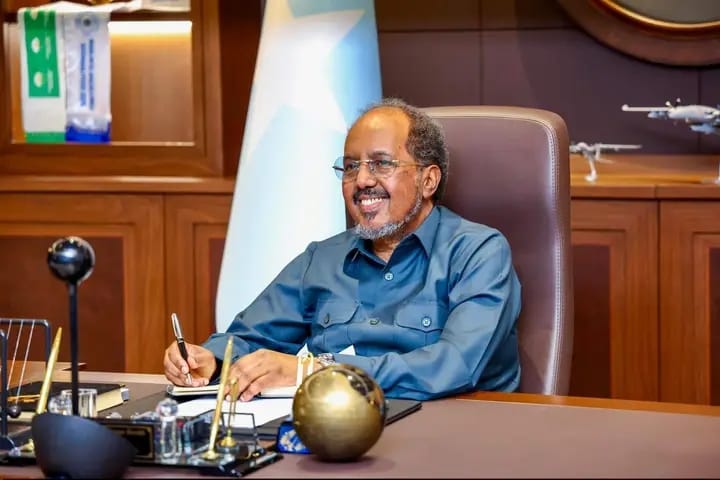
Somalia is once again approaching a decisive political moment as President Hassan Sheikh Mohamud presses ahead with additional amendments to the country’s provisional constitution amid a deepening election standoff. What the federal government presents as a continuation of long-overdue constitutional reform has instead ignited a serious national dispute, drawing sharp resistance from opposition leaders and key federal member states. With just four months remaining before the scheduled presidential election, the controversy has exposed long-standing tensions over power, federalism, and the legitimacy of Somalia’s political institutions.
At the center of the crisis is President Mohamud’s decision to instruct the Constitutional Review and Implementation Commission to submit further proposed amendments to parliament for debate and approval. Constitutionally, Somalia has remained in a transitional phase for over a decade, with repeated commitments to finalize a permanent constitution through inclusive dialogue between federal authorities and regional administrations. However, critics argue that the recent trajectory of reforms represents a clear shift away from that consensus-based framework.
In recent years, amendments approved by parliament altered key provisions governing presidential powers, electoral arrangements, and term limits. While the government insists these changes are lawful and necessary for state-building, the opposition and regional leaders contend that the process was rushed, unilateral, and politically motivated. They argue that constitutional reform, especially on issues as sensitive as elections and executive authority, cannot be legitimate without broad agreement among federal member states and political stakeholders.
This dispute has escalated into an unprecedented political rupture. Puntland and Jubaland two of Somalia’s most influential federal member states have rejected the amendments outright, declaring them unconstitutional and announcing their withdrawal of recognition from President Mohamud’s government. Both administrations maintain that the federal leadership has deviated from the constitutional path and undermined the spirit of federalism upon which the Somali state was rebuilt.
The constitutional battle is inseparable from the looming presidential election. Somalia’s electoral history is marked by repeated delays, elite bargaining, and indirect voting systems that have long frustrated public demands for democratic participation. President Mohamud has positioned himself as a reformist seeking to deliver a nationwide one-person, one-vote electoral system, arguing that constitutional amendments and voter registration are essential steps toward ending indirect elections dominated by clan elders and political brokers.
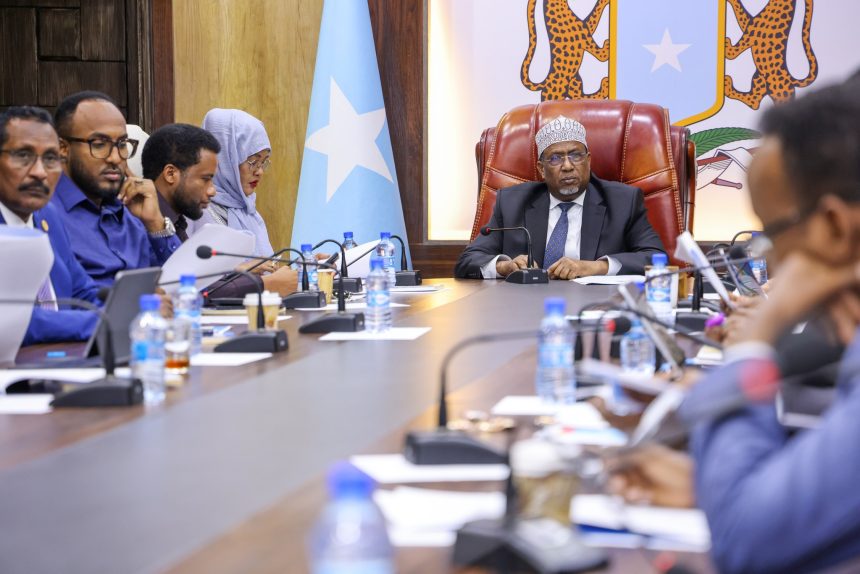
Yet the opposition remains deeply skeptical. For them, the timing of further constitutional amendments so close to an election raises fears of legal uncertainty and manipulation. Critics argue that altering the constitutional framework during an active electoral cycle risks creating loopholes that could justify postponements or even a term extension allegations the administration firmly denies. Nonetheless, mistrust between political actors remains high, fueled by Somalia’s history of contested transitions.
The federal government’s announcement that it will convene talks with the opposition and leaders of Puntland and Jubaland suggests recognition of the growing crisis. These leaders are aligned under the National Future Council, a coalition that has emerged as a counterweight to the current administration. However, dialogue efforts face an uphill battle, particularly as the government continues to advance reforms that its critics see as prejudging the outcome of negotiations.
Meanwhile, political divisions within Somalia’s federal system are becoming more pronounced. While Puntland and Jubaland openly oppose the constitutional changes, other federal member states including Galmudug, Hirshabelle, South West State, and the Northeastern State of Somalia remain aligned with the federal government. During a recent video conference with leaders from these regions, President Mohamud reaffirmed his commitment to continuing the constitutional review process, reopening voter registration, and allowing political organizations to mobilize in preparation for universal suffrage elections.
This emerging alignment risks creating a fragmented political landscape in which elections proceed in government-friendly regions while dissenting states remain excluded. Such a scenario would almost certainly undermine the credibility of any electoral outcome, regardless of technical preparations.
The role of the federal electoral commission has also become a focal point of contention. The president’s directive for the commission to begin distributing voter identification cards and registering new voters in allied federal member state capitals is being framed by the government as a practical step toward inclusive elections. Local council elections are planned between February and March as part of this process.
However, opposition leaders argue that the commission lacks independence, claiming it was selected to serve the interests of the presidency. In Somalia’s fragile political environment, perceptions of bias can be as destabilizing as actual misconduct. Without widespread confidence in the electoral body, voter registration and elections risk being rejected by significant segments of the political class.
The unfolding standoff reflects deeper structural challenges within Somalia’s governance model. The balance of power between the center and the regions remains contested, and constitutional ambiguity continues to be exploited by competing political actors. As the election approaches, the absence of consensus threatens to push the country into another cycle of political paralysis.
What Is at Stake for Somalia
What is unfolding is not merely a dispute over legal clauses or electoral procedures; it is a defining test of Somalia’s state-building project. The current crisis touches the core questions of political legitimacy, federal cohesion, and democratic transition. If constitutional reform and electoral preparations are pursued through inclusive dialogue and mutual compromise, Somalia could finally take a historic step toward stable, people-driven governance.
If, however, reforms continue amid deep mistrust and political exclusion, the country risks entrenching divisions that could weaken national institutions, delay elections, and erode public confidence. At a time when Somalia faces persistent security threats, humanitarian pressures, and economic challenges, prolonged political instability could prove costly.
As the election clock ticks down, the decisions made in the coming weeks will shape not only who governs Somalia next, but how legitimate that government will be in the eyes of its people and regions.
Whether this moment becomes a turning point toward democratic consolidation or another chapter of political confrontation remains an urgent and unresolved question.