

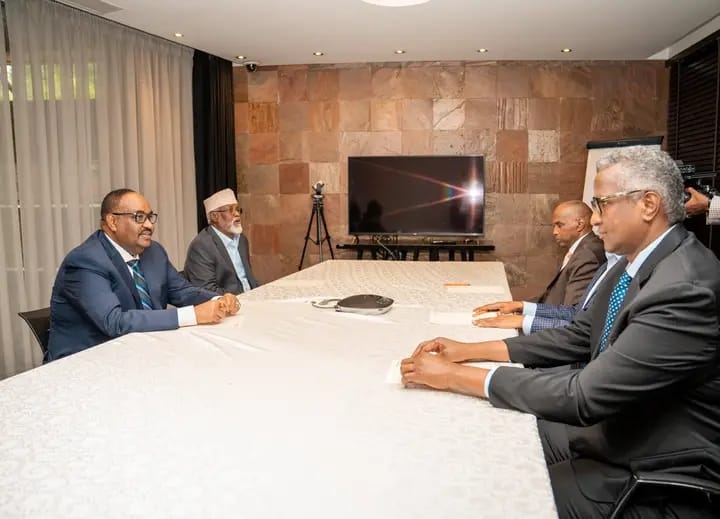
Somalia once again finds itself standing at a familiar but dangerous crossroads where dialogue is proposed, but trust remains fragile; where national unity is invoked, yet political divisions continue to deepen. The decision by Somalia’s National Future Council, meeting in Nairobi, to conditionally attend talks proposed by the federal government marks both a potential breakthrough and a stark warning about the direction the country is heading.
The council’s position is clear and calculated, it is willing to engage, but only if President Hassan Sheikh Mohamud halts all changes to the 2012 Provisional Constitution and redirects the national conversation toward urgent priorities
security threats posed by Al-Shabaab and ISIS, a consensus-driven electoral framework, national cohesion, and the worsening drought crisis. These demands reflect not only political grievances but also deep anxieties about state legitimacy, power concentration, and the survival of Somalia’s fragile federal system.
At the heart of the standoff lies the prolonged electoral crisis.
Somalia’s delayed elections have gone beyond a procedural dispute and evolved into a broader struggle over who controls the rules of the political game. For the opposition and regional leaders particularly Jubaland and Puntland the push to amend the constitution without broad consensus is viewed as an attempt to re-engineer the state in favor of the federal executive. For the federal government, constitutional reform and electoral restructuring are framed as necessary steps toward completing state-building and transitioning the country toward one-person-one-vote democracy.
This clash of narratives has created a political paralysis that the National Future Council warns is eroding Somalia’s unity and territorial integrity. Their statement underscores a critical fear: that prolonged elite conflict is creating a vacuum one that extremist groups are all too ready to exploit. Somalia’s recent history provides painful evidence that political uncertainty often translates into security setbacks, as militant groups thrive when state institutions are divided and distracted.
The council’s agreement to attend talks, therefore, is not an endorsement of the federal government’s agenda but a strategic move to prevent total political breakdown. By insisting on good-faith dialogue and concrete outcomes, the opposition is attempting to reclaim political relevance while placing responsibility squarely on the federal leadership to prove its commitment to inclusivity.
Competing Visions of Governance and the Struggle for Legitimacy
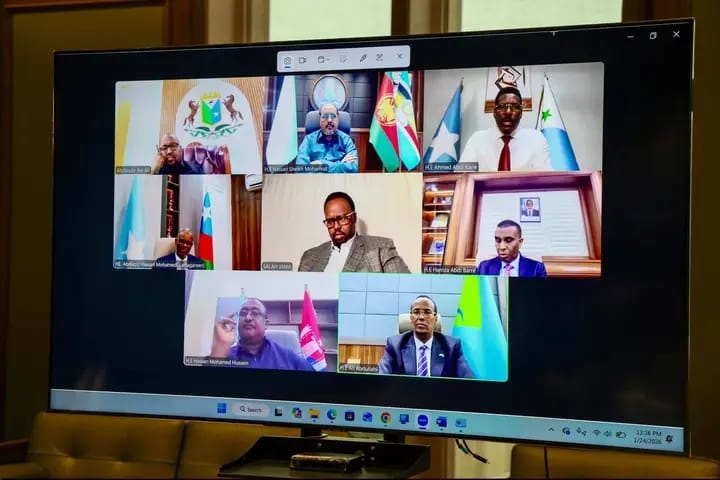
While the opposition council was meeting in Nairobi, the National Consultative Council convened virtually under the leadership of President Hassan Sheikh Mohamud, bringing together the Prime Minister, his deputy, the presidents of Galmudug, South West, Hirshabelle, SSC-Khaatumo (Waqooyi Barri), and the Governor of Banadir. Notably absent were Puntland and Jubaland an absence that speaks volumes about the fragmented nature of Somalia’s federal politics.
The resolutions issued by the National Consultative Council project confidence and institutional continuity. The council reaffirmed full support for the federal government’s constitutional mandate to protect Somalia’s sovereignty, unity, and territorial integrity. It praised the Banadir local council elections as a positive precedent and agreed to accelerate local government elections in federal member states. It welcomed the National Future Council’s acceptance of the February 1, 2026 national dialogue initiative, applauded recent military gains against Al-Shabaab, and called for urgent humanitarian intervention to address the drought. The council also expressed gratitude to international partners for supporting Somalia’s sovereignty.
On the surface, these resolutions present a picture of a government firmly in control, advancing democratization, security, and state authority. But beneath the official language lies a more complex reality. The Banadir local elections, while symbolically significant, remain controversial among opposition groups who argue that selective electoral processes risk entrenching political imbalance rather than building nationwide consensus. Similarly, accelerating local elections without resolving national-level disputes could further widen mistrust between Mogadishu and dissenting federal member states.
The contrasting tones of the two councils reveal Somalia’s core political dilemma, competing visions of legitimacy. The federal government derives legitimacy from institutional continuity, international recognition, and constitutional authority.
The opposition and certain regional leaders, on the other hand, emphasize consensual politics, federal balance, and the spirit rather than the letter of the provisional constitution.
Security and humanitarian issues further complicate the political landscape. While the government rightly highlights military gains against Al-Shabaab, the opposition warns that political fragmentation undermines long-term security gains. Both positions hold truth. Somalia’s fight against extremism cannot be sustained solely through military victories; it requires political cohesion, credible governance, and public trust. Likewise, the worsening drought crisis serves as a grim reminder that political elites are negotiating power while millions of citizens struggle for survival fueling public frustration and weakening faith in leadership across the board.
International actors remain deeply invested in Somalia’s stability, as reflected in the Consultative Council’s gratitude to the United Nations, African Union, IGAD, and other partners. Yet external support alone cannot resolve a crisis rooted in domestic political mistrust. Donors and allies may encourage dialogue, but the substance and sincerity of that dialogue must come from Somali leaders themselves.
Ultimately, the decision by the National Future Council to attend talks albeit conditionally opens a narrow but crucial window for de-escalation. Whether this window leads to genuine compromise or merely postpones confrontation will depend on the federal government’s willingness to pause unilateral actions and the opposition’s readiness to engage constructively beyond red lines.
Somalia’s future hinges on a simple but elusive principle, that no single actor can impose a political settlement on a divided nation. Dialogue, if reduced to a tactical maneuver, will fail. But if grounded in mutual restraint, constitutional consensus, and a shared recognition that national survival outweighs political advantage, it could mark a turning point away from crisis and toward cautious stability.
For a country long defined by cycles of collapse and recovery, the stakes could not be higher.