

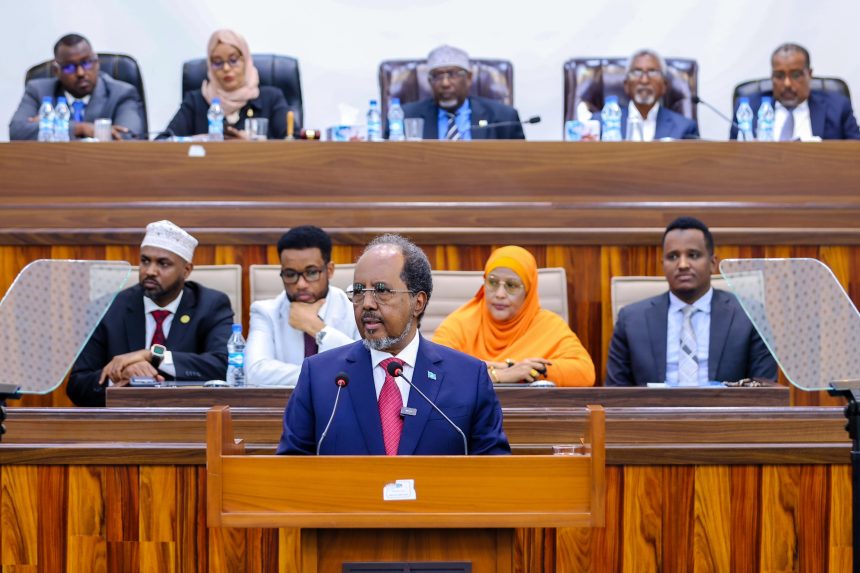
The chaos that erupted yesterday inside Somalia’s parliament did not occur in a political vacuum. It unfolded against one of the most unforgiving realities in politics: time. With President Hassan Sheikh Mohamud’s term nearing its end and roughly ninety days remaining, the confrontation between MPs and security forces over disputed constitutional amendments takes on a far sharper and more dangerous meaning. What might once have been framed as a contested reform process now looks increasingly like an endgame, where urgency, pressure, and shrinking political space collide.
This is what fundamentally changes the analysis. Constitutional reform pushed early in a term can be absorbed, debated, delayed, or renegotiated. Constitutional reform forced in the final stretch of a presidency is almost always interpreted as legacy-building or power-preservation. In Somalia’s fragile system, that perception alone is enough to ignite resistance.
Yesterday’s scenes MPs from Puntland and Jubaland blocked from entering parliament and allegations of explicit death threats by security forces suggest that political consent has been replaced by political compulsion. When the clock is ticking, compulsion becomes tempting, but it is also the most destabilizing option available.
President Hassan Sheikh Mohamud is now operating under extreme time pressure. Ninety days is not enough to rebuild trust, neutralize federal opposition, pass contested amendments, and ensure nationwide buy-in. That reality creates a strategic dilemma. Either he slows down and risks leaving office without completing a central pillar of his agenda, or he accelerates and risks detonating a constitutional crisis that could outlive his presidency. Yesterday’s chaos strongly suggests that the second path is already being tested.
Politically, the timing hands enormous leverage to opponents of the amendments. Federal member states and dissenting MPs know that the president’s bargaining power weakens with every passing week. They also know that any constitutional changes pushed through at the tail end of a term can be challenged, reversed, or ignored by the next administration. This reality undermines the credibility of the entire process. Even supporters of reform may quietly question whether changes made under such conditions are worth defending in the long run.
The exclusion of Puntland and Jubaland MPs is particularly significant in this late-stage context. These regions are not merely objecting to technical clauses; they are signaling that they do not recognize the political legitimacy of the process itself. In Somalia’s federal structure, legitimacy is everything. Without it, the federal government’s authority becomes geographic rather than national. If key regions disengage now, the president lacks both the time and the political capital to bring them back on board before his term ends.
The alleged use of security forces to manage this exclusion is where the crisis deepens. In a final-term scenario, the politicization of security institutions carries heavier consequences. It creates the impression that the state is being used to settle political timelines rather than national priorities. For MPs to publicly allege that police told them, “We will kill you, we will shoot you,” is not just an accusation of misconduct; it is an accusation that the state’s monopoly on force is being redirected inward, against constitutional actors. That perception alone can delegitimize any outcome achieved under such pressure.
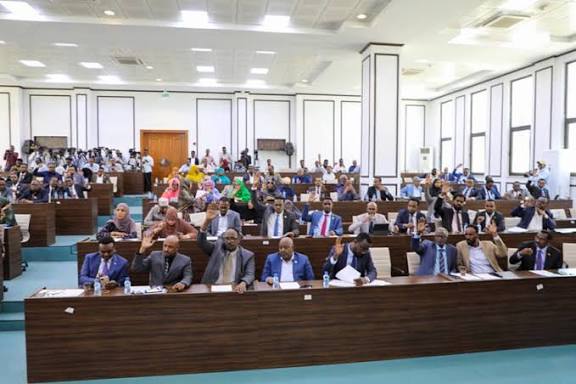
There is also a strategic risk that President Hassan Sheikh Mohamud may be underestimating: the next administration. Any president who inherits office after a contested, rushed amendment process will face strong incentives to distance themselves from it. In Somalia, political survival often depends on undoing the decisions of predecessors rather than defending them. If constitutional changes are passed amid chaos, exclusion, and coercion, they may become politically radioactive, easy to dismantle and impossible to institutionalize. In that sense, pushing forward now may secure a short-term procedural victory but guarantee a long-term political defeat.
International actors are unlikely to ignore the timing either. Somalia’s partners understand electoral cycles and end-of-term behavior. Moves made in the final ninety days are often scrutinized more harshly than those made earlier. While public statements may remain cautious, behind closed doors there will be serious concern about stability during a transition period. International partners prioritize predictability at the end of a term, not constitutional upheaval. If they conclude that the amendment process is increasing the risk of post-term instability, pressure for restraint will quietly but firmly increase.
Another layer of risk lies in public perception. Ordinary Somalis are less concerned with the technicalities of constitutional clauses than with stability, security, and economic survival.
Parliamentary chaos, MPs fighting police, and claims of death threats reinforce a sense that elite politics is disconnected from public needs. With elections or political transitions approaching, this perception matters. A president seeking to shape his legacy in the final months of office cannot afford to be remembered as the leader under whom parliament turned into a battleground.
There is also the danger of precedent. If constitutional amendments can be forced through under security lockdowns in the last stretch of a presidency, future leaders may adopt the same model. This would institutionalize crisis governance, where major national decisions are postponed until the final months and then imposed under pressure. Somalia’s political system, already fragile, may not survive repeated cycles of such brinkmanship.
Yet, the shrinking timeline also creates one final alternative: de-escalation. With only ninety days left, President Hassan Sheikh Mohamud could choose to lower the temperature rather than raise it. A pause, even a symbolic one, could shift the narrative from force to responsibility. While it may limit how much reform is achieved before his term ends, it could protect the legitimacy of the state and reduce the risk of post-term instability. In Somalia’s context, leaving office without triggering a constitutional rupture may itself be a form of leadership.
Yesterday’s chaos, when viewed through the lens of time, looks less like a random breakdown and more like a warning flare. The system is signaling that it cannot absorb this level of pressure so close to a political transition. Whether President Hassan Sheikh Mohamud interprets that signal as resistance to overcome or as a boundary not to cross will define not only the final chapter of his presidency, but the political terrain his successor will inherit.
With the clock ticking and political oxygen thinning, Somalia is not just debating constitutional amendments.
It is confronting a fundamental question: can power in its final days still be exercised with restraint, or does urgency inevitably turn reform into coercion? The answer will shape Somalia long after these ninety days are gone.