

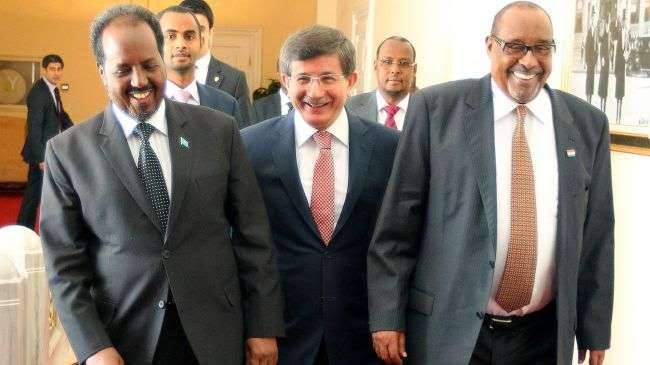
In one of the most explosive diplomatic revelations to emerge about Somalia’s post-war international politics, former Turkish Prime Minister Ahmet Davutoğlu has disclosed that the United Kingdom actively lobbied European and African diplomats to recognize Somaliland as an independent state during the 2012 London Conference on Somalia. According to Davutoğlu, this was not a marginal or informal suggestion, but a coordinated diplomatic effort led at the highest levels of British foreign policy one that, if successful, could have fundamentally altered the territorial and political future of Somalia.
Davutoğlu’s account casts new light on the London Conference, an event long portrayed as a turning point for Somalia’s recovery after two decades of state collapse. While publicly framed as a forum to rebuild Somali institutions, strengthen security, and coordinate international support, the former Turkish premier suggests that behind closed doors, a parallel agenda was unfolding one aimed at legitimizing Somaliland’s secession from Somalia.
At the heart of this effort, Davutoğlu says, was then British Foreign Secretary William Hague. Britain’s argument, as relayed by the former Turkish leader, was grounded in what might be called a “functional statehood” logic. Somaliland, Hague reportedly argued, possessed key attributes of a state: a functioning administration, its own security forces, an elected parliament, and a level of stability absent in much of southern and central Somalia at the time. From London’s perspective, these factors justified international recognition.
This reasoning was not entirely new. Since declaring independence in 1991 following the collapse of Siad Barre’s government, Somaliland has pursued a long campaign for international recognition, often emphasizing its relative peace, periodic elections, and institutional continuity. The UK, as the former colonial power in British Somaliland, has maintained close historical, political, and social ties with Hargeisa. Davutoğlu’s revelation, however, suggests that Britain went far beyond quiet sympathy and into active diplomatic lobbying at a moment when Somalia was exceptionally vulnerable.
What makes this disclosure particularly significant is Davutoğlu’s claim that Turkey intervened decisively and personally to stop the initiative. He recounts confronting William Hague directly during the conference, delivering a blunt warning that exposed what he viewed as the inconsistency and danger of Britain’s position. “We are bringing stability to Somalia,” Davutoğlu says he told Hague, “and you are trying to divide it.”
The Turkish leader then deployed a sharp diplomatic counterargument. If Britain’s criteria for recognition were based on the existence of an army, a parliament, and internal security, Davutoğlu argued, then London should first recognize the Turkish Republic of Northern Cyprus. The TRNC, recognized only by Turkey since its declaration in 1983, possesses all the same attributes cited in Somaliland’s case. Britain’s refusal to recognize Northern Cyprus, despite these features, exposed what Davutoğlu framed as a selective and politically motivated application of international law.
This comparison, he says, effectively stalled the British proposal. By drawing a parallel with Northern Cyprus a case deeply entangled in European politics, NATO sensitivities, and unresolved international disputes Davutoğlu forced the issue into uncomfortable territory for London. The message was clear: recognition is not merely a technical assessment of governance capacity, but a political act with far-reaching consequences, precedents, and contradictions.
Beyond the immediate exchange, Davutoğlu situates Turkey’s actions within a broader strategic philosophy toward Somalia. Since the early 2010s, Ankara has positioned itself as one of Somalia’s most influential external partners, combining humanitarian aid, development assistance, security cooperation, and high-level diplomacy. Turkey reopened its embassy in Mogadishu in 2011, hosted Somali leaders, invested in infrastructure, and trained Somali security forces. Central to this engagement, Davutoğlu emphasizes, was an unwavering commitment to Somalia’s unity and territorial integrity.
It was in this spirit, he says, that Turkey later facilitated direct talks between leaders from Somalia and Somaliland in Ankara and Istanbul in 2012 and 2013. These meetings did not aim to impose solutions, but to create a framework for dialogue, reduce tensions, and keep the question of Somaliland within a Somali-owned political process rather than an externally driven recognition campaign. While those talks ultimately failed to produce a lasting settlement, they underscored Turkey’s preference for mediation over fragmentation.
The implications of Davutoğlu’s revelations extend far beyond the events of 2012. They raise uncomfortable questions about the role of external powers in shaping Somalia’s political trajectory and about how close the country may have come to formal partition under international sponsorship. For many Somalis, the idea that recognition of Somaliland was seriously pushed at a global conference meant to “save Somalia” will reinforce long-held suspicions about foreign agendas in the Horn of Africa.
They also complicate the narrative of Somaliland’s quest for recognition. While Somaliland’s achievements in local governance and security are often cited as organic successes, Davutoğlu’s account suggests that at key moments, external actors may have sought to accelerate or legitimize secession for their own strategic reasons. This does not negate Somaliland’s internal dynamics or popular support for independence, but it highlights how international recognition is rarely a neutral process.
The timing of Davutoğlu’s disclosure is also critical. He has made these comments in the context of warning against what he describes as Israel’s potential recognition of Somaliland in late 2025. In his view, such a move would not be an isolated diplomatic decision, but part of a broader strategy to reshape regional alignments in the Red Sea and Horn of Africa. Recognition, he argues, can become a geopolitical tool one that fragments already fragile states, deepens rivalries, and redraws influence zones.
From this perspective, Somaliland is not merely a local Somali issue, but a node in a much larger regional contest involving Middle Eastern powers, global shipping lanes, security partnerships, and great-power competition. Davutoğlu’s warning suggests that Turkey continues to see Somalia’s unity as a stabilizing factor in a volatile region, and fragmentation as a gateway to prolonged instability.
Critically, these revelations also force a reassessment of the London Conference itself. Widely remembered as a symbol of renewed international commitment to Somalia, it now appears, through Davutoğlu’s lens, as a battleground of competing visions: one seeking to reconstruct a unified Somali state, and another willing to accept or even encourage formal separation as a solution to chronic instability. That Turkey and Britain stood on opposite sides of this divide underscores how deeply contested Somalia’s future has been among its supposed partners.
For Somalia, the lesson is sobering. Decisions about its territorial integrity were debated in rooms far from Mogadishu, by actors with their own histories, conflicts, and strategic calculations. The fact that recognition did not materialize owed less to international consensus than to the intervention of a single determined actor willing to challenge the logic and precedent behind it.
Ultimately, Davutoğlu’s account is not just a historical anecdote; it is a warning. It suggests that the question of Somaliland’s recognition has never been settled, only postponed, and that external pressures can resurface whenever regional or global interests shift. For Somalis, it underscores the importance of internal political cohesion and dialogue, lest decisions about their country’s future once again be shaped more by foreign bargaining than by Somali consensus.
In revealing how close Somalia came to an internationally backed partition in 2012, Davutoğlu has reopened a chapter many assumed was closed. Whether his account will prompt deeper scrutiny of past diplomacy or influence current debates about recognition and unity remains to be seen.
But one thing is clear: the struggle over Somalia’s territorial future has never been solely a Somali affair, and the forces that once pushed to redraw its map are still watching, waiting for the next opportunity.