

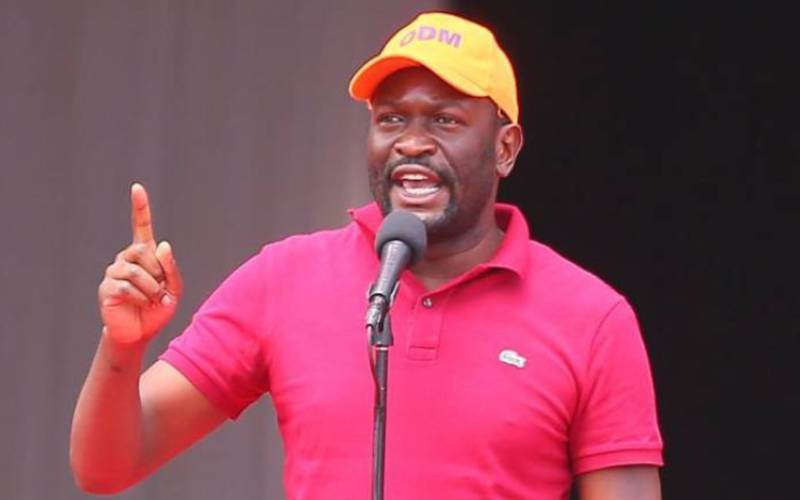
During an extensive interview with Citizen TV’s Yvonne Okwara, Edwin Sifuna, the Secretary-General of the Orange Democratic Movement (ODM), provided candid insights into his political philosophy, party dynamics, and the broader Kenyan political landscape. He discussed the challenges of leadership, party loyalty, and the strategic choices facing ODM.
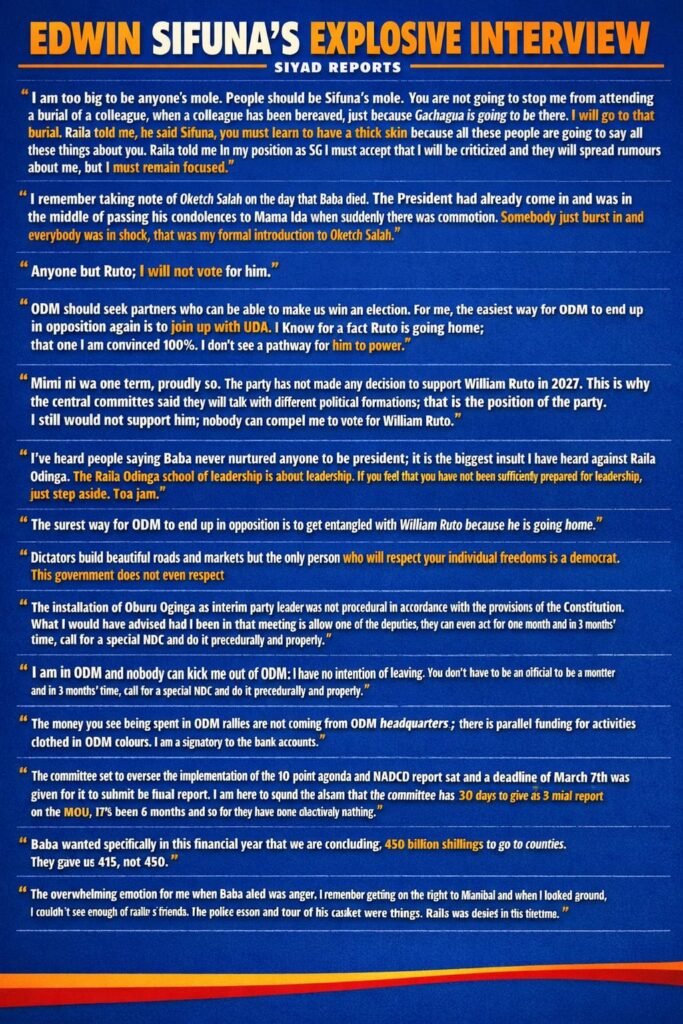
Addressing allegations of being a “Gachagua mole,” Sifuna made clear his commitment to personal integrity and independence, emphasizing that political rumors should not dictate his actions. He stated: “I am too big to be anyone’s mole. People should be Sifuna’s mole. You are not going to stop me from attending a burial of a colleague, when a colleague has been bereaved, just because Gachagua is going to be there. I will go to that burial. Raila told me, he said Sifuna, you must learn to have a thick skin because all these people are going to say all these things about you. Raila told me in my position as SG I must accept that I will be criticized and they will spread rumours about me, but I must remain focused.” This highlights his view that loyalty to colleagues and adherence to moral principles are paramount in political life.
Reflecting on an encounter with Oketch Salah during a funeral, Sifuna illustrated the unexpected moments that define political experiences: “I remember taking note of Oketch Salah on the day that Baba died. The President had already come in and was in the middle of passing his condolences to Mama Ida when suddenly there was commotion. Somebody just burst in and everybody was in shock, that was my formal introduction to Oketch Salah.” His narrative underscores the unpredictable nature of political engagements and their impact on professional relationships.
When discussing presidential preference, Sifuna was decisive, demonstrating his willingness to take a public stand: “Anyone but Ruto; I will not vote for him.” He elaborated on the importance of strategic alliances for ODM’s electoral success: “ODM should seek partners who can be able to make us win an election. For me, the easiest way for ODM to end up in opposition again is to join up with UDA. I know for a fact Ruto is going home; that one I am convinced 100%. I don’t see a pathway for him to power.” He further clarified his personal conviction aligned with party decisions: “Mimi ni wa one term, proudly so. The party has not made any decision to support William Ruto in 2027. This is why the central committee said they will talk with different political formations; that is the position of the party. I still would not support him; nobody can compel me to vote for William Ruto. I simply do not see a path to power for William Ruto.” This demonstrates the tension between personal judgment and collective party strategy.
Sifuna emphasized that the Secretary-General’s role is primarily strategic rather than ceremonial. He explained: “There is no requirement on the SG to attend all those rallies. The party leader has the freedom to be able to consult party members to meet delegates in the counties. If he asks me to join him, I will join him. I require to be involved to have information about where we are going tomorrow. I was not involved, I was not invited and I was not informed. I saw them on the media the way that you saw them.” His explanation highlights the necessity of clear communication and coordination within party structures.
On leadership development, Sifuna defended Raila Odinga’s legacy and ODM’s approach to nurturing leaders: “I’ve heard people saying Baba never nurtured anyone to be president; it is the biggest insult I have heard against Raila Odinga. The Raila Odinga school of leadership is about leadership. If you feel that you have not been sufficiently prepared for leadership, just step aside. Toa jam.” He underlines the principle that aspiring leaders must actively prepare themselves rather than relying entirely on mentorship.
Sifuna warned against aligning ODM with William Ruto, arguing that such a move could weaken the party: “The surest way for ODM to end up in opposition is to get entangled with William Ruto because he is going home.” He further stressed the importance of strategic foresight in safeguarding the party’s political future.
On succession and party positions, Sifuna highlighted merit over entitlement: “It is okay. There is nowhere it is written that Sifuna can be the only one who is SG. I have said that I have predecessors, people who have done this job; I have young people in ODM who, I know for a fact, if they are given the opportunity, they can do this job even better than Sifuna or all the other SGs that have served before. It is not anyone’s birthright to be SG or to be any position in the party.” This reinforces the importance of preparing capable future leaders.
Sifuna criticized the government’s approach to democracy, arguing that true leadership requires respect for individual freedoms: “Dictators build beautiful roads and markets but the only person who will respect your individual freedoms is a democrat. This government does not even respect court orders.” His commentary frames the tension between development and civil liberties in Kenya.
On internal party procedures, Sifuna questioned the legitimacy of Oburu Oginga’s installation as interim leader: “The installation of Oburu Oginga as interim party leader was not procedural in accordance with the provisions of the Constitution. What I would have advised had I been in that meeting is allow one of the deputies they can even act for one month and in 3 months’ time, call for a special NDC and do it procedurally and properly. I was not in that meeting because I was going to fetch my party leader to bring Baba back home. I don’t think anybody considers me important enough to be waited upon and they have their reasons why they did it in the manner they did.” He clarified his absence further: “The public needs to be reminded that I was not part of that meeting that installed Oburu as interim party leader. When Baba died, many people saw me at State House when the official announcement was being made. I was wearing an ODM t-shirt because that same day we were supposed to go to Kajiado. In the morning, I wake up and it is one of the most shocking things, I saw a message saying Amollo has left us. It was quite shocking because I had spoken with Mzee the previous day. I was not in the initial plan to travel to Mumbai.” These statements reveal the emotional and procedural complexities within ODM.
He addressed misrepresentation of ODM’s relationship with UDA: “The posturing we see from some of the leadership in ODM in public is as if the UDA marriage has already been settled upon. Our expectation was that the party would talk to different political formations.” He reaffirmed his loyalty: “I am in ODM and nobody can kick me out of ODM; I have no intention of leaving. You don’t have to be an official to be a member of the party.” This emphasizes his commitment to party unity and principle.
On corruption and resource management, Sifuna highlighted ongoing concerns: “Many of us miss Raila; it is just that sometimes we do not know what to do. I was supposed to be in Turkana with the energy committee this week because we are doing public participation on this so-called Field Development Plan (FDP). I want to tell Kenyans that this is going to be the biggest corruption scandal Kenya has ever seen. There are so many things that point to obvious corruption in that deal, and I can assure you, if we do not fight that particular issue, Kenya is not going to see a single shilling of that oil.” He criticized the politicization of public programs: “Can the committee on MoU stop wasting our time and public resources. We do not need benchmarking tours for us not to kill our children. When we went to the streets in 2023 with Baba, and by the way, many of these people who are speaking here, I never saw them in the streets with Raila, but these days they are the experts on how maandamano is a bad thing or a good thing. We are in a situation where they even teargas churches; these days, they don’t even respect our freedom of worship, that I am not safe in church. It is not just a specific leader, I know they talk about Gachagua and his incidents.”
He clarified the MoU’s implications for ODM: “This MoU is not what birthed the broad-based government. This document in fact says that it is not the basis of the formation of a coalition with UDA but they conflate issues and use this document as an excuse for the broad-based government existence. The Raila Odinga that I knew would never wish the worst even on his own worst enemy. Raila Odinga, in power or in cooperation with a party in power, would not allow the teargassing of the devil in church. You can call out Rigathi’s hypocrisy when he was in power, but that does not make it right that now, because he is outside of power, it is okay for him to be teargassed in church. They have turned into the Rigathi Gachagua’s of today; they are the ones speaking the language of shares now because they have tasted government power.”
He further exposed financial discrepancies: “The money you see being spent in ODM rallies are not coming from ODM headquarters; there is parallel funding for activities clothed in ODM colours. I am a signatory to the bank accounts and the last money we expended officially was for the celebrations in Mombasa and it was a fraction of what we saw there.” He also criticized state opulence: “This is the problem that got us into the 2024 quagmire in the first place. I have given you the example of Kindiki and his private jets. Should we still be seeing such opulence in government? We are being told that State House runs through its budget of mandazi and soda way before the financial year closes. Have killings stopped? I have counted upwards of 20 young people killed by this regime after signing this document (MOU). The NYOTA programme is an abuse of public resources. How can you turn the distribution of these resources, funded by the World Bank, and turn them into UDA rallies? How can you do that and nobody is saying anything about it?”
Sifuna highlighted delays and funding shortfalls: “The committee set to oversee the implementation of the 10-point agenda and NADCO report sat and a deadline of March 7th was given for it to submit its final report. I am here to sound the alarm that the committee has 30 days to give us a final report on the MoU. It’s been 6 months and so far they have done absolutely nothing.” On county allocations: “Baba wanted specifically in this financial year that we are concluding, 450 billion shillings to go to counties. They gave us 415, not 450. As a senator, I can tell you, there was a time when the regime was making a lot of noise, saying they were up to date with remittances. Counties are struggling and then they are telling us they are supporting devolution.”
Reflecting on Raila Odinga’s death, Sifuna said: “The overwhelming emotion for me when Baba died was anger. I remember getting on the flight to Mumbai and when I looked around, I couldn’t see enough of Raila’s friends. The police escort and tour of his casket were things Raila was denied in his lifetime. Raila and I used to drape coffins of people in party colours but they didn’t allow us to drape him in party colours. Nothing prepared anyone for the death of Raila. There are no protocols to mourn a man of Raila’s stature. It hit everybody hard. For me, even just getting to Mumbai, it was crazy. I feel that the state mismanaged the arrival of the body of Raila Odinga. At the airport, I feel that if there were a public address system and the leadership of the party were there to calm the people down. The deaths in Kasarani broke my heart because they were very avoidable.”
On alliances within ODM: “We are members of the same party. Politics can be very lonely. I have lost a lot of friends; these people that you see were my friends, and we used to spend a lot of time together. When all of these friends of yours instantly start to sing a different tune, you need to look for comrades, people who see things from the same perspective as you. That does not necessarily mean there is a working arrangement.”
Edwin Sifuna maintains a firm stance within ODM, resisting alliances with UDA that could compromise the party’s position. His emphasis on procedural integrity, strategic alliances, and party unity highlights the ongoing internal wrangles within ODM. The party’s future depends on clear leadership succession, principled decision-making, and maintaining independence in coalition choices to safeguard its political relevance in Kenya.