

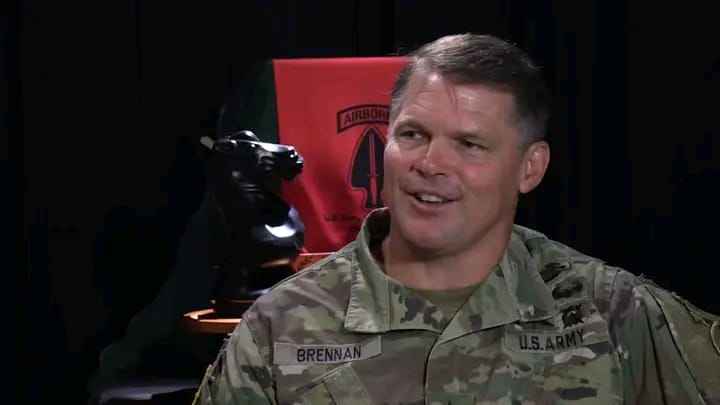
For the first time in recent history, the United States has openly linked its military operations in Somalia to economic opportunities, specifically the extraction of natural resources off the Somali coast. This revelation, reported by Fox News and attributed to General John Brennan, the second-highest-ranking officer at U.S. Africa Command (AFRICOM), marks a significant shift in the narrative surrounding U.S. involvement in Somalia. Historically framed as a counterterrorism mission against al-Shabaab and other extremist groups, U.S. military engagement in Somalia now appears increasingly intertwined with economic and strategic considerations.
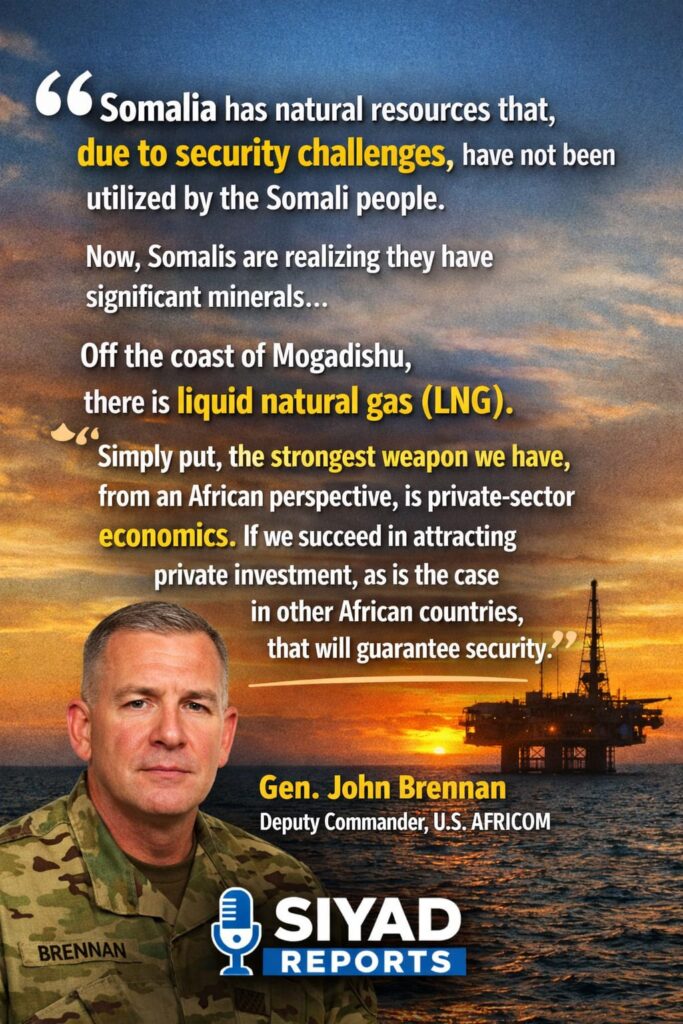
General Brennan stated, “Somalia has natural resources that, due to security challenges, have not been utilized by the Somali people. Now, Somalis are realizing they have significant minerals,Off the coast of Mogadishu, there is liquid natural gas (LNG). Simply put, the strongest weapon we have, from an African perspective, is private-sector economics. If we succeed in attracting private investment, as is the case in other African countries, that will guarantee security.” This statement is remarkable not only for its candid acknowledgment of U.S. economic interests but also for the explicit framing of military operations as a vehicle for enabling private-sector investment.
The U.S. military has maintained a presence in Somalia for decades, often under the justification of counterterrorism, regional stability, and humanitarian assistance. The country has faced protracted political instability, armed insurgencies, and persistent threats from extremist groups like al-Shabaab. U.S. operations have ranged from drone strikes and special forces raids to logistical support for Somali security forces. Until now, discussions about these operations rarely emphasized economic incentives or resource security.
Brennan’s comments signal a clear acknowledgment that Somalia’s natural resources, particularly offshore LNG reserves, are an underlying motivation for U.S. involvement. This is consistent with broader trends in U.S. foreign policy, where strategic military engagement often overlaps with economic interests. Africa, with its abundant natural resources, remains a region where geopolitics and economics are deeply intertwined. By linking military operations to private-sector investment, the U.S. positions itself to leverage security assistance as a gateway to economic influence.
Offshore Somalia has long been suspected to contain substantial energy resources, including oil and gas. These potential reserves have been difficult to exploit due to security challenges, a lack of infrastructure, and political instability. Brennan’s comments suggest that the U.S. recognizes both the strategic and economic value of these resources, and that military presence is partly aimed at creating the conditions for investment. In other words, military power is being framed as an instrument not only for counterterrorism but also for securing access to energy resources.
Liquid natural gas (LNG) is one of the most lucrative and strategically significant energy commodities in the global market. Countries with access to LNG reserves have the potential to transform their economies, attract foreign investment, and gain geopolitical leverage. For Somalia, the discovery and potential exploitation of LNG could be transformative. According to industry analysts, offshore Somali LNG reserves could rival those of neighboring East African states like Mozambique and Tanzania, which have already attracted billions of dollars in foreign investment.
However, these opportunities are not without challenges. Political instability, governance deficits, and ongoing security threats have historically limited Somalia’s ability to develop and profit from its natural resources. Brennan’s comments highlight this gap: “Due to security challenges, these resources have not been utilized by the Somali people.” This implies that stabilizing the security situation is a prerequisite for economic development and, notably, that U.S. military operations are being used to create precisely that environment.
If foreign investors, particularly private-sector entities from the U.S. and allied nations, are to engage in LNG extraction in Somalia, the presence of a stabilizing security force becomes a critical factor. Brennan’s framing equates economic development with security provision, suggesting that U.S. intervention serves dual purposes: curbing extremist threats and ensuring the conditions for profitable resource extraction.
Brennan’s assertion that “the strongest weapon we have, from an African perspective, is private-sector economics” reflects a broader strategic doctrine that economic influence can be as powerful as military force in securing geopolitical interests. In this framework, investment, trade, and economic development are not only tools for promoting prosperity but also mechanisms for ensuring stability and allegiance.
In Somalia, this approach could have several implications. First, it positions the U.S. as both a security provider and an economic partner, potentially shaping the Somali government’s policies and strategic decisions. Second, it could shift local power dynamics, as access to investment and economic opportunities may become linked to political alignment with U.S. interests. Third, it raises ethical and political questions about sovereignty and the control of national resources, particularly if foreign military presence is justified in part by the desire to protect commercial interests.
Historically, foreign intervention in resource-rich but politically unstable countries has often led to a complex mix of economic development, political leverage, and, at times, local resentment. Somalia could face similar dynamics if LNG extraction becomes a focal point for foreign investment backed by military security.
The U.S. interest in Somali LNG must also be understood within the context of global energy markets and regional geopolitics. Energy security is a key component of U.S. foreign policy, and securing access to LNG reserves in East Africa could diversify supply chains and reduce dependence on traditional sources in the Middle East. Additionally, the U.S. may perceive a strategic advantage in preempting other regional or global powers from dominating Somali energy resources.
China, for instance, has invested heavily in East African infrastructure and energy projects, creating a competitive environment for foreign influence. Russia and Gulf states have also shown interest in the region. U.S. military and economic engagement in Somalia may thus serve multiple purposes: counterterrorism, securing LNG resources, and maintaining geopolitical leverage vis-à-vis other global actors.
Brennan’s comments raise questions about the ethical implications of linking military operations to economic opportunities. While promoting security and investment can benefit Somalia’s development, framing foreign military engagement as a means to secure natural resources for private-sector gain may be perceived as neo-colonial or exploitative. The Somali government, local communities, and international observers may scrutinize whether U.S. military presence genuinely prioritizes Somali interests or primarily serves foreign economic and strategic goals.
Furthermore, the potential for resource-driven conflict cannot be ignored. Control over LNG reserves could become a source of tension among political factions, local militias, and foreign actors. Ensuring that the benefits of resource extraction accrue to Somali citizens, rather than being siphoned off by external actors, will require careful governance, transparency, and robust legal frameworks.
General John Brennan’s statement represents a rare and candid acknowledgment that U.S. military operations in Somalia are influenced not only by counterterrorism objectives but also by the strategic and economic potential of Somali natural resources. By framing private-sector investment as a “weapon” for security, Brennan highlights a broader doctrine in which economic influence and military power are deeply interconnected.
The implications of this approach are far-reaching. While the prospect of LNG extraction offers transformative economic potential for Somalia, it also introduces complex political, ethical, and security considerations. Balancing foreign investment with national sovereignty, ensuring that local communities benefit, and preventing resource-driven conflict will be critical challenges in the years ahead.
As Somalia continues to navigate its path toward stability and development, the international community must carefully examine the interplay between military engagement, economic ambition, and national sovereignty. The U.S. involvement, as articulated by Brennan, underscores a new chapter in Somalia’s engagement with global powers one in which security, economics, and geopolitics are inseparable, and the stakes for both Somali citizens and foreign actors are extraordinarily high.