

For decades, Wajir County symbolized the historical marginalisation of Northern Kenya a region long defined by limited infrastructure, chronic drought vulnerability, and systemic exclusion from major national milestones. But during President William Samoei Ruto’s development tour, that narrative appeared to shift dramatically as the Head of State announced that Kenya’s 2026 Madaraka Day celebrations will be hosted in Wajir County, marking the first time a national holiday will be commemorated in the Northern Frontier region.
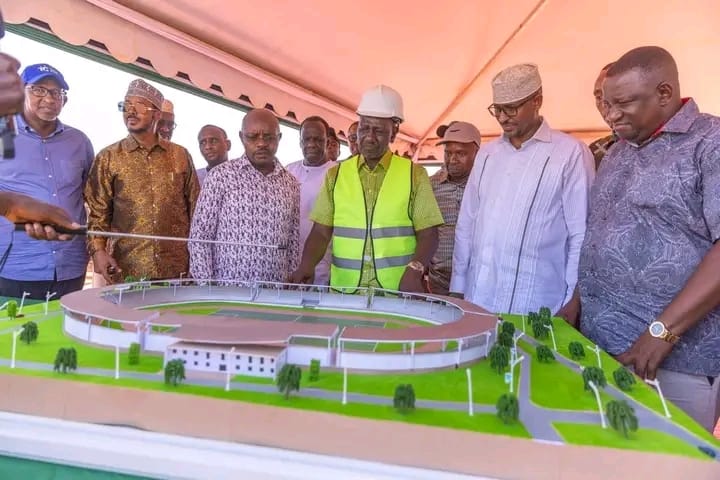
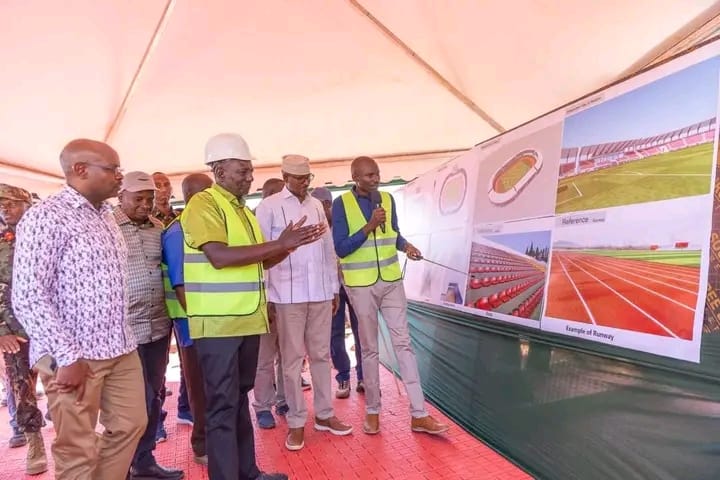
Speaking during the disbursement of funds under the national NYOTA youth empowerment programme, President Ruto declared Wajir’s symbolic elevation to the national stage while officiating the groundbreaking ceremony of a 10,000-seater modern stadium, which will serve as the venue for the historic celebration.
“Today I am officiating the groundbreaking ceremony for the construction of Wajir Stadium, which will serve as the venue for the national event,” President Ruto announced, emphasizing that the move reflects the government’s commitment to inclusivity and equal development across the country.
The President framed the decision as a deliberate effort to dismantle regional disparities that have persisted since independence. He reiterated that national celebrations must rotate across regions to reflect unity and equal citizenship.
“This will be the first time we celebrate Madaraka Day in Northern Kenya. Every Kenyan is equal and every part of this country deserves recognition and development,” he said.
A Turning Point for Wajir’s Development Trajectory
Beyond symbolism, the President unveiled an expansive development agenda for Wajir County, positioning the region as a growing economic and infrastructural hub within Kenya’s northern corridor.
Central to the government’s strategy is the construction of the KSh 900 million Wajir Stadium, expected to catalyse economic growth through sports tourism, youth engagement, and national events hosting. The stadium is envisioned not merely as a sports facility but as a statement of state presence in a region historically sidelined from large-scale public investment.
President Ruto’s visit also highlighted the nationwide NYOTA Project, a flagship youth empowerment programme aimed at nurturing entrepreneurship among young Kenyans. In Wajir alone, KSh 63 million was disbursed to 2,520 youth entrepreneurs, with each beneficiary receiving KSh 50,000 in phased financial support.
“We concluded the national roll-out of NYOTA’s Business Start-Up Capital component with the disbursement of KSh 63 million to 2,520 beneficiaries in Wajir County,” the President announced.
He further revealed that 121,800 beneficiaries across the country have already received KSh 2.5 billion, marking one of Kenya’s largest youth financing programmes.
“In the coming weeks, each beneficiary will receive an additional KSh 25,000, bringing the total allocation to KSh 50,000 for each young entrepreneur,” he added, noting that beneficiaries would also receive structured mentorship for six months and access to affordable credit facilities to ensure business sustainability.
The government’s development blueprint for Wajir extends beyond youth empowerment to critical infrastructure expansion. Among the flagship projects is the planned integration of Wajir into the national electricity grid through a transmission line from Ethiopia, an initiative designed to end decades of unreliable power supply.
As a transitional solution, the government pledged to install a 300-megawatt power generator to stabilize electricity availability across the county.
Additionally, the President highlighted significant investment in road infrastructure, including the strategic 750-kilometre Isiolo-Wajir-Mandera highway, which aims to improve connectivity between Northern Kenya and the rest of the country. Plans are also underway to upgrade approximately 1,000 kilometres of roads to bitumen standards, enhancing trade, mobility, and regional integration.
Healthcare expansion also formed a key pillar of the President’s visit, with the government committing to the construction and equipping of the Wajir County Teaching and Referral Hospital, which is expected to transform access to specialized medical services for residents.
Meanwhile, the ongoing expansion of Wajir Airport and the formalization of the Wajir Airbase were presented as part of a broader national security and economic connectivity strategy aimed at strengthening Kenya’s northern aviation infrastructure.
President Ruto also revealed that the government had allocated over KSh 10 billion for drought mitigation programmes nationwide within the last three months, underscoring efforts to protect pastoral livelihoods in arid and semi-arid regions.
“We will continue scaling up our interventions to safeguard lives, protect livelihoods, and preserve livestock in the most affected regions,” he said.
Wajir Governor Ahmed Abdullahi described the President’s visit as a historic moment for the county and the wider Northern Kenya region. Reflecting on decades of perceived neglect, the governor linked the current development wave to the reversal of policies that previously undermined the region’s growth.
“For the last sixty years, no president of the Republic of Kenya has ever addressed a national holiday from Northern Kenya,” the governor said while thanking the President for selecting Wajir as the Madaraka Day host.
He further referenced Kenya’s Sessional Paper No. 10 of 1965, widely criticized for prioritizing development in already productive regions while sidelining arid areas.
“The things you are doing in Northern Kenya the roads, electricity, airport and development projects are reversing sixty years of marginalisation,” Governor Abdullahi said.
The governor specifically highlighted road construction projects connecting remote communities as transformative interventions that could redefine economic access and social integration across Wajir.
As preparations begin for the historic Madaraka Day celebrations, analysts view the event as both a political and developmental milestone that could reshape perceptions of Northern Kenya’s role in the country’s national identity.
For Wajir residents, the hosting of a national celebration represents more than ceremonial recognition. It signals the gradual dismantling of structural inequalities that have historically isolated the region from mainstream national development.