

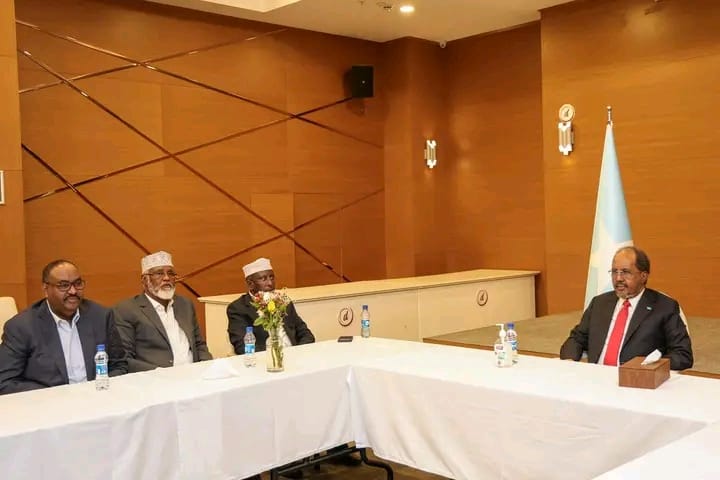
Somalia has entered one of the most delicate political moments in its recent history, as President Hassan Sheikh Mohamud convened a series of high-level meetings in Mogadishu with key opposition figures and regional leaders who had previously cut ties with the Federal Government.
At the center of the renewed engagement are Puntland President Said Abdullahi Deni and Jubbaland President Ahmed Mohamed Islam, widely known as Ahmed Madobe. Both leaders have been at odds with Villa Somalia over constitutional reforms, electoral models, and questions of political legitimacy. The talks, hosted at the Decale Hotel near Aden Adde International Airport, are being described by officials as preparatory discussions ahead of broader national political negotiations.
The timing is critical. The meeting comes just three months before President Hassan Sheikh’s four-year term comes to an end, placing enormous political weight on the outcome of these discussions. For Somalia, the stakes extend beyond political optics they touch the core of federalism, electoral reform, and national stability.
The Political Crisis: From Constitutional Amendments to Armed Confrontation
The roots of the current tensions stretch back to March 2024, when Puntland formally withdrew recognition and confidence in federal institutions after Parliament approved amendments to the first four chapters of Somalia’s provisional constitution. President Deni argued that the amendments were passed without broad national consensus and risked concentrating power at the center, weakening the federal structure.
From Puntland’s perspective, the constitutional changes altered foundational governance arrangements without inclusive consultation.
From Villa Somalia’s standpoint, reform was necessary to modernize the political system and advance Somalia toward universal suffrage elections.
This disagreement hardened into a political standoff.
In Jubbaland, tensions escalated even further. In November 2024, Jubbaland re-elected President Ahmed Madobe. The Federal Government rejected the re-election process, citing procedural concerns. By December 2024, the dispute had transformed into armed clashes in Ras Kamboni after federal forces, led by Prime Minister Hamza Abdi Barre, intervened following Mogadishu’s rejection of the outcome.
The Ras Kamboni confrontation marked one of the most serious breakdowns in federal-state relations in recent years. It demonstrated how quickly political disagreements in Somalia can evolve into security crises.
That history gives the current talks added significance. The same leaders who were locked in confrontation are now seated at the same table.
The choice of venue itself became symbolic of mistrust. President Hassan Sheikh proposed holding formal talks at Villa Somalia, the presidential complex. However, Deni and Madobe preferred the Halane secured zone, citing neutrality and security considerations. The disagreement over venue delayed the dialogue for seven days before sources confirmed that the regional leaders agreed to hold upcoming talks at Villa Somalia a small but important confidence-building measure.
The working lunch at the Decale Hotel brought together leaders affiliated with the Somalia Future Council, an opposition-aligned political bloc that has positioned itself as a key stakeholder in the ongoing negotiations. Technical committees from both sides had previously met to develop an agenda, signaling that discussions are moving beyond symbolic gestures toward structured political engagement.
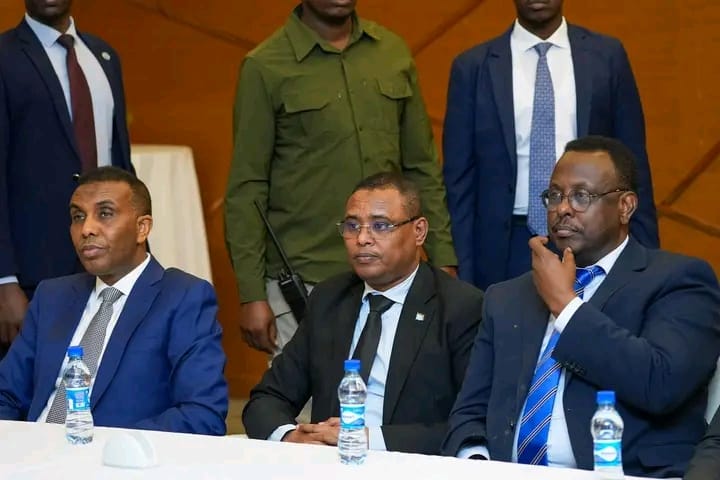
Key issues expected to dominate negotiations include the electoral framework, the timeline for constitutional reforms, federal-state power distribution, and dispute resolution mechanisms. At the center of all of this lies the question of Somalia’s next electoral model.
President Hassan Sheikh has been pushing for a transition toward universal suffrage — moving away from the indirect clan-based system that has defined Somalia’s political process for decades. Opposition figures and regional leaders, however, have raised concerns over feasibility, preparedness, and political fairness.
They argue that institutional capacity, voter registration systems, and security arrangements may not yet support a nationwide one-person-one-vote election within the proposed timeframe. Some fear that rushed implementation could deepen divisions rather than resolve them.
Prime Minister Hamza Abdi Barre’s role in this phase is particularly delicate. Having led federal forces during the Ras Kamboni crisis, he now finds himself mediating reconciliation with Puntland and Jubbaland leadership. Reports indicate that he held separate late-night discussions with Deni and Madobe at their Mogadishu residence, contributing to the breakthrough over the venue dispute.
His involvement reflects a coordinated federal effort to stabilize relations ahead of the political transition.
International actors are closely monitoring developments. The European Union welcomed the start of talks, with EU envoy Francesca Di Mauro urging all sides to act in good faith. For international partners, political stability is directly tied to ongoing security cooperation, economic reform programs, and financial support.
What Is at Stake as the 2026 Transition Nears
With only months remaining before the end of the president’s term, Somalia faces a narrowing window to achieve consensus.
For President Hassan Sheikh Mohamud, securing a broad political agreement would strengthen his legacy as a reformer and stabilizer. Failure, however, could leave Somalia entering a new electoral cycle without a unified framework a scenario that has historically led to prolonged political uncertainty.
For President Deni, participation in the dialogue allows Puntland to defend its autonomy while avoiding political isolation. It reinforces Puntland’s role as a decisive national actor rather than a peripheral critic.
For President Ahmed Madobe, engagement offers an opportunity to reset relations with Mogadishu after months of tension and to reaffirm Jubbaland’s legitimacy within the federal structure.
For Prime Minister Hamza Abdi Barre, effective mediation could enhance his national stature as a bridge-builder capable of navigating Somalia’s complex political landscape.
The coming weeks will determine whether the talks at Villa Somalia evolve into a formal negotiation process with written agreements and clear timelines, or whether they remain preliminary engagements.
Somalia’s recent history has shown that dialogue alone is not enough; implementation and sustained trust are essential. Yet even in a political environment marked by deep mistrust, the fact that federal and regional leaders are engaging directly is significant.
The image of former rivals sitting together in Mogadishu sends a message that political confrontation has limits and that compromise, however difficult, is still possible.
As Somalia approaches another critical transition, the choices made in these meetings may shape not only the next election, but the future balance between federal authority and regional autonomy.
For now, dialogue has replaced confrontation.
Whether it produces lasting political stability remains the defining question for Somalia’s leaders and for the country’s future.