

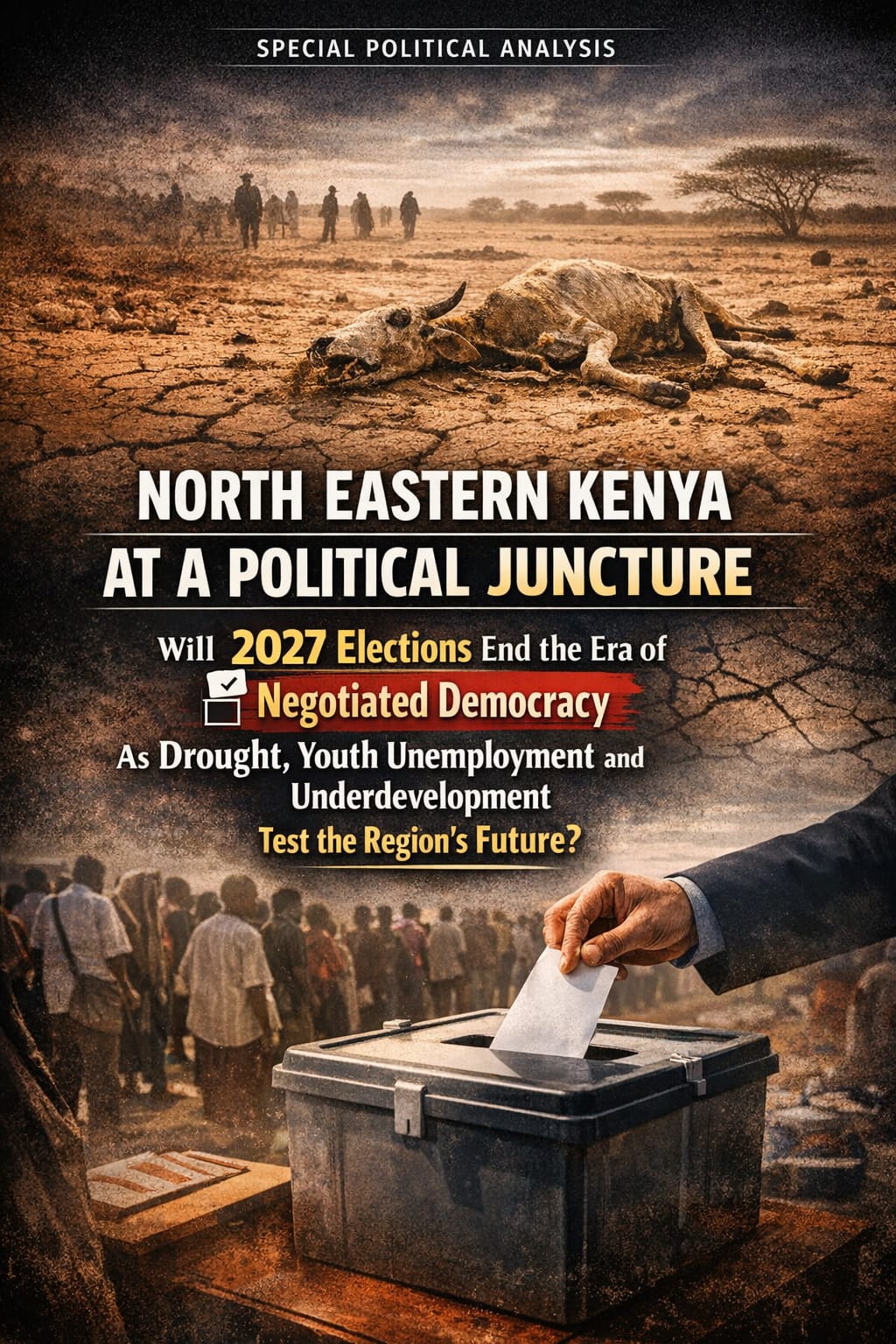
Barely eighteen months to Kenya’s next General Election, political temperatures are already rising across North Eastern Kenya. In counties such as Garissa County, Wajir County and Mandera County, clan elders are meeting quietly in rural villages and bustling town centres alike, negotiating power-sharing formulas long before the Independent Electoral and Boundaries Commission declares the official campaign period open. Endorsements are being crafted, alliances sealed, and political ambitions either elevated or extinguished not through party primaries or competitive public debates, but through the enduring model popularly known as “negotiated democracy.”
For decades, negotiated democracy has shaped the region’s electoral politics. It is a system built on consensus among clan elders, where communities agree to field a single candidate for a given seat to avoid splitting votes and risking defeat. In theory, it reduces political violence, minimizes costly campaigns, and preserves communal harmony.
In practice, however, it has increasingly raised fundamental questions about representation, accountability, generational equity and development outcomes.
As drought tightens its grip once again on the arid and semi-arid lands, as youth unemployment deepens, and as infrastructure gaps persist despite years of devolution, a growing number of voices are beginning to ask a difficult question, is it time for North Eastern Kenya to move beyond negotiated democracy?
The region’s history cannot be divorced from its political culture. Marginalization dating back to the post-independence era, the legacy of security operations, and decades of limited state investment shaped a society that relied heavily on internal cohesion for survival.
Clan structures became not only social safety nets but also political vehicles. When multiparty politics intensified competition across Kenya in the 1990s and 2000s, North Eastern leaders often argued that negotiated democracy was a rational adaptation preventing chaotic contests that could inflame clan tensions.
Supporters of the model point to its stabilizing effect. Compared to other parts of the country that have experienced violent electoral clashes, North Eastern counties have largely maintained relative calm during elections. By agreeing on candidates in advance, communities avoid divisive campaigns. The cost of running for office is also lowered.
Instead of spending millions of shillings on rallies, posters and mobilization, candidates invest in consensus-building meetings with elders.
Yet stability alone cannot be the sole measure of democratic health.
The deeper question is whether negotiated democracy has delivered tangible development outcomes for ordinary citizens.
After more than a decade of devolution, counties in North Eastern Kenya still rank among the most underdeveloped in the country. Road networks remain poor, access to clean water is limited, health facilities are overstretched, and education indicators lag behind national averages. Recurrent droughts continue to devastate pastoralist livelihoods, with climate change compounding the crisis.
The current drought cycle underscores this vulnerability. Livestock deaths have wiped out household wealth. Water trucking has become a recurring emergency measure rather than a temporary intervention. Food insecurity remains high. Despite early warning systems and national government pledges, responses often appear reactive rather than preventive. In such a context, the performance of elected leaders comes under scrutiny.
Critics argue that negotiated democracy weakens accountability. When leaders are selected through elite agreements rather than competitive contests, their primary obligation may tilt toward the elders who endorsed them rather than the broader electorate.
Voters are often presented with a “community candidate” and are socially pressured to support that individual in the name of unity. Dissenting voices, particularly among youth and women, can be sidelined.
Moreover, the absence of robust competition can dampen policy debates. Campaign periods elsewhere in Kenya often feature intense public scrutiny of development records, manifesto promises and ideological differences. In contrast, in negotiated setups, political discourse may focus more on clan arithmetic whose “turn” it is to hold a seat than on concrete plans for water infrastructure, drought resilience or economic diversification.
The concept of rotational leadershipwhere major clans take turns occupying key positions has become particularly entrenched. While this formula seeks fairness among communities, it can inadvertently sideline meritocracy. Capable individuals may be locked out because their clan’s “turn” has not arrived.
Conversely, individuals with limited administrative experience may ascend to office because of clan entitlement rather than demonstrated competence.
This dynamic also affects political parties. National parties often have limited influence in determining candidates in North Eastern Kenya. Once elders agree on a name, parties line up to issue tickets, effectively rubber-stamping local deals.
As a result, party ideology and national policy frameworks play a minimal role in shaping campaigns. The region’s politics become hyper-localized, revolving around clan negotiations rather than broader governance debates.
At the same time, it would be simplistic to dismiss negotiated democracy outright without acknowledging the structural challenges the region faces. North Eastern Kenya’s sparse population, vast geography and pastoralist mobility patterns make conventional campaign models difficult.
Clan identity remains a powerful organizing principle in social life. Abruptly abandoning negotiated frameworks without alternative conflict-resolution mechanisms could risk fracturing fragile communal cohesion.
However, the demographic reality is shifting. The region has a youthful population, increasingly educated and digitally connected.
Young people are exposed to national conversations about governance, transparency and rights. Many are questioning why unemployment remains high despite devolved budgets running into billions of shillings annually.
They are asking why water scarcity persists despite repeated campaign pledges. They are demanding inclusion beyond symbolic youth representatives.
Women, too, are gradually asserting political agency. Negotiated democracy structures have historically been male-dominated, with councils of elders comprising mostly older men.
As gender equality becomes more central to national discourse, pressure is mounting to ensure that consensus processes are more inclusive or that competitive elections create space for female candidates to emerge based on public support rather than clan endorsement.
The worsening drought situation adds urgency to the debate. Climate change demands long-term planning: investment in water harvesting, irrigation, livestock insurance schemes, alternative livelihoods and early response systems. Such transformative agendas require visionary leadership and consistent policy execution.
If political systems prioritize short-term clan balancing over long-term strategic planning, the region risks remaining trapped in cycles of crisis.
Furthermore, negotiated democracy can discourage civic engagement. When outcomes appear predetermined by elite agreements, voter turnout may be driven more by communal obligation than genuine belief in policy alternatives. Over time, this can erode faith in democratic institutions.
Citizens may feel that their individual votes carry little weight compared to decisions made in closed-door meetings.
On the other hand, defenders of the system contend that the region’s unique social fabric necessitates culturally grounded political models. They argue that Western-style competitive democracy does not automatically translate into better governance.
They point to instances elsewhere in Kenya where fiercely contested primaries have led to defections, court cases and violence. In their view, negotiated democracy is not anti-democratic but a localized adaptation that blends tradition with modern electoral frameworks.
The challenge, therefore, may not be a binary choice between negotiated and competitive democracy. Instead, the question could be how to reform the consensus model to enhance transparency, inclusivity and accountability. For example, could elder negotiations be complemented by open public forums where candidates present development plans?
Could youth and women representatives be formally integrated into endorsement councils? Could performance audits of sitting leaders inform endorsement decisions rather than relying solely on rotational formulas?
As 2027 approaches, political maneuvering is intensifying. Aspirants are quietly building networks, elders are calculating clan arithmetic, and communities are debating whose “turn” it is. Yet beyond these calculations lies a more profound crossroads. North Eastern Kenya stands at the intersection of tradition and transformation.
The region’s resilience is unquestionable, its people have endured marginalization, insecurity and climatic shocks with remarkable fortitude. But resilience alone is not development.
Devolution was meant to empower counties to chart their own destinies. Billions of shillings have flowed into county governments in Garissa County, Wajir County and Mandera County over the past decade. The critical issue is whether political systems are producing leaders capable of converting these resources into sustainable transformation.
Roads, water systems, health facilities and schools are not built through consensus alone; they require effective planning, transparent procurement and accountable oversight.
The coming months will likely see intensified clan consultations, endorsement ceremonies and strategic alignments. Yet amid these processes, the electorate particularly the youth may increasingly demand substantive discussions about drought mitigation, economic opportunity and governance reform. Social media platforms are already amplifying alternative voices, challenging traditional gatekeepers.
Ultimately, the debate over negotiated democracy is a debate about the future trajectory of North Eastern Kenya. It is about whether unity must come at the expense of competition, whether stability must mean limited choice, and whether tradition can evolve to meet contemporary governance demands. The region does not have to abandon its cultural foundations to deepen democratic practice.
But it may need to reimagine how those foundations interact with modern state institutions.
With eighteen months to the ballot, North Eastern Kenya faces more than an electoral cycle, it faces a moment of introspection. As drought ravages livelihoods and underdevelopment persists despite devolved funds, the question grows louder, is consensus enough, or is it time to allow the ballot to speak more freely?
The answer will shape not only the 2027 elections but the region’s developmental trajectory for decades to come.