

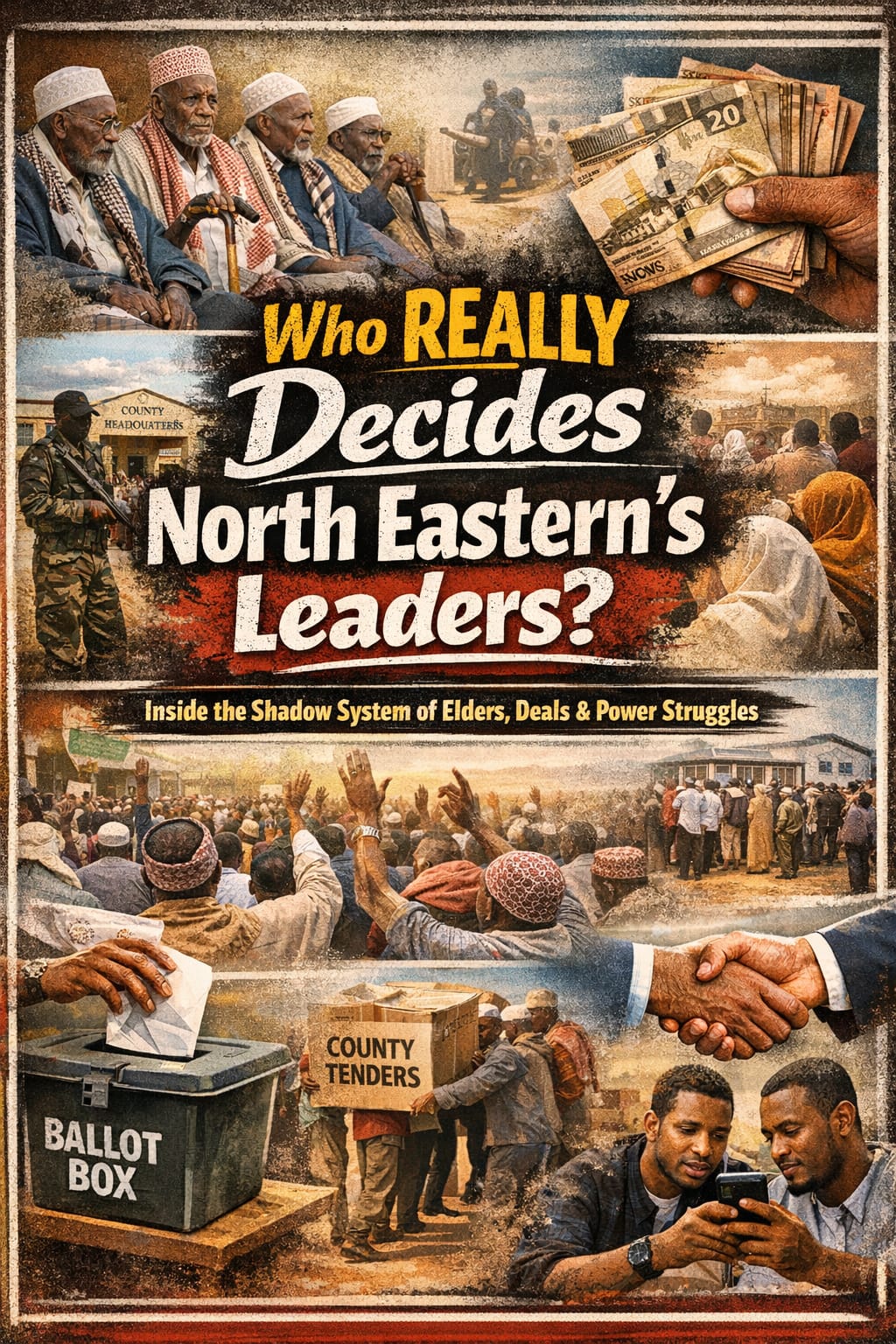
On a hot afternoon in North Eastern Kenya, long before ballot papers are printed and campaign posters flood the streets, politics quietly takes shape under tents, in dusty open fields, and inside community barazas called by elders. Plastic chairs are arranged in rows. Elders sit at the front.
Youth stand at the edges. Women watch from a distance. A microphone passes from one respected figure to another.
By the time formal campaigns begin, many residents already know who “their candidate” will be.
In much of Wajir, Garissa and Mandera counties, the decisive political moment does not always happen at the polling station. It happens earlier during clan endorsement gatherings convened by elders. According to residents interviewed across the region, these meetings determine who runs, who steps down, and who receives the collective blessing of the community.
The system is commonly referred to as “negotiated democracy.” Supporters say it prevents conflict and promotes power-sharing. Critics argue it protects elites, sidelines youth, and weakens accountability.
The question increasingly being asked ahead of 2027 is simple but uncomfortable: Who truly decides North Eastern’s leaders the voters or the power brokers?
In many areas, elders themselves call the barazas. These gatherings are often public. There is no secret ballot inside the tent. Consensus is expected. While there may not be a formal show of hands, the social pressure is unmistakable. Disagreeing publicly with a clan-endorsed position can mean isolation.
Youth participation exists physically but not structurally. Young people attend, but they rarely influence the final decision. Women are largely excluded from the decisive inner circles. Those who challenge the outcome risk being sidelined socially.
“It is difficult to oppose elders,” one youth from Garissa said quietly. “If you do, it feels like you are opposing your whole community.”
In some cases, candidates have defied clan endorsements and still won but such instances are rare. By one local estimate, perhaps one in five attempts succeed. The odds favor conformity.
This does not mean the system is universally rejected. Some residents defend it, arguing that the region’s fragile inter-clan balance requires careful negotiation. They point to past tensions and say open, winner-takes-all competition could inflame divisions.
Yet others feel trapped.
“Performance does not matter,” said another resident from Wajir,“Once it is your clan’s turn, that is what matters.”
That phrase “your clan’s turn” captures the essence of an informal but deeply entrenched rotation system that shapes parliamentary and county seats in parts of the region.
The Informal Rotation Agreements
Across Garissa and Wajir, residents describe informal and sometimes written agreements between clans to rotate political seats. If one sub-clan holds a parliamentary seat for one term, it is expected to relinquish it in the next election cycle to another.
These agreements are mediated by elders. In some cases, voters are aware of them before campaigns even begin. In others, negotiations happen quietly, then emerge as public consensus.
Performance is rarely the deciding factor. A leader’s record in office does not necessarily determine whether they are retained. The rotation agreement often overrides evaluation.
Supporters say this approach spreads opportunity and prevents domination by a single clan. Critics argue it removes voter choice and weakens democratic competition.
There have been slight cases where clans resisted waiting their turn. In such moments, tensions rise. Elders intervene quickly. Pressure mounts internally within communities to maintain unity.
Candidates who refuse to step down after an endorsement decision face social and political isolation. Families and clan members may influence them to comply. Without clan backing, running an independent campaign becomes extremely difficult.
Some residents describe subtle threats across the region not always physical, but social and economic. Support structures disappear. Campaign volunteers withdraw. Financial contributions dry up.
In such an environment, the ballot becomes the final ritual of a process largely settled beforehand.
Money plays a critical role in sustaining this structure.
Several residents allege that major campaigns are financed through resources that were originally meant for public benefit. They point to sudden development projects launched close to election periods road grading, borehole drilling, classroom construction as tools to impress voters.
There is widespread suspicion among residents that public funds may be indirectly used to build political loyalty. While no specific individual accusations were substantiated, the perception itself is powerful.
Jobs in county governments are sometimes viewed as rewards for loyalty. Employment opportunities can strengthen political networks and secure future support.
Vote-buying, residents claim, occurs secretly during election periods. Cash allegedly circulates quietly near polling stations. Such practices are difficult to verify and rarely formally reported, but they remain a persistent allegation in political conversations.
Beyond campaign financing lies another critical layer of influence, county procurement.
In Wajir, Garissa and Mandera, residents describe a system where politicians exert significant control over tenders. Businesses are sometimes registered under proxy names or relatives, according to multiple local accounts. Certain clans are perceived to dominate specific departments.
Members of County Assemblies (MCAs), who are constitutionally mandated to provide oversight, are described by some residents as politically captured. Few openly challenge procurement processes. Silence is often the norm.
Development, critics argue, becomes uneven. Wards aligned politically with the dominant leadership may receive more visible projects, while others lag behind.
Inside county governments, fear reportedly shapes behavior. Civil servants who disagree with political directives risk transfers or dismissals. Officers avoid speaking to media. Loyalty can appear more valuable than competence.
This environment reinforces elite control. Political, economic and social power intertwine.
And yet, something is shifting.
The Youth Reality Check
Social media has begun to challenge negotiated democracy in ways traditional forums could not.
TikTok debates, Facebook posts and WhatsApp groups are increasingly questioning elder dominance and rotation agreements. Young voters are openly criticizing what they call “old guard politics.”
For the first time, generational tension is visible.
Youth activists argue that competence, education and performance should matter more than lineage. They question why leaders are shielded from competition simply because it is “their turn.”
Some elders have reacted cautiously. Others dismiss online activism as noise.
But digital platforms have introduced something new, alternative spaces for political conversation outside clan-controlled structures.
Young people who would never speak against elders in a public baraza now express dissent online. They analyze budgets. They share procurement data. They debate constitutional principles.
Not all youth reject negotiated democracy. Some still align with clan-based voting patterns. But the automatic obedience of previous generations appears to be weakening.
The region stands at a crossroads.
Supporters of the current system insist it preserves peace. They argue that in a historically marginalized region bordering Somalia, unity is paramount. Fragmented competition, they warn, could invite instability.
Critics counter that peace without accountability is fragile. They say negotiated democracy has not translated into accelerated development. Infrastructure gaps persist. Youth unemployment remains high. Drought continues to devastate livelihoods.
If the system truly protected the public interest, critics ask, would development indicators look different?
The deeper issue is not merely who wins elections, but whether voters feel genuinely empowered to choose.
Many residents express ambivalence. Some support the system for its stability. Others feel constrained by it. They describe a tension between collective loyalty and individual political freedom.
Would the same leaders win under fully open competition?
Many interviewed believe not.
Would voters support an open primary system? Many say yes.
Is the current model sustainable beyond 2027? That remains uncertain.
As Kenya moves toward another election cycle, North Eastern’s political structure faces its most significant internal test in years. The elders still command respect. Rotation agreements still influence calculations. Tender networks still shape power.
But a generation raised on smartphones and constitutional language is beginning to ask difficult questions.
In public barazas, consensus may still prevail.
Online, debate is intensifying.
The 2027 election may not simply be a contest between candidates. It may be a referendum on whether negotiated democracy continues to define the region or whether voters reclaim a more competitive, performance-based politics.
In the end, the story of North Eastern’s leadership is not only about elders or youth, money or rotation deals. It is about a community negotiating its identity between tradition and modern democratic expectation.
The ballot paper remains the final act.
But the real decision as many residents acknowledge often happens long before election day.
And whether that changes may determine not just who wins in 2027, but what democracy truly means in North Eastern Kenya.