

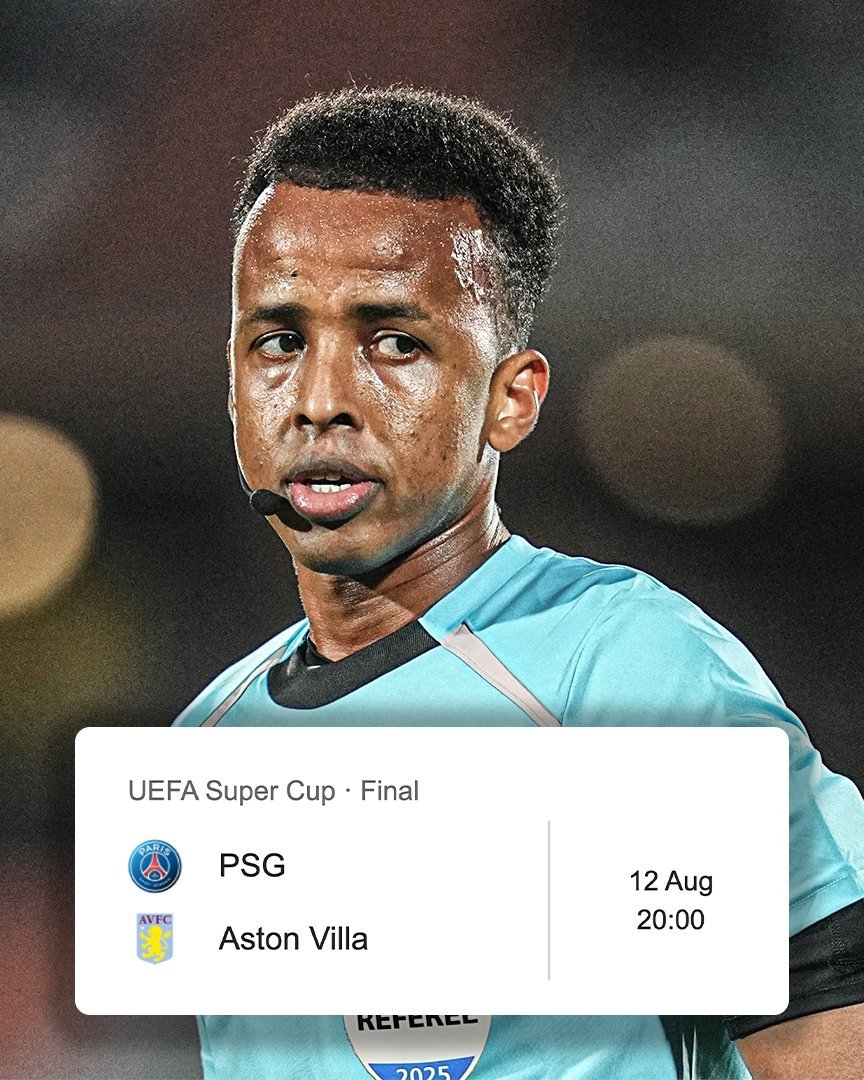
For Omar Artan, the past 18 months have taken him from the highest point of his refereeing career to one of its most difficult moments and now back to another historic stage.
On Wednesday in Salzburg, the 34-year-old Somali referee will walk onto the pitch to take charge of the UEFA Super Cup between Champions League winners Paris Saint-Germain and Europa League winners Aston Villa, becoming the first non-European referee to officiate the prestigious fixture.
It is an appointment that carries significance far beyond one match.
Just weeks ago, Artan was preparing for what would have been the defining assignment of his career: becoming the first Somali referee to officiate at a men’s FIFA World Cup. He had been selected among the officials for the 2026 tournament in the United States, Canada and Mexico, having spent years climbing through the international refereeing ranks.
But that dream was abruptly interrupted when he was not permitted to enter the United States for the tournament.
The disappointment was immense. Yet Artan’s story did not end there.
Instead, he has emerged from that setback with another opportunity to make history — this time on European football’s biggest club stage.
Speaking to UEFA ahead of the Super Cup, Artan acknowledged the emotional difficulty of what happened in the United States.
“It was a very tough period,” he said. “A lot of people have sympathy for me, because when someone has been working a lot of years and is supposed to do something, and then can’t do it, it’s very challenging.”
For a referee who had devoted years to reaching the World Cup, being unable to fulfil that ambition was understandably painful. But Artan also made clear that he was deeply moved by the support he received from across the football world.
“I really appreciate the support I received throughout the world; I’m so grateful,” he said.
That support has now been followed by another remarkable chapter.
Artan’s appointment to the Super Cup came through the cooperation between the Confederation of African Football and UEFA under a memorandum of understanding signed in April to strengthen cooperation between the two confederations, including in refereeing.
The significance of the appointment is difficult to overstate.
For the first time, a referee from outside Europe will take charge of the UEFA Super Cup. Artan will lead a multinational officiating team that includes Djibouti’s Liban Abdoulrazack Ahmed and Kenya’s Stephen Eleazar Onyango Yiembe as assistant referees, while Slovenia’s Rade Obrenovič will serve as fourth official. Italy’s Marco Di Bello will operate as VAR, with Spain’s Guillermo Cuadra Fernandez as assistant VAR.
For Artan, however, the assignment is not about symbolism alone. It is also an opportunity to learn and test himself against a new environment.
“This will be my first match in Europe,” he said. “Having adventures, making memories and learning new things is always great.”
He described the cooperation between CAF and UEFA as mutually beneficial, praising the high standards of European refereeing while emphasising that African officials also have much to contribute.
“The standard in Europe is fantastic and the football they play is very, very good,” Artan said. “I believe that CAF referees can learn a lot from UEFA, and UEFA referees can also learn a lot from CAF. It’s mutually beneficial.”
The Super Cup appointment is the latest achievement in a rise that has already rewritten Somali refereeing history.
Artan became the first Somali referee to officiate at the Africa Cup of Nations in 2024. He later took charge of the CAF Champions League final, becoming the first Somali to reach that stage, before being named CAF Men’s Referee of the Year for 2025.
He also officiated the third-place match at the FIFA Under-20 World Cup in Chile in 2025 and, after returning from the United States, took charge of the Kuwaiti Premier League title decider in June another first in his career.
His journey is even more remarkable considering the difficult circumstances from which he emerged.
Artan has spoken about losing his father at a young age and growing up apart from his mother. His route into refereeing began after a minor playing injury redirected his ambitions. What started with informal neighbourhood matches and school games eventually developed into a career on the international stage.
“I grew up in a difficult situation, but it didn’t prevent me from pursuing my dreams,” he said.
Now, as he prepares for Paris Saint-Germain against Aston Villa, Artan is drawing on that same determination.
He has been keeping himself match-fit through domestic assignments in Somalia and has studied the two European teams closely, analysing their playing styles, tactics and behaviours.
For the Somali referee, preparation is part of the responsibility that comes with making history.
But perhaps his most powerful message is not about tactics or refereeing technique. It is about refusing to allow setbacks to determine what is possible.
“I believe that if I can succeed, anyone can,” Artan said. “You can do whatever you want to do. Don’t ever stop dreaming.”
That message captures the remarkable trajectory of his career.
The World Cup dream may have been interrupted, but it has not erased what Artan had already achieved nor stopped him from breaking another barrier.
On Wednesday in Salzburg, when the whistle sounds and two of Europe’s biggest clubs begin their battle for the Super Cup, Omar Artan will stand at the centre of it.
A Somali referee who was denied one historic stage will now command another.
And once again, he will be making history.