

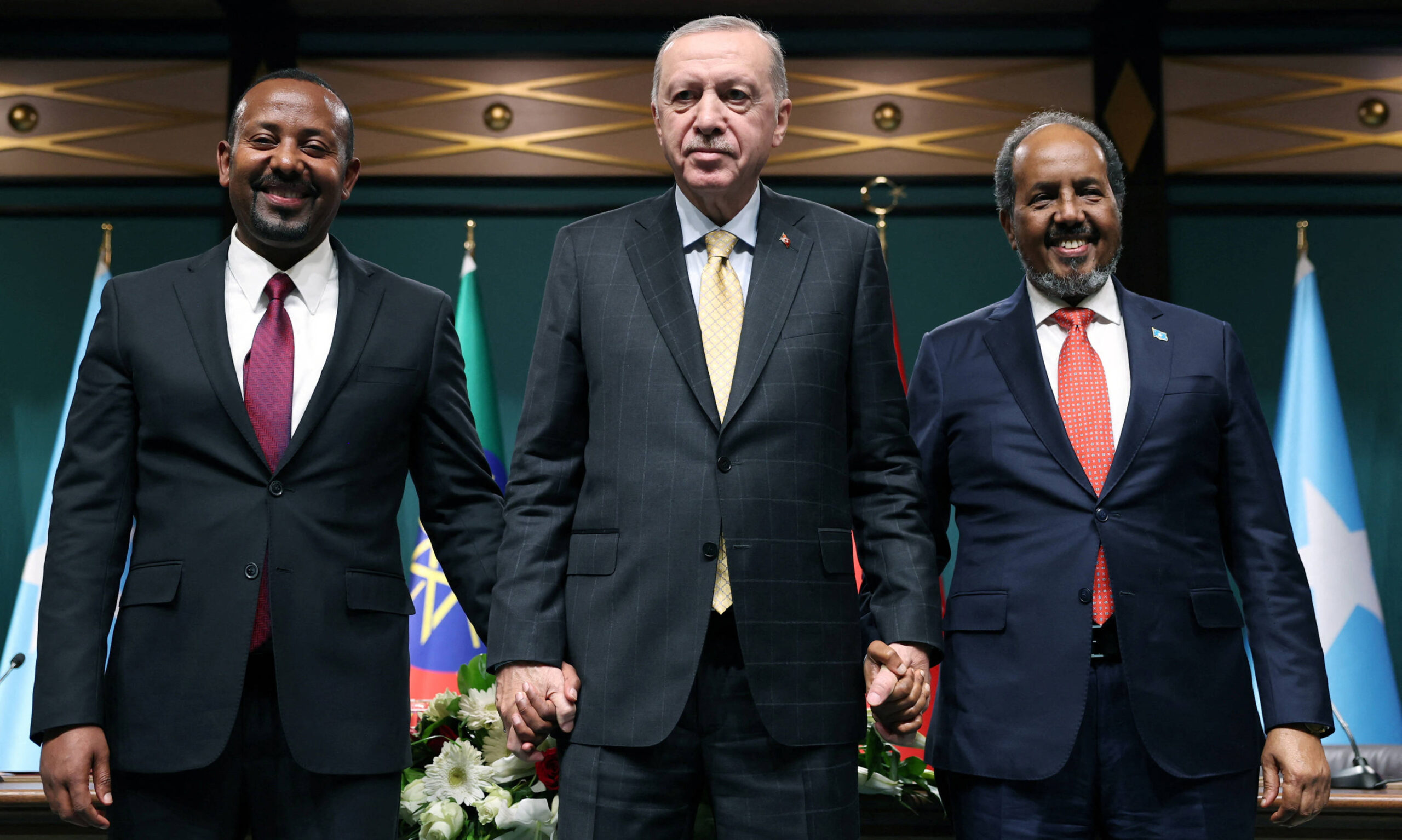
What was supposed to be a global climate summit is increasingly attracting attention for developments far beyond climate negotiations. In the diplomatic corridors of COP31 in Antalya, the presence of Somali President Hassan Sheikh Mohamud, Ethiopian Prime Minister Abiy Ahmed and Turkish President Recep Tayyip Erdoğan has placed one of the Horn of Africa’s most complicated diplomatic disputes back into the international spotlight.
At the centre of the unfolding diplomatic calculations is the unresolved relationship between Somalia and Ethiopia, two neighbouring countries whose disagreements over maritime access, territorial sovereignty, military cooperation and regional influence have continued to shape the politics of the Horn of Africa.
The timing is particularly significant. Ethiopia is still pursuing a reliable route to the sea, Somalia remains firmly opposed to any arrangement that compromises its sovereignty, and President Hassan Sheikh is confronting mounting political pressure at home. For Abiy Ahmed, the current circumstances present an opportunity to reopen a diplomatic conversation that has remained unresolved since the signing of the Ankara Declaration in December 2024.
The two leaders have now held discussions on the sidelines of COP31 in Antalya. Somalia’s state news agency, SONNA, reported that Hassan Sheikh met Abiy Ahmed, with the discussions covering bilateral relations, regional security and matters of mutual interest. Ethiopia’s Addis Media Network similarly reported that the leaders discussed Somalia’s security situation and regional stability.
Although neither government has announced a new agreement or confirmed the signing of a fresh maritime-access arrangement, the meeting itself carries considerable diplomatic significance.
The involvement of Türkiye makes the situation even more interesting. President Erdoğan was instrumental in bringing the two countries together in December 2024, and Ankara remains one of the few international actors with the diplomatic relationships necessary to engage both governments.
To understand why the Antalya meeting matters, it is necessary to revisit what happened two years ago.
In January 2024, Ethiopia signed a controversial memorandum of understanding with Somaliland, a self-declared independent region that Somalia considers an integral part of its territory. The agreement reportedly envisaged access to the Red Sea through a coastal arrangement, alongside the prospect of Ethiopia recognising Somaliland’s independence.
For Mogadishu, this was not an ordinary bilateral disagreement. It was viewed as a direct challenge to Somalia’s territorial integrity and sovereignty.
The Somali government strongly rejected the arrangement, describing it as illegal and unacceptable. Diplomatic tensions escalated, with Somalia recalling its ambassador from Ethiopia and demanding respect for its internationally recognised borders.
The dispute threatened to destabilise an already fragile region, particularly given Ethiopia’s historical military involvement in Somalia and the continuing fight against Al-Shabaab.
Türkiye subsequently stepped in, bringing Hassan Sheikh and Abiy Ahmed together in Ankara on December 11, 2024.
The resulting Ankara Declaration was intended to prevent a diplomatic confrontation from escalating into a wider regional crisis.
Under the declaration, both countries reaffirmed their respect for each other’s sovereignty, unity and territorial integrity. More importantly, they agreed to work towards commercial arrangements that would give landlocked Ethiopia reliable, secure and sustainable access to the sea through agreements negotiated with Somalia.
One provision was particularly important: Ethiopia’s access would operate under the sovereign authority of the Federal Republic of Somalia.
In other words, the declaration did not hand Ethiopia Somali territory or automatically grant it a port. It established a diplomatic framework for negotiating mutually beneficial maritime access while respecting Somalia’s sovereignty.
Technical negotiations were supposed to begin by the end of February 2025 and conclude within four months, with Türkiye facilitating the process.
The first round eventually took place in Ankara on February 18, 2025. However, the initial diplomatic progress did not translate into a publicly announced final maritime-access agreement. The unresolved differences, subsequent political developments and continuing mistrust left the central question unsettled.
This is the diplomatic background against which Abiy Ahmed and Hassan Sheikh have now met again in Antalya.
But the disagreement is no longer exclusively about access to the sea. It has become intertwined with Somalia’s internal political crisis and competing regional security interests.
One of the most complicated developments concerns Ethiopia’s military presence inside Somalia.
Ethiopian forces have historically operated in Somalia through different security arrangements, including bilateral cooperation and African Union missions. Their presence has been justified by the fight against Al-Shabaab and the broader objective of stabilising Somalia.
However, Mogadishu and Addis Ababa have increasingly found themselves on different sides of political developments within Somalia.
The South West State crisis is particularly significant. The confrontation involving the federal government, former regional president Abdiaziz Hassan Mohamed Laftagareen and the administration led by Sheikh Aden Mohamed Nur Madobe has exposed deep divisions over political authority, constitutional changes and control of regional institutions.
The federal government’s military intervention in Baidoa in March 2026 resulted in Laftagareen’s departure from office and the installation of a new political administration.
The situation has since remained contentious, with competing political accusations and security concerns.
Against this background, questions have emerged over the conduct and positioning of Ethiopian forces operating in the region. Critics have questioned whether Ethiopia’s military presence has consistently supported Mogadishu’s position during the political confrontation.
There have also been allegations circulating among Somali political circles that Ethiopian forces have failed to defend federal government interests and have been sympathetic to forces accused of destabilising the new administration.
These are serious allegations, but they require independent verification. There is no established evidence presented publicly that Ethiopian forces are collaborating with Al-Shabaab. Such claims must be distinguished from documented disagreements over military positioning and political loyalties.
Nevertheless, the broader question remains: what does Ethiopia’s military presence in Somalia mean when the two governments cannot agree on the political and security direction of the country?
For Hassan Sheikh, this question is becoming increasingly difficult to manage.
His government is already facing a serious domestic political confrontation. The constitutional amendments passed in March 2026, which extended presidential and parliamentary terms from four to five years, triggered strong opposition from political figures and regional administrations.
The disagreement escalated further when Somalia’s Supreme Court ruled on November 5 that the constitutional amendments did not automatically extend the mandates of the current officeholders. The court determined that the president’s original term had expired on May 15, 2026, and ordered political stakeholders to agree on an electoral framework within 30 days, with elections to follow within 90 days.
The court also rejected the president’s dismissal of Chief Justice Baashe Yusuf Ahmed.
The Attorney General’s office subsequently challenged the legal effect of the ruling, deepening the institutional confrontation.
This has placed Hassan Sheikh under extraordinary political pressure at precisely the moment he is expected to navigate Somalia’s most sensitive foreign policy questions.
The security dimension adds another complication. Uganda, one of the most important military contributors to Somalia’s security operations, announced on November 2 that it had begun withdrawing troops deployed under a bilateral arrangement. Uganda has also indicated that all its forces, including those serving under AUSSOM, will gradually leave by the end of 2027.
Somalia has clarified that the immediate withdrawal concerns bilateral troops and does not mean its entire Ugandan AUSSOM contingent has already departed. Nevertheless, the longer-term withdrawal creates an important strategic challenge for Mogadishu.
At a time when Somalia continues to fight Al-Shabaab, any reduction in international military support raises questions about the country’s ability to maintain security gains and protect strategic positions.
This is where Ethiopia’s importance becomes difficult to ignore. Despite the diplomatic disagreements, Ethiopian forces remain a significant security actor in the Horn of Africa. Neither government can easily dismiss the consequences of a complete breakdown in military cooperation.
Regional alliances are also influencing the calculations.
Somalia has strengthened its diplomatic and security relationships with Egypt, Eritrea and other regional partners, while Ethiopia remains concerned about the growing involvement of countries that have competing interests in the Red Sea and the wider Horn of Africa.
The emerging regional alignments have made the Somalia-Ethiopia disagreement much bigger than a bilateral dispute.
Egypt’s military and diplomatic engagement with Somalia, its longstanding disagreement with Ethiopia over the Grand Ethiopian Renaissance Dam, and the wider rivalry involving Sudan and Eritrea have created an increasingly complicated strategic environment.
For Addis Ababa, the possibility of Somalia becoming more closely aligned with countries opposed to Ethiopia’s regional ambitions is a serious diplomatic consideration.
For Mogadishu, maintaining those relationships provides strategic partnerships and additional diplomatic leverage, particularly when its territorial integrity is at stake.
However, Somalia must also be careful not to allow regional rivalries to determine its foreign policy at the expense of its own national interests.
This brings us back to Antalya.
COP31 provides Erdoğan with an unusually important diplomatic opportunity. Hosting both leaders at the same international gathering allows Türkiye to encourage dialogue without necessarily organising a separate high-profile reconciliation summit.
Erdoğan has invested considerable diplomatic capital in the Ankara process. A breakdown between Somalia and Ethiopia would undermine one of Türkiye’s most important mediation efforts in the Horn of Africa.
For Abiy Ahmed, reopening the Ankara process is strategically important because Ethiopia’s search for reliable maritime access remains a long-term national objective. The country’s geographical dependence on neighbouring states for access to international shipping routes is a major economic and strategic concern.
For Hassan Sheikh, however, any maritime-access agreement must be politically defensible at home. Accepting an arrangement that could be interpreted as compromising Somalia’s territorial sovereignty would expose his government to fierce criticism, especially from an already mobilised opposition.
His political opponents could argue that he is negotiating from a position of weakness, particularly given the constitutional confrontation and the uncertainty surrounding his administration’s mandate.
This is why the diplomatic timing matters.
It would be premature to conclude that Hassan Sheikh has agreed to revive or formally sign a new maritime arrangement. Equally, it would be inaccurate to describe the Antalya meeting as a failure simply because no agreement has been announced.
The immediate question is whether the discussions will produce a concrete diplomatic process beyond general commitments to cooperation and regional stability.
There are several possible outcomes. Türkiye could revive technical negotiations under the Ankara framework, with both governments attempting to separate maritime access from their wider security disagreements. Alternatively, the discussions could remain limited to confidence-building measures, leaving the maritime question unresolved.
A third possibility is that both governments continue engaging diplomatically while maintaining their competing security and political positions on the ground.
The coming weeks will therefore be important. The real test will not be the photographs of leaders meeting in Antalya, but whether Mogadishu and Addis Ababa can agree on practical measures addressing sovereignty, maritime access, military cooperation and regional stability.
For Somalia, the priority must remain the protection of its territorial integrity, the restoration of political consensus and the strengthening of its own security institutions.
For Ethiopia, a sustainable maritime arrangement cannot be achieved through diplomatic pressure or agreements that undermine the sovereignty of its neighbour. It requires the confidence and cooperation of Somalia’s recognised federal government.
And for Türkiye, the challenge is to ensure that the Ankara Declaration does not become another diplomatic document whose promises remain unfulfilled.
COP31 may be remembered for climate commitments and international environmental negotiations. But in the Horn of Africa, the conversations taking place in Antalya could carry consequences far beyond the conference’s official agenda.
The central question is no longer simply whether Ethiopia will obtain access to the sea. It is whether Hassan Sheikh Mohamud and Abiy Ahmed can rebuild enough trust to prevent a maritime disagreement from becoming a much wider regional confrontation.