

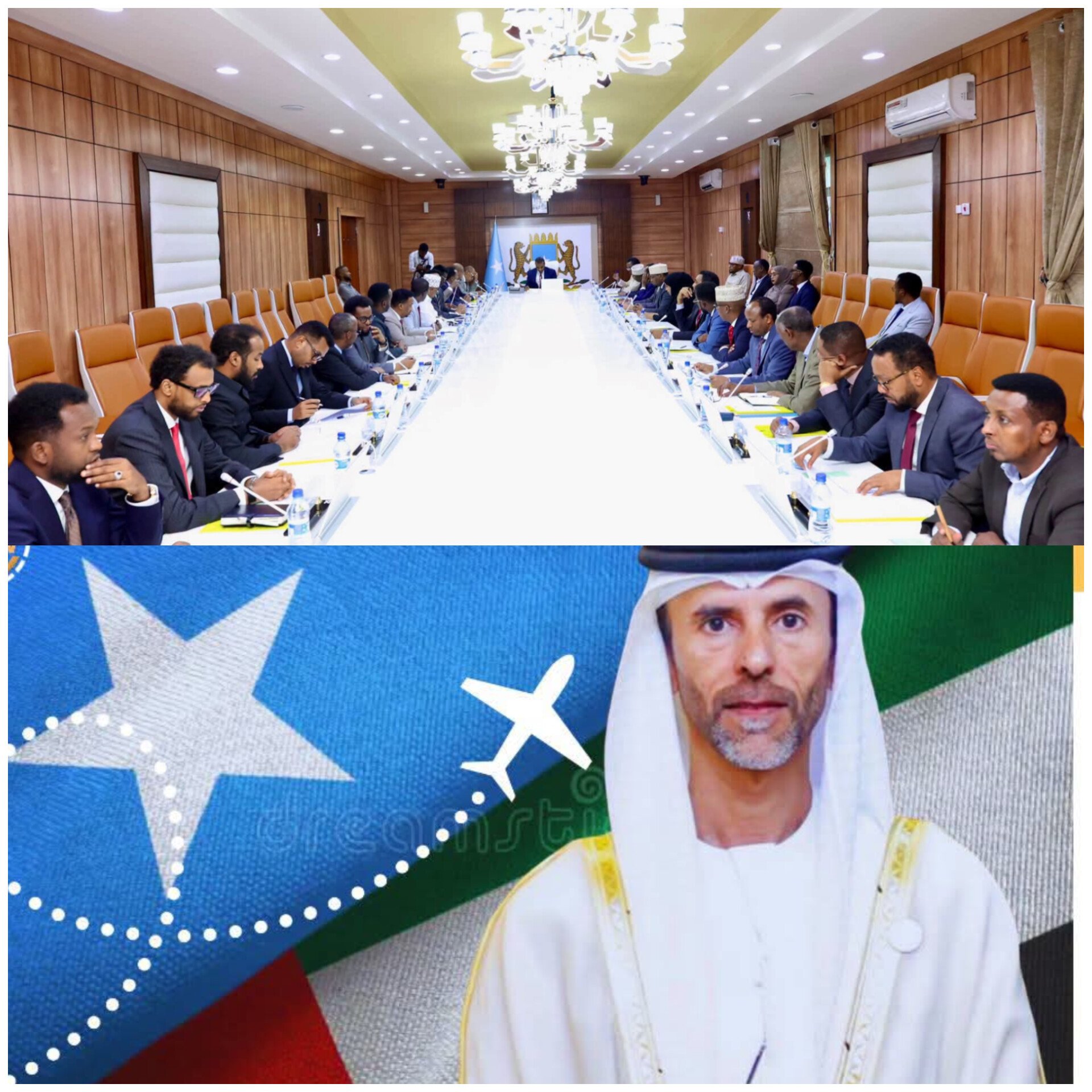
Somalia has taken its most consequential diplomatic action against the United Arab Emirates in the escalating dispute between Mogadishu and Abu Dhabi, ordering the Emirati ambassador to leave the country within 72 hours and recalling its own ambassador from the UAE for consultations. The decision marks a sharp shift from public accusations and diplomatic protests to direct action, as the Federal Government accuses Abu Dhabi of undermining Somalia’s sovereignty, territorial integrity and national unity.
The measures were announced on Thursday following a meeting of the Council of Ministers chaired by Prime Minister Hamza Abdi Barre in Mogadishu. Information Minister Abdulfatah Kasim Mohamud said the Cabinet had reviewed a report from the Ministry of Foreign Affairs detailing what the government described as Emirati interference in Somalia’s internal affairs. The Cabinet characterised the alleged actions as “open aggression” and a violation of international law.
The government also instructed the Foreign Ministry to present its report to the international community, warning that further measures would be taken against individuals or groups cooperating with activities it considers harmful to Somalia’s sovereignty. It called on Somali citizens and community leaders to unite in defence of the country.
But the government’s decision was accompanied by an even sharper message from Defence Minister Ahmed Moalim Fiqi, who took to X to address the UAE ambassador directly.
“We are fed up with an ambassador who represents strife and evil! The Somali people have realised the scale of the plots being hatched against them and the danger of the subversive policies targeting their sovereignty, unity and security. Pack your bags and leave; Somalia is greater than your ambitions, and its people’s dignity is above your influence and money. Those who do not respect our sovereignty have no place for their interference on our land,” Fiqi wrote.
The statement was more than a reaction to the Cabinet announcement. It reflected the increasingly confrontational language being adopted by senior Somali officials as the dispute moves into a new phase. The message from Mogadishu is that the government no longer intends to treat its concerns as a routine diplomatic disagreement.
The expulsion order follows a televised address by President Hassan Sheikh Mohamud on Tuesday, in which he accused the UAE of pursuing policies that weaken Somalia’s federal authority and encourage divisions among its political and regional leadership.
The President questioned Emirati engagements involving the strategic ports of Berbera, Bosaso and Kismayo, arguing that agreements concerning Somali territory and national assets should not be concluded without the involvement and approval of the Federal Government. He also accused Abu Dhabi of supporting military facilities and armed forces operating outside Somalia’s national command structure, as well as providing political and financial backing to regional administrations in ways he said fuel internal divisions.
These allegations touch on one of Somalia’s most sensitive political questions: who has the authority to enter into foreign agreements involving the country’s territory, security and strategic infrastructure? Mogadishu maintains that foreign governments must conduct their dealings through federal institutions. However, Somaliland, Puntland and Jubaland have developed their own relationships with the UAE and have previously rejected Mogadishu’s attempts to cancel agreements involving their territories.
That disagreement has turned the UAE relationship into a wider test of federal authority. It is no longer simply about diplomatic relations between two countries; it is also about the balance of power between Somalia’s central government and regional administrations.
Abu Dhabi has rejected Mogadishu’s accusations. In a statement issued by its Ministry of Foreign Affairs on Thursday, the UAE condemned what it described as the Somali government’s “escalatory and hostile approach”, arguing that the decision undermines bilateral relations and weakens cooperation between the two countries.
The UAE said decisions affecting relations between states should be guided by shared interests and kept separate from domestic political disputes. It also recalled that it had closed its embassy in Mogadishu and withdrawn diplomatic personnel in January 2026, following what it described as hostile actions by the Somali government, including the cancellation of bilateral agreements.
The Emirati government maintained that its relationship with the Somali people remained important, particularly given the large Somali community living and working in the UAE. It expressed its commitment to preserving those ties despite the deteriorating relationship with Mogadishu.
The January decision to annul agreements covering security, defence and economic cooperation had already placed relations under considerable strain. The latest expulsion order now raises questions about whether the two governments can maintain meaningful diplomatic engagement, even as they continue to insist that their disagreement should not damage relations between their peoples.
Prime Minister Hamza Abdi Barre has also adopted a defiant tone. Defending the government’s position, he made remarks that appeared to dismiss the prospect of international mediation, saying: “We expelled the UN envoy and dismantled C6+. Come on then; there is no international community left to mediate between us.”
He added: “There is no such thing as an international community operating in Somalia. We have sent them away; we are a government.”
The remarks come at a particularly sensitive moment for Somalia, which is dealing with internal political disagreements and security challenges. They also raise questions about the government’s approach to international diplomacy at a time when Somalia continues to depend on external partnerships in areas including security, development and humanitarian support.
The Prime Minister’s remarks were accompanied by another serious accusation concerning the conflict in parts of southern Somalia. Speaking about the situation in Bay, Bakool and Lower Shabelle, Hamza said the UAE authorities were responsible for every person killed, alleging that they provided funding, ammunition and drones.
“What is happening in Bay, Bakool and Lower Shabelle, the UAE authorities are responsible for every single person we lose. They provide the money, they supply the ammunition, and they also purchase the drones,” he said.
The allegation, if substantiated, would represent a serious accusation of foreign involvement in Somalia’s security crisis. However, the Prime Minister’s statement did not publicly provide evidence to establish the specific claims. The UAE has broadly rejected accusations of interference in Somalia, and the allegations require independent scrutiny.
Meanwhile, the diplomatic confrontation has begun to generate public reactions inside Somalia. Demonstrators took to the streets of Mogadishu on Thursday night in support of the government’s decision to expel the UAE ambassador. The rally reflected the growing public attention surrounding the dispute, although demonstrations in support of the government do not necessarily represent the views of every Somali citizen.
Beyond Somalia, the confrontation is attracting attention from commentators examining the UAE’s wider role in regional politics. Geopolitical commentator Abdiwahab Sheikh described the developments as part of a growing regional backlash against what he characterised as Emirati support for separatist and fragmentation movements.
“From Algeria to Sudan. From Yemen to Somalia all the way to Libya, Emirates’ growing axis of separatist and fragmentation is increasingly running into a wall of resistance from sovereign governments,” Sheikh said.
He added that the consequences of such policies were becoming harder to avoid, arguing: “You cannot set entire regions on fire and expect to remain untouched by the flames.”
His assessment places the Somalia-UAE dispute within a wider regional debate over the influence of Gulf powers in conflicts, port infrastructure, military partnerships and relationships with non-central authorities. However, the political situations in Algeria, Sudan, Yemen, Libya and Somalia are different, and the commentator’s comparison remains an interpretation rather than proof of a single coordinated regional policy.
For Somalia, the immediate challenge is whether the expulsion of the ambassador will translate into a more effective defence of federal authority or deepen the country’s existing political divisions. The UAE has significant economic and security relationships in the Horn of Africa, while Somalia remains strategically important because of its coastline, ports and position along major international shipping routes. Any prolonged breakdown in relations could therefore carry consequences beyond the two capitals.
There is also the question of what happens after the 72-hour deadline. Somalia has not announced a complete severing of diplomatic relations, but the expulsion order and recall of its ambassador represent a serious deterioration in official ties. Whether Abu Dhabi responds with further diplomatic measures, and whether the two sides eventually return to negotiations, will help determine the next phase of the dispute.
For now, Mogadishu is insisting that foreign partnerships must respect the authority of the Somali state, while Abu Dhabi argues that the Somali government is allowing its internal political disagreements to damage bilateral cooperation.
The central question is no longer whether relations between Somalia and the UAE have deteriorated. That is already clear. The bigger question is whether this confrontation will remain a diplomatic dispute between two governments or develop into a wider regional contest over influence, security and the political future of Somalia.