

Kenya and the Democratic Republic of Congo (DRC) have agreed to restore full diplomatic relations, including the return of ambassadors to their respective capitals, in a significant diplomatic breakthrough aimed at ending years of strained relations between the two neighbouring African countries.
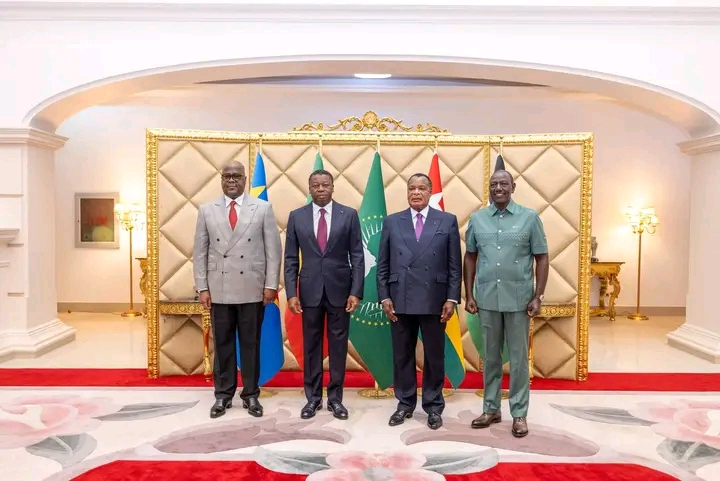
The agreement was reached on Sunday following talks between Kenyan President William Ruto and his Congolese counterpart, Félix-Antoine Tshisekedi Tshilombo, during a Quadripartite Political Summit held in Oyo, Republic of the Congo.
The meeting was convened at the initiative of President Denis Sassou Nguesso and brought together the two leaders in the presence of Togo’s President of the Council of Ministers, Faure Essozimna Gnassingbé, who is also the African Union-appointed mediator in the security crisis in eastern DRC.
The outcome marks an important attempt by Nairobi and Kinshasa to move beyond their diplomatic disagreements and establish a renewed framework for cooperation, dialogue and regional stability.
In a joint press communiqué issued after the meeting, the two presidents reaffirmed their commitment to the principles of sovereignty, territorial integrity, non-interference in the internal affairs of states, good-neighbourliness and the peaceful settlement of disputes.
They further agreed to prioritise diplomatic engagement and existing regional and continental mechanisms in addressing concerns that could affect relations between the two countries.
The communiqué stated that the two leaders had resolved to “prioritise ongoing consultation and diplomatic channels as means of preventing and resolving any potential disputes”, with the restoration of diplomatic representation through the return of ambassadors forming a central part of the agreement.
President Ruto described the outcome as an opportunity for both countries to move forward, saying they had agreed to “open a new chapter” in their bilateral relations.
The diplomatic breakthrough follows a prolonged period of tension between Nairobi and Kinshasa, during which relations deteriorated over political and diplomatic disagreements. One of the major sources of friction emerged in October 2025, when Kenya hosted a gathering of Congolese opposition figures that included former DRC President Joseph Kabila.
The gathering attracted criticism from Kinshasa, which viewed Nairobi’s engagement with opposition figures as a sensitive political matter. Kenya, however, maintained that it could not restrict political expression, reflecting a disagreement over the boundaries of political engagement and respect for domestic political sensitivities.
The tensions contributed to a deterioration in diplomatic relations, with both countries going for years without ambassadors formally stationed in each other’s capitals. The absence of full diplomatic representation limited an important channel through which governments traditionally communicate, manage disagreements and strengthen bilateral cooperation.
Sunday’s agreement therefore represents more than a symbolic diplomatic gesture. The proposed return of ambassadors provides an opportunity to restore direct communication between the two governments and establish mechanisms for addressing future disagreements before they develop into wider diplomatic confrontations.
The two leaders also agreed to revive the Joint Grand Commission for Cooperation, an important bilateral framework intended to facilitate structured engagement across various sectors. Regular political consultations will also be prioritised as part of efforts to institutionalise dialogue and prevent a recurrence of the tensions that have affected relations.
Beyond the diplomatic question, the agreement carries considerable economic and strategic significance.
Kenya and the DRC are important players in the wider East and Central African economic landscape. Their geographical positions, commercial interests and membership in regional institutions create opportunities for cooperation in trade, investment, infrastructure, security and regional integration.
For Kenya, stronger relations with Kinshasa could reinforce its ambitions of expanding economic engagement across Central Africa, particularly through trade, investment and regional connectivity. The DRC, with its substantial natural resources and large domestic market, remains an important economic partner for countries seeking to deepen commercial relations across the continent.
For Kinshasa, rebuilding relations with Nairobi could strengthen its engagement with East African institutions and provide another diplomatic avenue for advancing regional cooperation.
The two presidents consequently committed themselves to expanding cooperation in economic matters and strengthening their engagement through regional organisations, particularly the International Conference on the Great Lakes Region (ICGLR) and the East African Community (EAC).
Both countries are members of these regional frameworks, which provide platforms for addressing shared security challenges, promoting economic integration and coordinating responses to regional developments.
Their renewed commitment to these institutions is particularly significant given the continuing instability in eastern Democratic Republic of Congo, where armed conflict has remained a major challenge to regional peace and security.
The security situation in eastern DRC has broader implications beyond the country’s borders, making cooperation among regional governments essential. The involvement of President Gnassingbé, in his capacity as the African Union-appointed mediator, also underlines the importance of connecting bilateral diplomatic reconciliation with wider efforts to achieve peace in the Great Lakes region.
The Oyo summit therefore brought together two interconnected diplomatic priorities: addressing the disagreements between Kenya and the DRC while reinforcing the wider regional commitment to dialogue and peaceful conflict resolution.
Another important issue addressed during the meeting was public health cooperation, particularly in response to the Ebola epidemic.
The two presidents recognised the serious consequences of the outbreak and called for greater cooperation among countries to contain and eradicate the disease.
The issue carries particular importance for Kenya, which recently confirmed its first Ebola case on October 6 involving a man who had travelled from the Democratic Republic of Congo. Kenya subsequently discharged its last patient on November 11, with Health Cabinet Secretary Aden Duale announcing that the country’s 42-day countdown would conclude on December 23.
The agreement to strengthen cooperation on Ebola prevention and control demonstrates how public health challenges can become an important component of diplomatic engagement between neighbouring countries.
Epidemics do not respect national borders, and effective responses require information sharing, coordinated surveillance, preparedness and cooperation between health authorities. For Kenya and the DRC, rebuilding trust could therefore strengthen their ability to respond collectively to public health emergencies.
The summit also reflected a broader commitment by African leaders to resolving continental challenges through dialogue and African-led diplomatic initiatives.
In the communiqué, the participating leaders described their engagement as part of ongoing efforts to promote peace, security and regional stability through consultation and dialogue. They further reaffirmed their commitment to Pan-Africanism, solidarity and the principle of finding African solutions to the challenges facing the continent.
President Sassou Nguesso’s facilitation and President Gnassingbé’s mediation were particularly acknowledged by Ruto and Tshisekedi, who expressed gratitude for their contribution towards creating an environment conducive to easing tensions and rebuilding relations.
The recognition of their respective roles reflects the importance of diplomatic facilitation in situations where direct engagement between governments has become difficult or politically sensitive.
However, while Sunday’s agreement represents a positive development, the real test will lie in its implementation.
The restoration of ambassadors, resumption of the Joint Grand Commission, regular political consultations and stronger cooperation through regional institutions will require sustained political commitment from both Nairobi and Kinshasa.
Diplomatic agreements often establish the framework for reconciliation, but lasting improvements depend on whether governments translate their commitments into practical action. The disagreements that strained Kenya-DRC relations demonstrate the importance of maintaining open communication, respecting diplomatic sensitivities and managing political differences through established channels.
For the two countries, the challenge now is to ensure that the Oyo agreement becomes the foundation of a more predictable and productive relationship rather than another diplomatic understanding that struggles to translate into meaningful cooperation.
As President Ruto and President Tshisekedi seek to turn the commitments made in the Republic of the Congo into concrete action, the renewed engagement offers an opportunity to strengthen bilateral relations while contributing to wider peace, security and economic integration across East and Central Africa.
The Oyo summit may not resolve every disagreement between Nairobi and Kinshasa, but it has opened an important diplomatic door. Whether the two governments can sustain the momentum will determine the significance of this new chapter in their relations.