


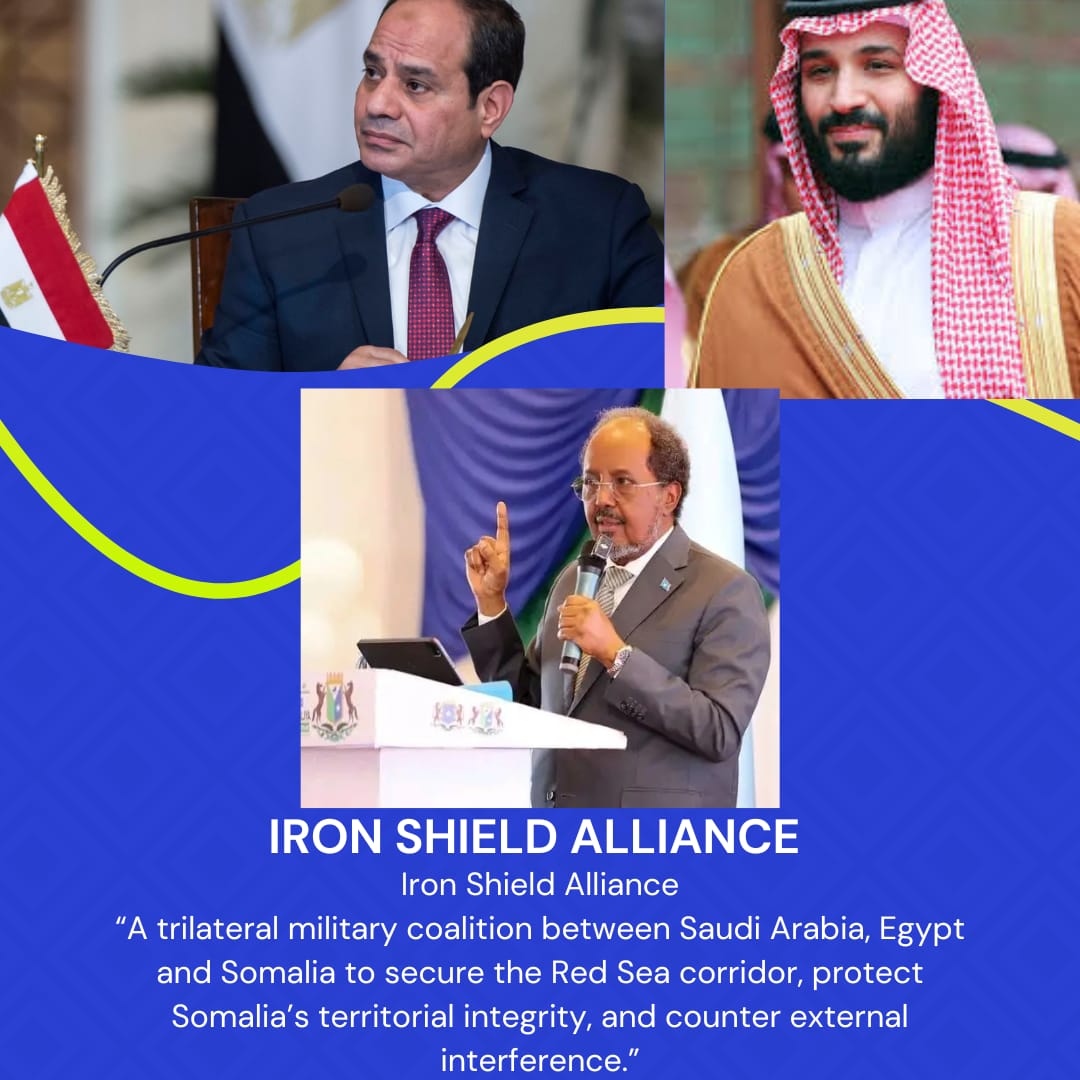
By early 2026, Somalia has crossed a geopolitical threshold that few fragile states ever do: it has become indispensable. No longer viewed solely through the lens of Al-Shabaab insurgency or post-state collapse recovery, Somalia is now the central arena of a high-stakes regional confrontation stretching across the Red Sea, the Horn of Africa, and the Middle East.
President Hassan Sheikh Mohamud’s swift diplomatic pivot from the historic inauguration of President Firdhiye in Las Anod to an imminent strategic mission in Riyadh signals not just a foreign policy adjustment, but a fundamental realignment of Somalia’s place in regional power politics. At the heart of this shift lies an emerging trilateral military coalition between Saudi Arabia, Egypt, and Somalia, backed strategically by Turkey an alliance increasingly referred to by analysts as the “Iron Shield” or the Red Sea Axis.
This new alignment is widely understood as a response to two seismic developments: Israel’s recognition of Somaliland on December 26, 2025, and the growing influence of the United Arab Emirates across Somali ports, regions, and security structures. Together, these events have accelerated Somalia’s transformation from a peripheral state into a frontline battleground in a modern proxy conflict.
From State Collapse to Strategic Prize: Somalia’s Long Road to the Red Sea Frontline
To understand the significance of the current moment, it is necessary to revisit Somalia’s post-1991 trajectory. For decades after state collapse, Somalia was treated as an object of international intervention rather than a subject of strategic choice. Foreign powers operated through fragmented agreements ports, bases, counterterrorism deals often bypassing the federal government and engaging directly with sub-national entities.
This fragmentation was not accidental.
Control of Somalia’s coastline Africa’s longest, stretching along the Gulf of Aden and the Indian Ocean has always been about more than Somalia itself. It is about the Bab el-Mandeb Strait, through which nearly 12% of global trade passes, linking the Indian Ocean to the Suez Canal and Europe.
In the 2010s and early 2020s, the UAE aggressively expanded its footprint across the Horn of Africa, securing port and security deals in Somaliland and elsewhere. Turkey, meanwhile, re-entered Somalia through state-to-state engagement, establishing its largest overseas military base in Mogadishu and framing Somalia as a pillar of its Africa policy. Egypt watched cautiously, viewing any shift in Red Sea control through the lens of its existential struggle with Ethiopia over the Nile.
What changed in late 2025 was recognition politics. Israel’s decision to recognize Somaliland was not merely symbolic it was interpreted in Riyadh, Cairo, Ankara, and Mogadishu as an attempt to create a permanent strategic foothold on the Red Sea coast outside Somali federal authority. That move collapsed any remaining ambiguity: Somalia’s territorial question had become a regional security issue.
The “Iron Shield” Takes Shape: Military Logic Behind the New Alliance
The emerging Saudi-Egypt-Somalia trilateral coalition is designed to do one thing above all else: lock down the Red Sea flank. According to Somali government confirmations as of January 16, 2026, negotiations are focused on intelligence sharing, joint training, maritime security, and coordinated defense planning.
For Somalia, the logic is straightforward. The federal government gains a powerful security umbrella at a moment when it faces both internal fragmentation and external pressure. Military cooperation with Arab heavyweights provides deterrence against unilateral recognitions, strengthens federal authority over contested maritime borders, and signals that Mogadishu is no longer diplomatically isolated.
For Saudi Arabia, the pact is about preventing the UAE from dominating the western Red Sea corridor and countering any Israeli naval or intelligence presence near Bab el-Mandeb. Riyadh’s leadership role reflects its ambition to define Arab security architecture independently of Abu Dhabi.
For Egypt, Somalia has become an indirect but vital front in its broader confrontation with Ethiopia. Securing the Red Sea and balancing Ethiopian ambitions in maritime access and regional influence is now inseparable from Cairo’s strategy to protect the Suez Canal and apply pressure in the Nile dispute.
Turkey’s role, though not formally within the trilateral pact, is decisive. Ankara’s existing 10-year defense and economic agreement with Somalia (signed in February 2024) provides the operational backbone of the Iron Shield, naval patrols, drone surveillance, military training, and soon, offshore energy protection. Turkish involvement ensures that the alliance is not merely Arab, but technologically and militarily capable.
Two Blocs, One Battleground: Somalia and the Logic of Proxy War
By 2026, analysts increasingly describe the region as divided into two competing blocs:
The Iron Shield / Red Sea Axis:
Saudi Arabia, Egypt, Turkey, and the Federal Government of Somalia committed to Somali territorial integrity, Red Sea security, and blocking recognition of breakaway regions.
The Rival Alignment:
The UAE, Israel, and Ethiopia linked by port access strategies, security cooperation, and engagement with sub-national actors such as Somaliland.
Evidence of proxy dynamics is no longer abstract. Somalia’s decision on January 12, 2026, to cancel all UAE security and port agreements marked a definitive rupture. Mogadishu accused Abu Dhabi of undermining sovereignty, including the unauthorized transit of Yemeni separatist figures. In response, UAE-aligned Somali regions rejected the federal government’s decision, deepening internal fractures that external actors can exploit.
The conflict has already spilled beyond diplomacy. The Saudi airstrike on Yemen’s Mukalla port on December 30, 2025 aimed at stopping a UAE-linked weapons shipment underscored how quickly Red Sea rivalries can escalate into direct military action. Somalia now sits squarely within that escalation ladder.
Las Anod to Riyadh: Why Timing Matters More Than Words
President Hassan Sheikh Mohamud’s appearance in Las Anod the first by a sitting Somali head of state in over three decades was not a domestic gesture alone. It was a strategic signal. By inaugurating President Firdhiye of the newly established Northeast State, the federal government demonstrated active territorial consolidation just days before finalizing external military guarantees.
The message was unmistakable, Somalia is reinforcing its internal federal architecture while anchoring itself within a powerful regional alliance. Recognition battles, maritime control, and internal state-building are now being pursued simultaneously.
This sequencing matters. In geopolitics, legitimacy is often established not by declarations, but by facts on the ground backed by credible power. The Iron Shield alliance provides Somalia with that credibility at a moment when the stakes—sovereignty, borders, and control of one of the world’s most critical maritime corridors could not be higher.
Somalia’s New Reality
Somalia is no longer fighting a single war. Alongside its long struggle against Al-Shabaab, it is now navigating a complex geopolitical confrontation in which regional and global powers are projecting their rivalries onto Somali territory, ports, and politics.
Whether the Iron Shield ultimately stabilizes Somalia or entangles it deeper in proxy conflict will depend on how effectively Mogadishu balances external support with internal cohesion.
What is certain, however, is that the Red Sea’s future and perhaps the balance of power between the Middle East and Africa will be shaped decisively by what happens in Somalia.
For the first time in decades, Somalia is not merely reacting to history. It is helping to make it.