

Former Director of Somalia’s National Intelligence and Security Agency (NISA), Fahad Yasin, has once again thrust himself into the national spotlight after delivering forceful and highly controversial remarks at a public intellectual forum organized by the MAAN Institute in Mogadishu.
The forum focused on the changing geopolitical landscape of the Horn of Africa, with particular attention to Somaliland’s pursuit of international recognition, Israel’s alleged regional ambitions, Somalia’s national security, and the federal government’s political handling of emerging threats. Fahad’s intervention, however, went beyond analysis reopening old political wounds and triggering sharp reactions from both government officials and the public.
Somaliland, Leadership Failure, and the Recognition Question
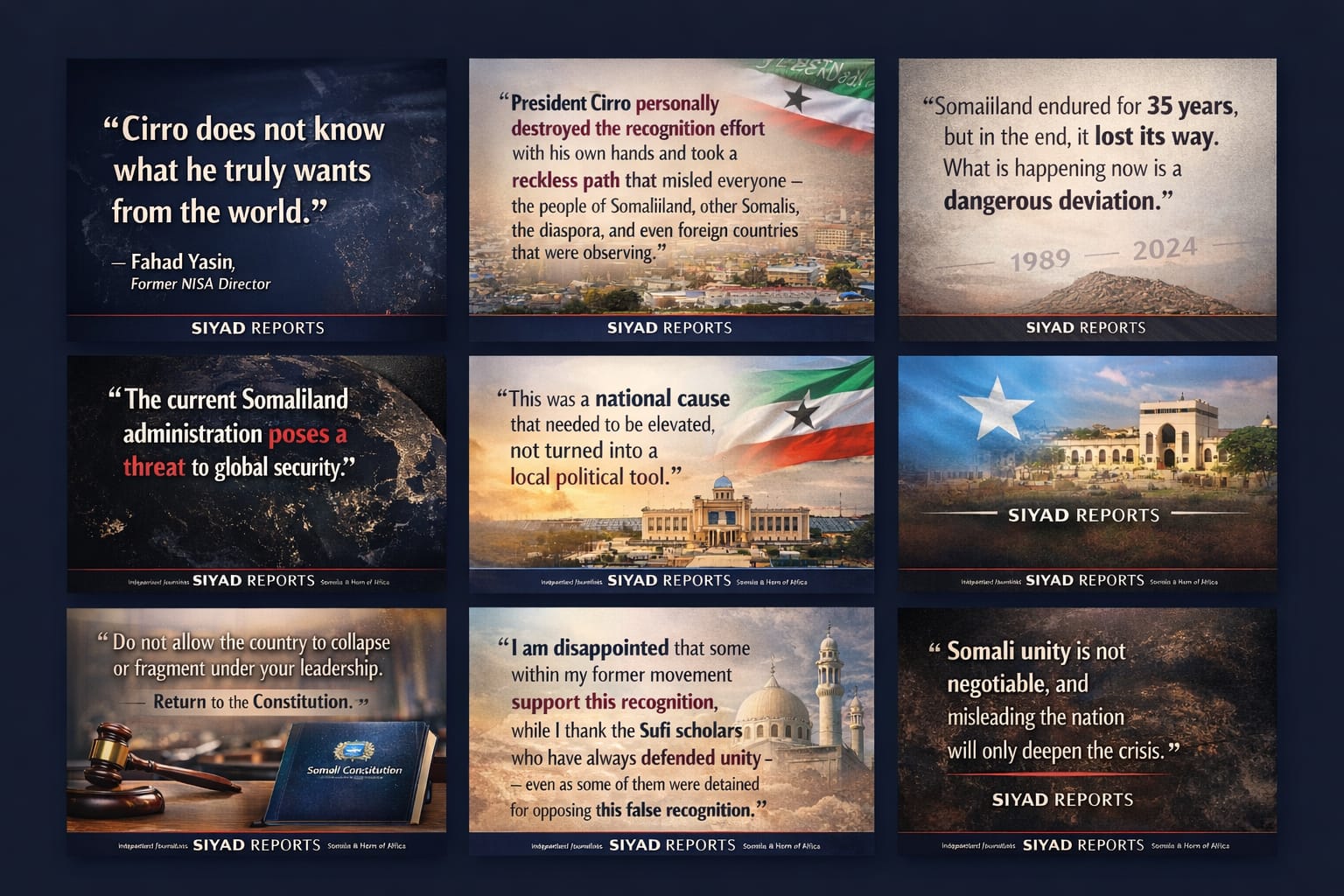
Fahad Yasin reserved his strongest criticism for Somaliland’s current leadership, particularly President Cirro, accusing him of pursuing what he described as a reckless and poorly thought-out recognition strategy.
According to Fahad, Somaliland’s leadership has failed to present a coherent vision to the international community, instead constructing political narratives that shift blame onto southern Somalia while shielding itself from internal accountability.
“Cirro does not know what he genuinely wants from the world,” Fahad said, referring to what he claimed were contradictory messages Somaliland leaders have communicated internationally in their quest for recognition.
He argued that the recognition drive has not only backfired diplomatically but has also undermined Somali unity and endangered the future of the current generation. Fahad went further, accusing Somaliland’s administration of aligning itself with foreign interests in a manner that threatens both regional and global security claims that have sparked intense debate and condemnation from Somaliland supporters.
Federal Government Response and Criticism of President Hassan Sheikh
Turning his attention to Mogadishu, Fahad claimed that Somalia’s intelligence and political institutions were aware in advance of the developments surrounding Somaliland’s recognition efforts. However, he sharply criticized the Federal Government of Somalia (FGS) for what he described as a weak and poorly coordinated response.
In particular, Fahad accused President Hassan Sheikh Mohamud of turning what he called a national cause into a tool for local political gain.
“This was a national issue that required elevation and unity, not political exploitation,” Fahad said, warning that mishandling such matters could deepen fragmentation.
He issued a direct appeal to the president, urging him to return to constitutional governance and cautioning against decisions that could lead to national disintegration.
Escalating Tensions: Religious Claims and Government Pushback
Fahad’s remarks extended into the religious sphere, where he expressed disappointment at what he described as support for Somaliland’s recognition among certain Islamist groups, while praising Sufi clerics for what he said was their historical role in defending Somali unity. He also alleged that some clerics in Hargeisa had been detained for opposing what he termed a “false recognition narrative,” claims that have not been independently verified.
The controversy intensified further when Somalia’s Deputy Minister of Information posted a pointed statement on Facebook widely interpreted as an indirect attack on Fahad Yasin. Without naming him, the deputy minister accused a former official of hypocrisy and recalled allegations linked to his tenure at NISA, stating:
“The city where he once terrorized the people, he now lives in peacefully.
The hotels he once attacked, he now celebrates in.
The microphones he once silenced, he now speaks into freely yet he continues to insult the very same people he treated this way.”
The post revived longstanding accusations that NISA, under Fahad’s leadership, was involved in human rights abuses and suppression of dissent allegations Fahad has consistently denied.
A Polarizing Figure in a Polarized Political Moment
Fahad Yasin’s renewed public presence comes at a sensitive moment for Somalia, as the country navigates diplomatic realignments and internal political tensions. While he has publicly welcomed the federal government’s decision to downgrade relations with the United Arab Emirates, his sharp criticism of both Somaliland’s leadership and the federal presidency underscores his continued role as one of Somalia’s most polarizing figures.
Whether Fahad’s remarks contribute to meaningful national dialogue or further deepen political divisions remains uncertain.
What is clear, however, is that Somalia’s struggle over unity, governance, and foreign influence is far from settled and voices from the past continue to shape the country’s contested future.
Trending
- Media Citizens Front Set to Host Third Annual Wajir County Media Summit on Electoral Integrity and Peaceful Elections
- ELDAS AT A POLITICAL CROSSROADS: ABDILLE YUSSUF’S 2027 AMBITION, ADAN KEYNAN’S FUTURE AND THE BATTLE OVER LEADERSHIP RENEWAL
- YOUTHFUL SENATORIAL ASPIRANT SHIMOY KHALIF “KAKA” OPENS UP ON HIS AMBITION, GOVERNANCE AGENDA AND VISION FOR WAJIR COUNTY
- INSIDE NAJMA ISSACK’S POLITICAL AMBITIONS, THE YOUTHFUL LEADERSHIP BID AND THE BATTLE FOR WOMAN REPRESENTATIVE
- INSIDE AFRICA HOUSE: THE SUSPECTED RUSSIAN INTELLIGENCE OPERATION THAT EXPOSES AFRICA’S SECURITY VULNERABILITIES
- ABIY AHMED’S ETHIOPIA AND THE SOMALI COST: MOYALE’S DEADLY CLASHES EXPOSE THE UNRESOLVED CRISIS OF TERRITORY, POWER AND FEDERAL RESPONSIBILITY
- WAJIR 2027: SHIMOY KHALIF ‘KAKA’ AND THE RISE OF A NEW GENERATION IN THE SENATE RACE
- THE FAI POLITICAL POWER GAME: MOHAMED FAI AND UGAS SHEIKH’S SURPRISE SIGNAL, THE TARBAJ MP QUESTION AND DR HASSAN FUJE’S GOVERNORSHIP TEST
Add A Comment