


For more than a decade, Northern Kenya has been one of the biggest beneficiaries of Kenya’s devolution experiment, at least on paper. Since 2013, counties such as Mandera, Wajir, Garissa, Marsabit, Samburu and Tana River have collectively received well over one trillion shillings in equitable share allocations, conditional grants, and special funds meant to correct decades of marginalisation. Devolution was sold to the people of these regions as a historic turning point a chance to fix broken health systems, build roads, expand access to clean water, strengthen education and create jobs in some of the country’s most neglected areas. Yet twelve years later, the promise of devolution remains painfully unfulfilled, and the gap between the money allocated and the reality on the ground continues to raise uncomfortable questions.
Across much of North Eastern and parts of northern Kenya, basic services remain fragile or non-existent. Hospitals lack drugs and equipment, roads are either incomplete or washed away after every rainy season, water projects stall halfway, and drought relief funds repeatedly vanish when communities need them most. Auditor-General reports year after year paint a grim picture of unsupported expenditures, inflated procurement costs, ghost projects and poor record-keeping. Civil society organisations and local whistleblowers have consistently flagged the misuse of public funds meant for health, water, education and emergency relief. Yet despite this mountain of red flags, accountability has been elusive.
It is against this backdrop that senior advocate and lawyer Donald Kipkorir posed a question that has resonated widely in legal, political and public circles.
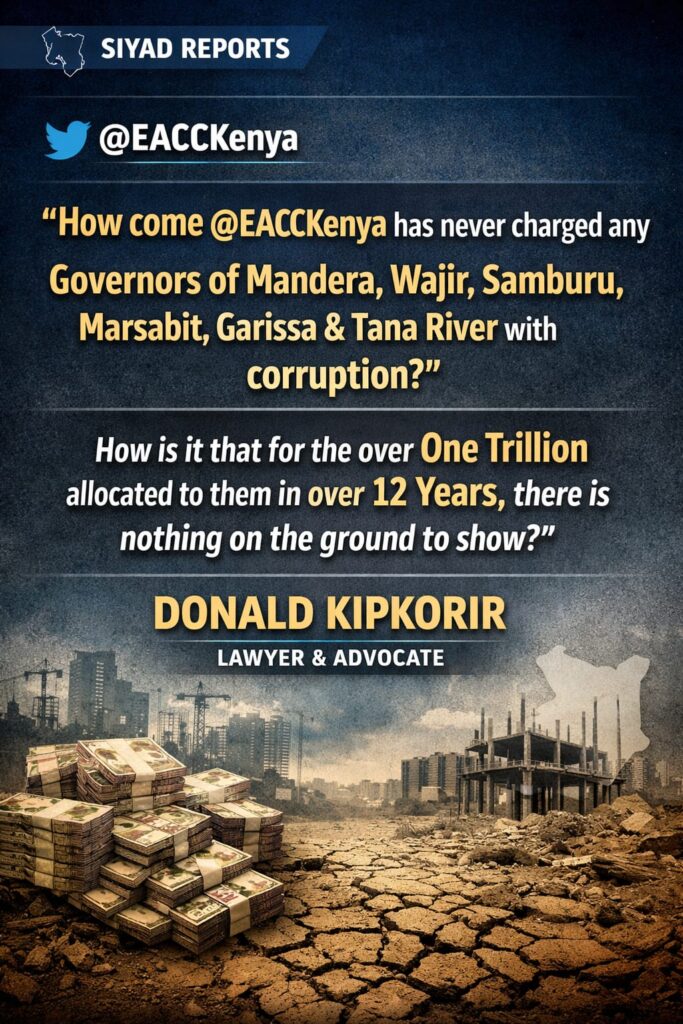
“How come @EACCKenya has never charged any Governors of Mandera, Wajir, Samburu, Marsabit, Garissa & Tana River with corruption? How is it that for the over One Trillion allocated to them in over 12 Years, there is nothing on the ground to show?” Kipkorir’s words capture a frustration that many Kenyans especially residents of these counties have quietly expressed for years. His question is not merely rhetorical; it strikes at the heart of the credibility of Kenya’s anti-corruption architecture.
The Ethics and Anti-Corruption Commission has often responded to such criticism by insisting that it does not target or shield any region. Recently, EACC Chief Executive Officer Abdi Mohamud dismissed claims that the commission selectively investigates certain counties while ignoring others. According to him, EACC investigations are guided strictly by law and policy, not geography or politics. He explained that cases are prioritised based on public interest, the amount of public funds involved, and the profile of the individuals implicated. On paper, this framework appears reasonable and fair.
However, when examined against the lived reality in North Eastern counties, the explanation feels insufficient. Time after time, the pattern is depressingly predictable: explosive audit reports raise serious concerns, credible whistleblowers provide details of how public funds were allegedly siphoned, citizens protest stalled projects and unpaid workers and then silence follows. There are no high-profile arrests, no governors hauled before courts, no landmark prosecutions that signal consequences for abuse of office. Files seem to disappear into institutional limbo, while political leaders complete their terms and, in some cases, return for re-election.
This persistent lack of visible accountability has had devastating consequences. First, it entrenches a culture of impunity where public office is viewed as a pathway to enrichment rather than service. Second, it deepens underdevelopment, as stolen resources translate directly into broken hospitals, dry boreholes and abandoned classrooms. Third, it erodes public trust not only in county governments but also in national oversight bodies tasked with protecting public resources. For communities already grappling with insecurity, climate shocks and poverty, corruption becomes yet another burden imposed from above.
Critically, this is not about singling out North Eastern Kenya as uniquely corrupt. Corruption is a national problem, cutting across counties and regions. Governors and officials from other parts of Kenya have faced arrest, prosecution and public trials, even if convictions remain rare. What raises concern is the apparent absence of similar enforcement outcomes in these specific counties despite the scale of funds involved and the consistency of adverse audit findings. When enforcement appears uneven, perceptions of selective justice inevitably take root.
The irony is that the people who suffer most from this failure of accountability are ordinary citizens of these counties pastoralists, traders, women, youth and internally displaced families not the political elites. Devolution was meant to empower them, not trap them in a cycle where billions flow into county coffers but little changes in daily life. Without credible investigations and prosecutions, corruption thrives in silence, shielded by political networks and institutional inertia.
Donald Kipkorir’s question, therefore, should not be dismissed as mere provocation. It should be treated as a serious call for introspection by Kenya’s anti-corruption agencies, Parliament, the Office of the Auditor-General and the criminal justice system. If indeed investigations are guided by public interest and the scale of funds, then few places should attract more scrutiny than regions that have received massive allocations while remaining visibly underdeveloped.
Until there is transparency on what happens after audit queries are raised, until investigations lead to arrests and prosecutions regardless of region, and until stolen public resources are recovered, the story of Northern Kenya will remain one of broken promises. One trillion shillings cannot simply evaporate without consequences. Accountability is not a favour to be granted; it is a constitutional obligation owed to every Kenyan, including those in the country’s most marginalised regions.