
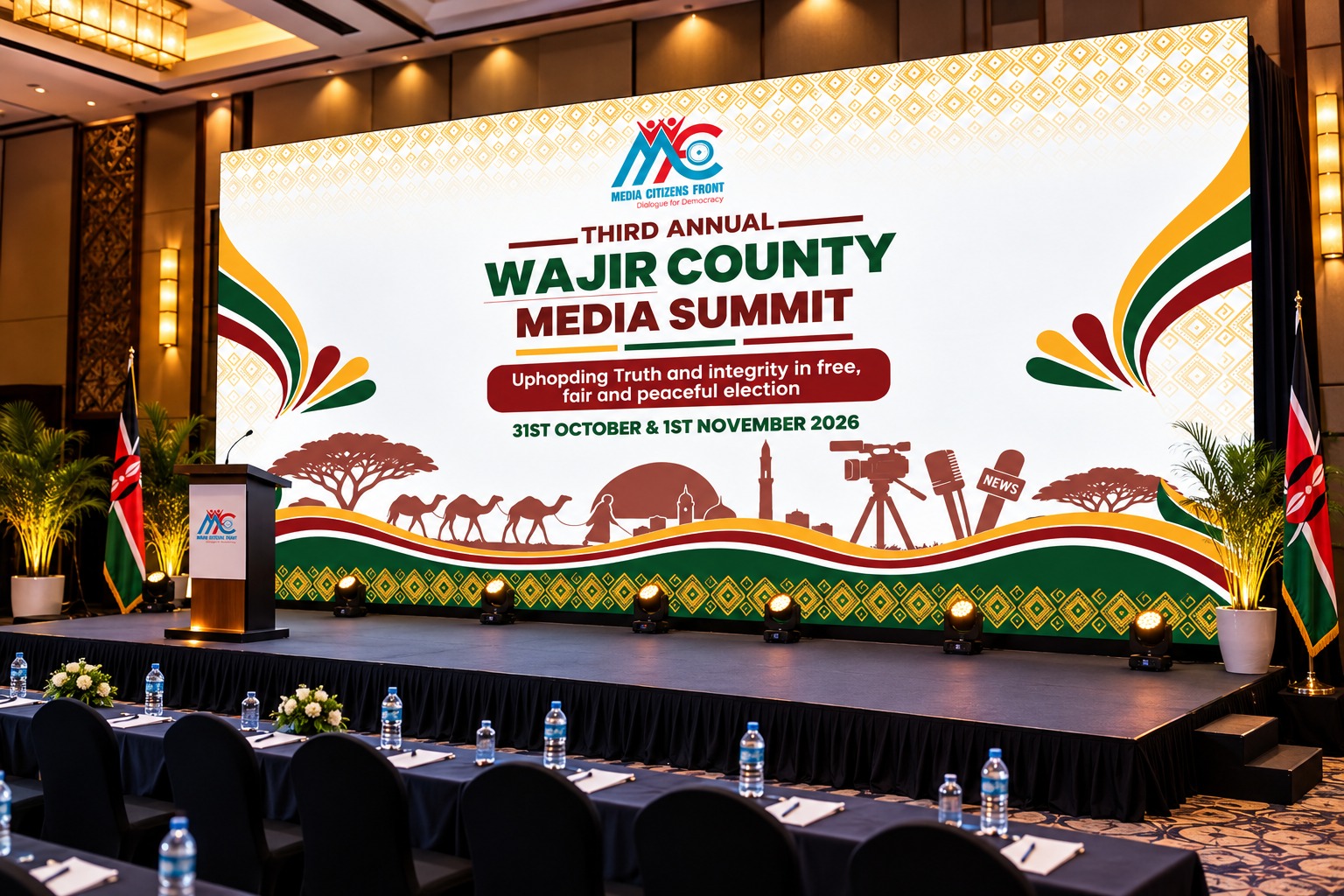
As Kenya gradually moves towards the 2027 General Election, the role of the media in safeguarding electoral integrity, countering misinformation and promoting peaceful political competition is coming into sharper focus, with the Media Citizens Front preparing to convene journalists and key stakeholders for the Third Annual Wajir County Media Summit on October 31 and November 1, 2026.
The two-day gathering, scheduled to take place at I Mall Hotel in Wajir County, will be held under the theme “Upholding Truth and Integrity in Free, Fair and Peaceful Elections,” placing responsible journalism, professional ethics and the media’s contribution to democratic stability at the centre of discussions.
Led by Chief Executive Officer Abdirahman Rashid Farah, the Media Citizens Front is positioning the annual summit as a platform for strengthening journalistic standards, encouraging professional collaboration and examining the responsibilities of media practitioners in an increasingly complex information environment.
This year’s summit is expected to bring together a broader cross-section of Kenya’s media industry, extending beyond the North Eastern region to include newsroom editors, representatives of media regulatory institutions, management and communication consultants, technology experts and other constitutional bodies. Their participation is expected to enrich discussions on the evolving relationship between journalism, technology, public accountability and electoral democracy.
At a time when information travels rapidly across traditional and digital platforms, the gathering comes against the backdrop of growing concerns about misinformation, disinformation, manipulated content and the potential consequences of irresponsible reporting during politically sensitive periods.
The summit will therefore provide an opportunity for journalists and other stakeholders to examine how accurate, impartial and independently verified reporting can help citizens make informed decisions while reducing the risks of political tension and election-related violence.
A central focus of the discussions will be election-responsive reporting, with participants expected to explore how journalists can cover political campaigns, candidates, electoral institutions and voting processes without compromising accuracy, fairness or professional independence.
The challenge facing newsrooms is not simply to report political developments as they unfold, but to ensure that the information reaching the public is verified, contextualised and presented responsibly. During election periods, unverified allegations, inflammatory statements and misleading narratives can spread quickly, making editorial judgement and rigorous fact-checking particularly important.
Through discussions on media ethics and elections, the summit is expected to examine the practical responsibilities of journalists when covering competing political interests, handling sensitive allegations and reporting on communities whose political differences could heighten tensions.
Another key area of discussion will be misinformation and disinformation, including the growing challenge of fake news surrounding election results. As political actors and members of the public increasingly rely on digital platforms to share information, false claims about voting, tallying and the announcement of results can undermine public confidence in electoral institutions.
Participants are expected to consider how journalists can strengthen verification procedures, distinguish credible information from fabricated claims and communicate clearly with audiences during moments of uncertainty. The discussions are also likely to reinforce the importance of relying on authorised sources and established verification processes when reporting on election outcomes.
The growing use of artificial intelligence in news production will form another important component of the summit. While emerging technologies offer opportunities to improve research, production and information verification, they also introduce risks through manipulated images, fabricated audio, misleading videos and other forms of synthetic content.
The summit’s focus on maintaining human control in the use of artificial intelligence highlights the need for journalists to exercise professional judgement rather than rely uncritically on automated tools. Editorial accountability, transparency and independent verification remain essential, particularly when AI-generated material could influence public opinion or intensify political divisions.
Beyond technology and newsroom practice, the gathering will also address the media’s role in advocating for zero election violence. Kenya’s experience with electoral competition has demonstrated the importance of peaceful political participation and the need for institutions, political leaders and citizens to uphold democratic principles even when disagreements emerge.
Journalists have a significant responsibility in this process. Through balanced reporting, responsible language and careful treatment of politically sensitive issues, the media can contribute to informed public debate and help prevent the spread of narratives that encourage hostility between communities.
At the same time, the summit is expected to highlight gender-sensitive election reporting, an area that remains important as women seek greater representation and participation in political leadership. Discussions are expected to consider how newsrooms can provide fair coverage of women candidates, avoid gender-based stereotypes and ensure that political reporting focuses on policies, leadership records and public accountability rather than discriminatory narratives.
The participation of women, youth, religious leaders, elders and other community representatives is expected to broaden the conversation on the relationship between journalism and peaceful democratic participation. Civil society organisations, non-governmental organisations and development partners will also be among the stakeholders expected to attend, alongside representatives of the National Government and the County Government of Wajir.
The diversity of participants is expected to create opportunities for dialogue between journalists, policymakers, regulators and community actors whose work intersects with public information, governance and democratic accountability.
For Wajir County and the wider North Eastern region, the summit also offers an opportunity to strengthen the visibility of local journalism within national media conversations. Journalists working in the region often cover issues involving governance, public services, security, development and community relations, making professional training, collaboration and ethical reporting particularly relevant.
By bringing regional journalists into conversation with national media professionals and institutional representatives, the gathering can help encourage the exchange of experience and ideas on how local reporting can remain accurate, independent and responsive to the needs of the public.
The summit comes at a consequential moment for Kenya’s democratic process, with the 2027 General Election expected to intensify political activity and public debate in the months ahead. The quality of election coverage will be an important part of how citizens understand competing political claims, assess public leadership and engage with the electoral process.
While the media cannot independently guarantee peaceful elections, professional journalism can contribute to an environment in which citizens have access to credible information, political disputes are reported responsibly and public debate is informed by facts rather than rumours.
As preparations continue, the Third Annual Wajir County Media Summit is expected to provide a platform for renewed reflection on these responsibilities and the standards required of journalists in the run-up to the next election.
Ultimately, the gathering’s significance will extend beyond the two days of discussions in Wajir. Its impact will depend on how the lessons shared translate into newsroom decisions, stronger verification practices, more inclusive reporting and sustained commitment to professional ethics.
For the Media Citizens Front, the summit represents an opportunity to advance conversations about journalism’s place in a democratic society at a time when public trust, electoral credibility and peaceful political participation remain essential national priorities.
As Kenya approaches another major electoral cycle, the central question confronting the media will be how to report the contest with accuracy, independence and fairness while protecting the public’s right to reliable information.
The Third Annual Wajir County Media Summit seeks to place that responsibility firmly at the heart of the national conversation.