

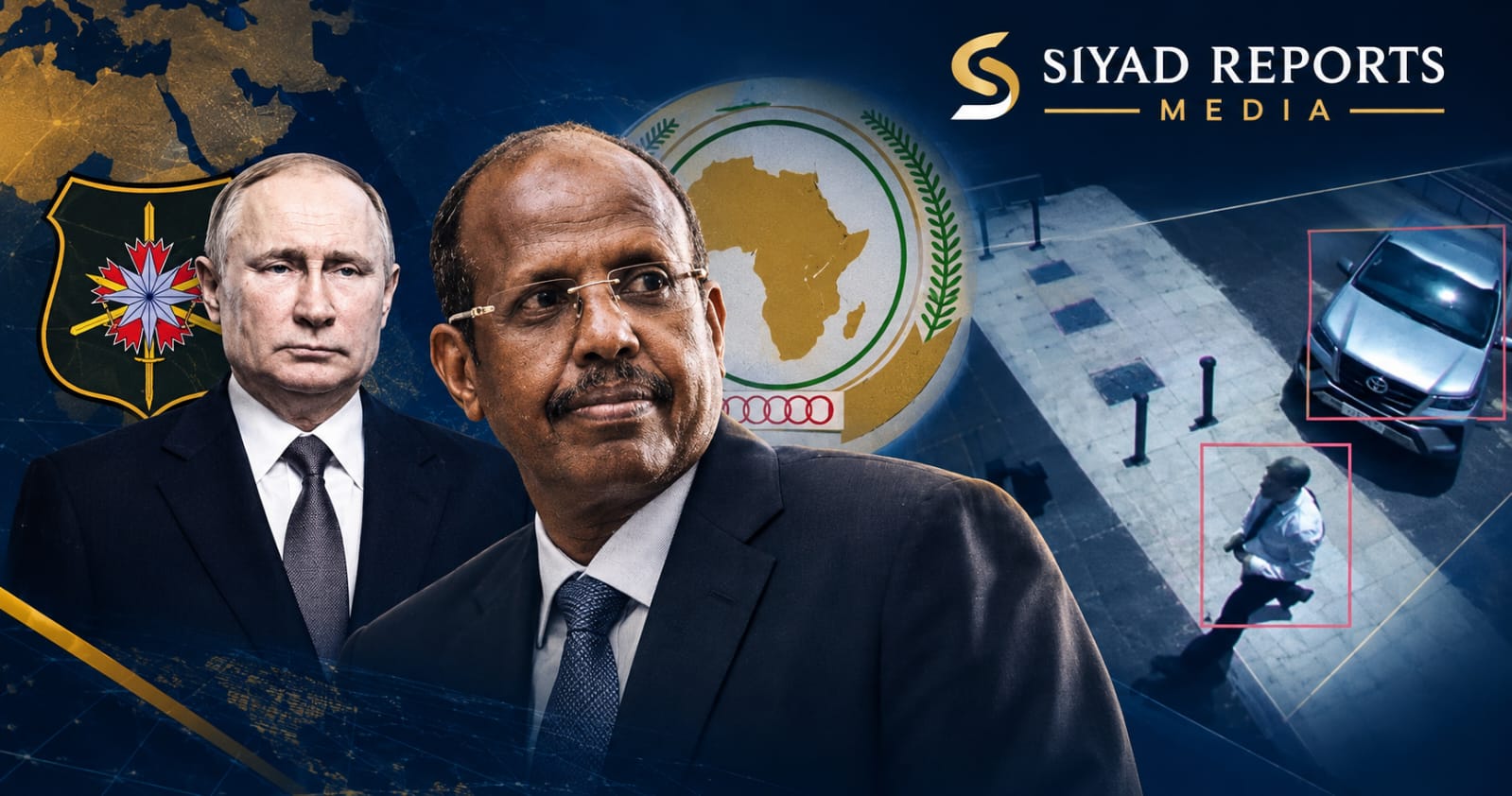
The reported intrusion into the Addis Ababa residence of African Union Commission Chairperson Mahmoud Ali Youssouf raises a troubling question about the security of Africa’s highest diplomatic institutions: what happens when the people responsible for protecting the continent’s political leadership cannot establish who has entered the room?
According to an investigation by The Insider published on October 23, 2026, a man identified as Russian military intelligence officer Aleksandr Dubikov allegedly entered the residence occupied by Youssouf in the Ethiopian capital, walked towards the chairperson’s bedroom and left within minutes.
The investigation, drawing on security camera footage, facial recognition technology and records examined by the publication, has raised suspicions of a possible intelligence operation linked to Russia’s military intelligence agency, the GRU.
The significance of the incident extends far beyond an alleged security breach at a diplomatic residence. It touches on Russia’s expanding intelligence activities across Africa, Ethiopia’s strategic importance to Moscow and the vulnerability of continental institutions entrusted with shaping Africa’s political, diplomatic and security future.
Yet the central mystery remains unresolved: investigators have not established what Dubikov allegedly did inside the bedroom, and the available account does not conclusively demonstrate what, if anything, he intended to obtain.
The details described by The Insider are particularly striking because of the apparent ease with which the man gained entry. On April 28, 2025, Youssouf was living with his family at Africa House, a residence officially associated with African Union Deputy Commission Chairperson Selma Haddadi. Youssouf had recently moved from Djibouti after serving as the country’s foreign minister before being elected to lead the African Union Commission.
At approximately 3:32 p.m., a vehicle carrying diplomatic registration reportedly arrived outside the residence. A man dressed in a white shirt, tie and dark trousers waited for an opportunity to enter. According to the investigation, he followed a vehicle carrying Youssouf’s daughter through the entrance, bypassing the normal security screening process. He then proceeded towards the chairperson’s bedroom.
The man reportedly remained inside the property for four minutes and 24 seconds. After encountering Youssouf’s daughter, he exited the building, where security personnel briefly stopped him. However, the guards allegedly appeared uncertain about his identity and status, allowing him to return to his vehicle and leave the compound at approximately 3:38 p.m.
If the account is accurate, the most disturbing aspect of the incident may not be the identity of the alleged intruder but the apparent failure of the security arrangements surrounding one of Africa’s most senior officials. A residence occupied by the head of the African Union Commission should be protected by procedures capable of identifying every visitor, verifying diplomatic credentials and preventing unauthorised access, regardless of how convincingly an individual presents himself.
The incident also illustrates a longstanding challenge in diplomatic security: the privileges and appearances associated with diplomatic life can create opportunities for deception when verification procedures are inadequate. A diplomatic registration plate, formal clothing or apparent familiarity with security personnel should never substitute for independently confirmed authorisation.
The Insider identified the man as Major Aleksandr Dubikov, reportedly a military assistant to Nikita Zayats, a Russian official serving in Ethiopia. Zayats had previously been expelled from Portugal in 2022 amid suspicions of links to Russian military intelligence, according to the investigation. The publication further alleged that Dubikov himself was connected to the GRU.
These allegations, if substantiated, would place the incident within a wider pattern of concern about Russian intelligence activities abroad. However, an alleged intelligence affiliation does not, on its own, establish the purpose of a particular visit.
Without independently verified evidence of what happened inside the room, it remains impossible to determine whether the incident involved an attempted theft, surveillance, the installation of listening equipment or another objective entirely.
Nevertheless, the possibility that an individual linked to a foreign intelligence service could have accessed the private quarters of the African Union Commission chairperson presents a serious intelligence-security concern. The value of such access would not necessarily lie in obtaining a document or a physical device.
It could also lie in discovering information about the chairperson’s routines, private conversations, personal relationships or working environment.
For intelligence agencies, access to private spaces can potentially provide opportunities to collect information that would otherwise be difficult to obtain through conventional diplomatic channels. A bedroom or private residence may contain electronic devices, documents and personal communications that reveal details about an official’s activities.
Whether any such collection occurred at Africa House remains unknown, but the possibility explains why the alleged intrusion warrants serious scrutiny.
The investigation’s reported telephone records add another dimension to the allegations. The Insider said Dubikov had frequent contact with Vladislav Popov, whom the publication linked to Sandworm, a hacking group associated with Russian military intelligence. Sandworm has been implicated in destructive cyber operations, including the 2017 NotPetya attack, which caused extensive disruption to businesses and organisations internationally.
The alleged connection is significant because contemporary intelligence operations increasingly combine physical access, human intelligence and cyber capabilities. An individual entering a sensitive residence could, in principle, seek information through physical documents, electronic equipment or access to communications systems.
However, the reported telephone contacts do not establish that Dubikov participated in Sandworm operations or that the Africa House incident involved a cyber operation. Such conclusions would require evidence beyond an association between individuals.
The broader geopolitical context is equally important. Since the death of Wagner Group founder Yevgeny Prigozhin in August 2023, Russia’s security presence in Africa has evolved, with state-directed military structures, including Africa Corps, assuming roles previously associated with Wagner in several countries. Alongside these military deployments, Russia continues to pursue diplomatic, economic and intelligence interests across the continent.
These activities form part of Moscow’s wider effort to strengthen its influence in Africa at a time when competition among global powers is intensifying. Russian engagement has included security partnerships, political relationships and efforts to cultivate support in international institutions.
For Moscow, Africa is not merely a collection of bilateral relationships; it is also an arena where diplomatic alignment, access to resources and strategic partnerships can reinforce its global position.
The African Union occupies a particularly important place in this contest. Its decisions and diplomatic positions influence debates on regional conflicts, sanctions, international representation and relations with major powers. The chairperson of its Commission is not the leader of a sovereign state, but the office carries considerable diplomatic significance because it sits at the centre of the organisation’s administrative and political machinery.
Any credible suspicion that a foreign intelligence service sought unauthorised access to the Commission chairperson’s private environment therefore raises questions that extend beyond personal security.
Could sensitive institutional information have been exposed? Were established security protocols followed? Did the incident trigger a comprehensive investigation? And were the findings shared with the relevant African Union member states?
The reported strengthening of security at Africa House following the incident would suggest that the authorities recognised the seriousness of the situation. But improving physical protection is only one part of the response. A credible investigation would also need to examine access logs, diplomatic vehicle records, electronic security systems and any evidence of tampering with devices or documents.
It would need to establish how the alleged intruder entered, why he was not intercepted earlier and whether any other individuals or institutions could have been affected.
Ethiopia’s position adds further complexity. Addis Ababa hosts the African Union headquarters and numerous diplomatic missions, making it one of the continent’s most important centres of international diplomacy. Its longstanding relationship with Russia has also given Moscow an established presence in the country. The Insider cited observers who described Ethiopia as an important base for Russian intelligence activity in the region.
That strategic relationship does not establish that Ethiopian authorities knew about or facilitated the alleged intrusion. Indeed, the investigation reportedly left unanswered whether the Ethiopian government had identified Dubikov’s alleged role or was aware of the suspicions surrounding his activities. Any assessment of official responsibility must therefore distinguish between the existence of diplomatic relations, allegations about an individual and evidence of state involvement.
The unanswered questions are particularly consequential because the incident reportedly dates back to April 2025, while the investigation appeared publicly in October 2026. The passage of time raises questions about when the relevant authorities first became aware of the incident, what investigative steps followed and whether the African Union considered the matter serious enough to review security arrangements at other senior officials’ residences.
The Insider said it sought a response from Youssouf’s office but did not receive one. Without a detailed response from the African Union, the Ethiopian government or the Russian authorities, important aspects of the allegations remain unverified. Their silence, where reported, should not be treated as proof of wrongdoing, but the seriousness of the claims makes a clear official account important.
The timing also places the controversy against the backdrop of the third Russia-Africa summit scheduled for October 28 and 29, 2026, in Moscow. The summit, expected to bring together Russian and African leaders, reflects Moscow’s determination to maintain and expand its relationships across the continent. The reported incident could complicate discussions about trust, security cooperation and the balance between diplomatic partnership and national sovereignty.
For African governments, the lesson is not that cooperation with Russia, or any other international partner, should automatically be treated with suspicion. Rather, strategic relationships must be accompanied by robust safeguards that protect African institutions from unauthorised interference, irrespective of the country involved. Diplomatic engagement and security cooperation cannot come at the expense of institutional independence.
Ultimately, the Africa House allegations present the African Union with an opportunity to demonstrate that the security of its leadership and the integrity of its institutions are matters of continental importance. If the reported breach occurred as described, the organisation must establish what happened, determine whether confidential information was compromised and explain what measures have been taken to prevent a recurrence.
The most consequential question is not simply why a suspected Russian intelligence officer would enter the residence of the African Union Commission chairperson. It is whether Africa’s principal continental institution has the capacity to detect, investigate and respond decisively when its own security may have been compromised.
Until the evidence is fully examined and the relevant authorities provide a clearer account, the alleged purpose of the intrusion will remain uncertain.
But the wider warning is already clear: in an era of intensifying geopolitical competition, Africa’s diplomatic influence depends not only on the positions its leaders take in international affairs, but also on the strength of the institutions, security systems and independent decision-making processes that protect them.