

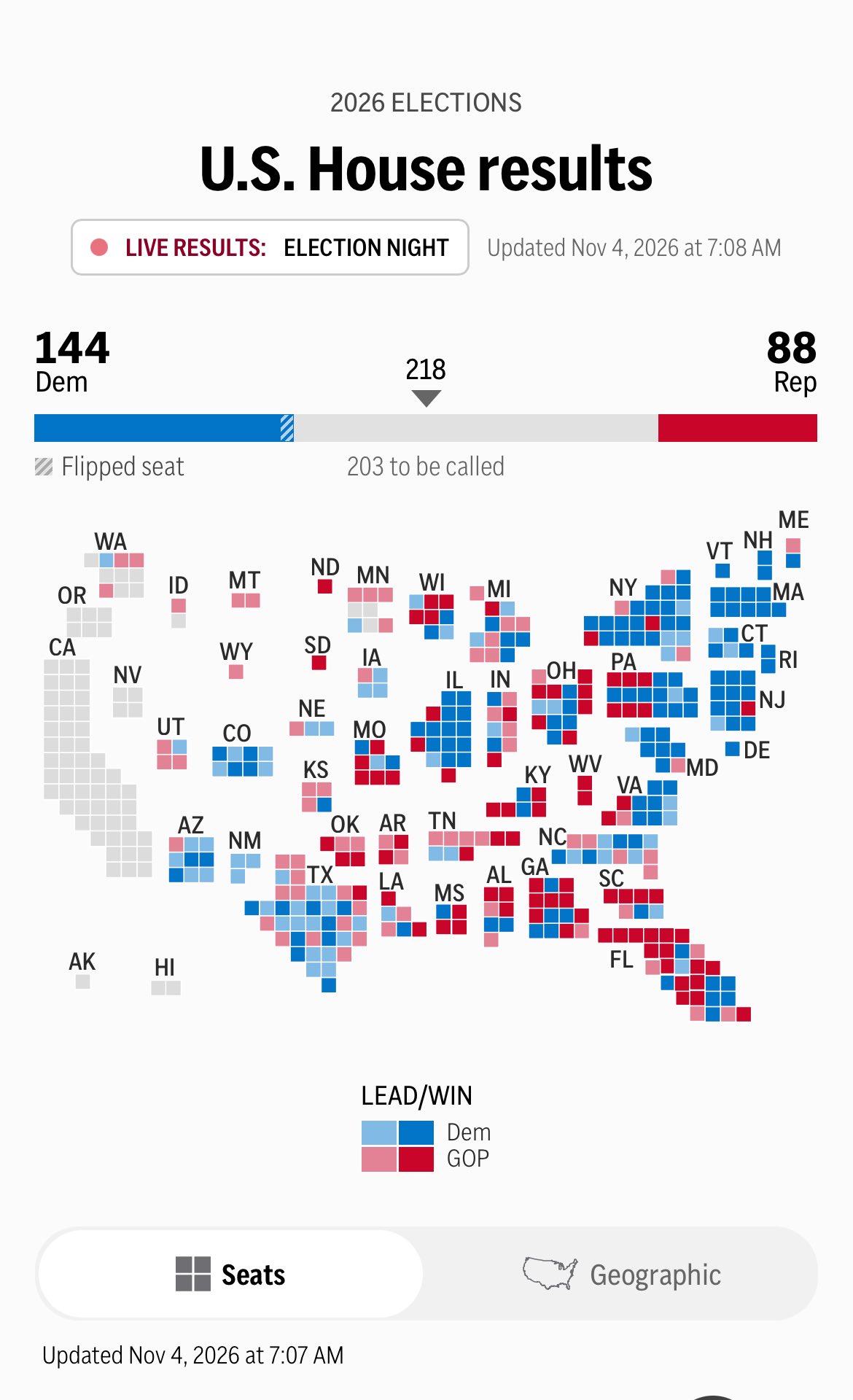
The Democratic Party is heading towards a major political comeback in the United States after it was projected that Democrats would take control of both chambers of Congress following Tuesday’s November 3 midterm elections, marking a significant reversal of the Republican Party’s control of Washington.
The projections come after a series of unexpected Democratic victories across several traditionally Republican states, with the party making substantial gains in the Senate, securing important gubernatorial victories and flipping congressional seats previously held by Republicans.
According to latest report, Democrats are projected to gain control of both the House of Representatives and the Senate when the new Congress takes office in January. The Associated Press has independently confirmed that Democrats have secured control of the Senate, while reporting that the House contest was approaching a Democratic majority as additional votes continued to be counted.
The Senate results represent one of the most consequential developments of the election night, with Democrats recording six major Republican-held seat flips in North Carolina, South Carolina, Texas, Ohio, Kansas and Iowa.
In North Carolina, former governor Roy Cooper defeated Republican Michael Whatley, delivering Democrats a crucial Senate victory. In South Carolina, Annie Andrews defeated Darline Graham to capture a seat previously held by Republicans, while James Talarico defeated Ken Paxton in Texas, ending decades of Republican dominance in statewide Senate elections.
Former senator Sherrod Brown also made a political comeback in Ohio, defeating Republican incumbent Jon Husted. Adam Hamilton secured victory in Kansas against Republican Roger Marshall, while Josh Turek won in Iowa, adding another Republican-held seat to the Democratic column.
Democrats also retained important Senate seats, with Jon Ossoff winning re-election in Georgia and Chris Pappas securing New Hampshire. Other Democratic victories included Chris Coons in Delaware, Cory Booker in New Jersey, Ed Markey in Massachusetts, Jack Reed in Rhode Island and Juliana Stratton in Illinois.
Republicans, however, maintained victories in some contests, including Florida, where Ashley Moody defeated Democrat Angie Nixon, and West Virginia, where Republican Shelley Moore Capito secured another term.
The gubernatorial elections also produced significant political changes, with Democrats capturing several Republican-held state governments.
In Texas, Democrat Gina Hinojosa defeated incumbent Republican Governor Greg Abbott, becoming the state’s first Latina governor and the first Democrat to win the governorship since 1990. Her victory represents one of the most remarkable outcomes of the election, given the state’s long-standing Republican political dominance.
Georgia also witnessed a historic change as Democrat Keisha Lance Bottoms defeated Republican Rick Jackson. Bottoms is set to become the state’s first woman governor and the first Black woman to serve as governor in the United States.
In Ohio, Democrat Amy Acton defeated Republican Vivek Ramaswamy, while Iowa’s Rob Sand secured victory against his Republican challenger, flipping another governorship previously held by Republicans.
Wisconsin also recorded a historic Democratic victory, with David Crowley defeating Republican Tom Tiffany to become the state’s first Black governor.
In California, Democrat Xavier Becerra defeated Republican Steve Hilton to succeed outgoing Governor Gavin Newsom. Democrats also retained key governorships, with JB Pritzker winning re-election in Illinois, Wes Moore in Maryland, Maura Healey in Massachusetts, Josh Shapiro in Pennsylvania and Kathy Hochul in New York.
The House of Representatives, which has 435 seats, was another major battleground in the election. Democrats made gains across several states, with NBC News projecting that the party would take control of the chamber after Republicans entered the election with a narrow majority.
Among the notable congressional developments, Democratic Representative Ilhan Omar was projected by Decision Desk HQ to retain Minnesota’s Fifth Congressional District, with the election forecast placing her chances of victory above 99 per cent.
In Pennsylvania, Democrat Janelle Stelson defeated Republican incumbent Scott Perry, flipping the state’s 10th Congressional District. Democrats also recorded gains in New Jersey, Kentucky and North Carolina, while Alabama Democrat Shomari Figures successfully defended his seat against a Republican challenge following congressional redistricting.
Other Democratic representatives, including Vicente Gonzalez in Texas and Greg Landsman in Ohio, also secured re-election despite facing challenges linked to redrawn congressional districts.
Although NBC News has projected Democratic control of both chambers, individual House races are still undergoing vote-counting and some outcomes remain subject to official confirmation. The final seat distribution will become clearer as election officials complete the remaining counts.
The results have also attracted national attention because of their implications for President Donald Trump’s administration. Republicans entered the election controlling both chambers of Congress, giving the president a unified government during the first half of his second term.
A Democratic takeover of Congress will significantly change the political balance in Washington, giving the opposition party greater influence over legislation, government oversight, congressional investigations and the administration’s policy agenda.
The Associated Press reported that concerns over the cost of living, dissatisfaction with the administration and demands for stronger congressional oversight were among the issues shaping voter decisions. Republican officials have also pointed to the political environment surrounding Trump’s administration as a factor behind the party’s losses.
Following the Democratic victories, Senate Democratic leader Chuck Schumer welcomed the outcome, saying Americans had voted for change. House Democratic leader Hakeem Jeffries also celebrated the party’s gains, with supporters chanting for him as he potentially moves closer to becoming Speaker of the House.
President Trump, meanwhile, said he was willing to accept the election results and work with Democrats, although he later criticised the Republican losses.
As counting continues in several outstanding races, the 2026 midterm elections are already emerging as a major political turning point in American politics, with Democrats preparing to return to congressional leadership and Republicans facing the prospect of divided government in Washington.
The election has raised a significant question about the direction of American politics: how will a Democratic-controlled Congress reshape the final two years of President Trump’s second term?