

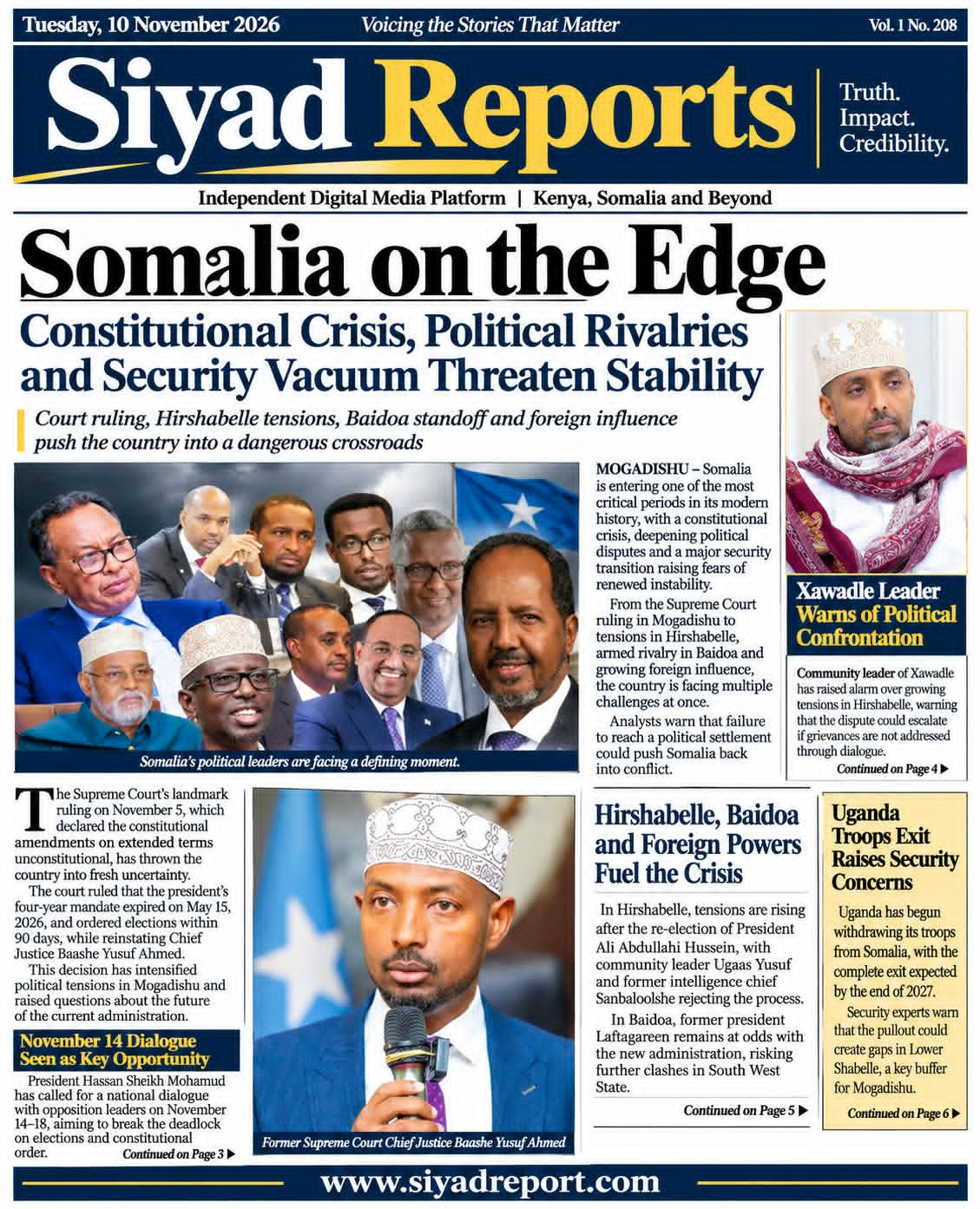
Somalia is approaching one of the most consequential moments in its recent political history. From the constitutional confrontation unfolding in Mogadishu to growing tensions in Hirshabelle, armed political rivalry in South West State and increasing competition among foreign powers, the country is facing multiple challenges that threaten to undermine its already fragile political and security architecture.
What makes the current situation particularly dangerous is not simply the number of disputes taking place, but the fact that they are unfolding simultaneously, with each crisis potentially reinforcing the other. At a time when Somalia needs political unity to strengthen its institutions and confront Al-Shabaab, its political leadership appears increasingly divided over power, legitimacy and the future direction of the state.
The latest development came on November 5, when Somalia’s Supreme Court delivered a significant ruling on the constitutional amendments passed in March. The amendments had extended presidential and parliamentary terms from four to five years, allowing President Hassan Sheikh Mohamud and the current parliament to remain in office until 2027. However, the court ruled that the extension could not automatically apply retrospectively to officeholders already serving under the previous constitutional framework.
The court determined that the president’s original mandate expired on May 15, 2026, while the mandates of both parliamentary houses and the federal government expired on April 14. It restricted the government to routine caretaker responsibilities, directed political stakeholders to agree on an electoral framework within 30 days and ordered elections within 90 days.
The court also nullified the president’s dismissal of Chief Justice Baashe Yusuf Ahmed, arguing that the executive lacked the constitutional authority to remove him unilaterally.
This ruling represents a major institutional setback for Hassan Sheikh Mohamud and introduces another layer of uncertainty into an already polarised political environment. However, the most important question is whether the judgment will be implemented and whether Somalia’s competing political institutions can agree on a peaceful constitutional way forward.
The timing could hardly be more sensitive. President Hassan Sheikh’s administration has invited opposition political groups and civil society representatives to a national consultative forum scheduled for November 14–18 in Mogadishu. The proposed discussions are intended to address disagreements over the electoral process and establish a common political understanding.
The meeting offers an important opportunity, but expectations should remain realistic. The opposition, particularly the Somali Future Council, has repeatedly challenged the government’s constitutional amendments and its unilateral approach to the electoral timetable. The electoral commission had already announced parliamentary elections for April 15, 2027, and a presidential election for May 15, 2027.
The Supreme Court’s ruling has now complicated that timetable considerably. The government and opposition must therefore confront a more fundamental question: who has the authority to determine Somalia’s political future when the constitutional legitimacy of the current institutions is being challenged?
Failure to reach an agreement during the November dialogue could deepen the confrontation and potentially turn a political disagreement into a struggle over competing claims of authority. Somalia cannot afford another political stalemate in which institutions become instruments of competing political interests.
While Mogadishu confronts this constitutional battle, another potentially explosive confrontation is developing in Hirshabelle, particularly in Hiiraan region.
The dispute centres on longstanding grievances among sections of the Hawadle community over political representation, power-sharing and the leadership of Hirshabelle. The re-election of President Ali Abdullahi Hussein Guudlaawe on October 24 has intensified those disagreements, with sections of the community rejecting the electoral process and questioning the legitimacy of the regional administration.
The situation has become increasingly sensitive following the involvement of traditional leader Ugaas Yusuf Ugaas Hassan and former National Intelligence and Security Agency director Abdullahi Mohamed Ali, popularly known as Sanbaloolshe.
Sanbaloolshe has emerged as one of the prominent political figures challenging the Hirshabelle leadership process. He has rejected the October election and called for a different political arrangement that addresses the grievances of communities in Hiiraan.
Tensions escalated further when newly elected Hirshabelle Vice President Abdifatah Hassan Afrah and Sanbaloolshe arrived in Beledweyne on November 7, accompanied by armed supporters. Their simultaneous presence raised fears of a possible confrontation between rival political camps.
Reports also indicated that opposition-aligned armed groups had taken control of government facilities, including the Hiiraan regional administration headquarters at Lama Galay. Traditional leaders have subsequently warned the federal government against using military force to resolve the political dispute.
President Hassan Sheikh has attempted to address some of the grievances, including proposing that Beledweyne could become Hirshabelle’s regional capital. However, Sanbaloolshe rejected the proposal, arguing that the decision must emerge from an inclusive agreement between the communities of Hiiraan and Middle Shabelle rather than being imposed by the federal presidency.
The underlying problem is much bigger than the location of a regional capital. It concerns the relationship between Mogadishu and federal member states, the distribution of political authority and whether communities feel adequately represented in the institutions governing them.
If the federal government responds to these grievances primarily through security deployments rather than negotiations, it risks transforming a political dispute into another armed confrontation. Such an outcome would be particularly damaging in a region where local community forces have previously played an important role in fighting Al-Shabaab.
A similar struggle for political control is unfolding in South West State, where former president Abdiaziz Hassan Mohamed Laftagareen remains locked in confrontation with the administration led by Sheikh Adan Mohamed Nur Madobe.
The crisis intensified in March when federal forces took control of Baidoa, forcing Laftagareen from office. Madobe subsequently assumed leadership with the backing of Mogadishu. Laftagareen and his supporters have rejected the political transition and continued to challenge the new administration.
The dispute has increasingly moved beyond political statements into armed confrontation. Fighting has been reported around Baidoa, including renewed clashes in September and October. Laftagareen-aligned forces have also reportedly taken control of strategic locations in Bay region, including Buurhakaba and Qansahdhere, although the situation on the ground remains contested.
The involvement of federal troops and regional forces supporting Madobe has made the dispute particularly dangerous. Baidoa is not simply another political centre; it is a major humanitarian hub hosting hundreds of thousands of people displaced by conflict and drought.
Every new confrontation threatens civilian lives, humanitarian operations and the security of communities already facing severe economic hardship.
There is also a wider geopolitical dimension to this conflict. Reports of meetings between Madobe and Ethiopian military officials, alongside allegations of external military involvement in fighting around Baidoa, demonstrate how local political disputes can become connected to regional security interests. Allegations concerning Turkish aircraft involvement have also circulated, although they have not been independently established.
This brings Somalia’s external relationships into sharper focus.
The United Arab Emirates and Türkiye have become two particularly influential foreign actors in Somalia’s political and security environment. Their competing relationships with different Somali political institutions and regional administrations have added another dimension to the country’s internal disagreements.
In January 2026, Mogadishu announced the cancellation of its defence and security cooperation agreements with the UAE, accusing Abu Dhabi of undermining Somalia’s sovereignty. The decision was rejected by regional administrations including Puntland, Jubaland and Somaliland, which maintained their own relationships with Emirati institutions and businesses.
The UAE has important economic and strategic interests in the Horn of Africa, including port operations and security partnerships. Its relationships with regional administrations that have disagreements with Mogadishu have consequently become part of the wider political conversation.
Türkiye, meanwhile, has developed a close strategic relationship with the federal government, including military training, defence cooperation and major economic investments. Its growing influence has attracted criticism from some opposition figures who question whether external military partnerships could affect Somalia’s internal political balance.
Other regional actors, including Ethiopia, Egypt, Qatar and Saudi Arabia, also have strategic interests in Somalia and the wider Horn of Africa. Ethiopia’s security interests, particularly around its borders and access to the Red Sea, intersect with Somalia’s federal politics. Egypt and Ethiopia have competing regional interests, while Saudi Arabia and Qatar have expanded their diplomatic and security relationships with Mogadishu.
However, it is important not to assume that every Somali opposition movement is directed by a foreign capital. Somali political actors have their own domestic grievances, ambitions and constituencies. The greater concern is that competing domestic elites may seek external backing to strengthen their negotiating positions, creating opportunities for foreign governments to influence internal political developments.
Somalia’s sovereignty is therefore being tested not only by disagreements within its institutions but also by the strategic interests surrounding its territory, ports, military partnerships and position along the Gulf of Aden.
Perhaps the most immediate security concern is emerging from the planned withdrawal of Ugandan troops.
Uganda began withdrawing troops deployed under bilateral arrangements with the federal government in early November. The country has also announced plans to complete the withdrawal of all its forces, including those serving under the African Union Support and Stabilization Mission in Somalia (AUSSOM), by the end of 2027.
Ugandan forces have played a central role in Somalia’s security operations since 2007. Their presence has been particularly important in Mogadishu and parts of Lower Shabelle, where military positions have helped protect strategic routes and contain Al-Shabaab’s movements.
The African Union mission has raised concerns about possible security gaps following the withdrawal, particularly around positions such as Bariire, Awdheegle and other strategically important areas. The challenge is whether Somali national forces possess the necessary personnel, equipment, funding and operational coordination to take over these positions effectively.
Lower Shabelle is particularly important because of its geographical proximity to Mogadishu. A deterioration in security there could expose the capital to increased militant pressure and undermine the government’s ability to protect strategic infrastructure.
Al-Shabaab does not need Somalia’s political institutions to collapse completely to benefit from the current situation. It only needs divisions among political leaders, weakened security coordination and military resources redirected from counterterrorism operations towards internal political confrontations.
This is precisely why the convergence of these developments should concern every Somali citizen.
Somalia is facing a constitutional confrontation in Mogadishu, political resistance in Hirshabelle, armed rivalry in South West State, competing foreign interests and a major security transition. Each development presents its own challenges, but together they create a dangerous environment in which the gains made against insurgency and institutional fragility could be reversed.
The responsibility for preventing such an outcome rests primarily with Somali political leaders. The November 14 dialogue must become more than another political gathering or an opportunity for competing leaders to exchange accusations. It must produce a credible agreement on elections, constitutional authority, federal relations and the future of the country’s institutions.
The federal government must recognise that political legitimacy cannot be sustained through constitutional amendments alone, while opposition leaders must also demonstrate that their pursuit of political change will not deepen insecurity or encourage armed confrontation.
Regional administrations must resolve their internal disagreements through inclusive political processes, and foreign partners must respect Somalia’s sovereignty rather than allow domestic divisions to become extensions of wider geopolitical rivalries.
Somalia has spent decades attempting to rebuild a functioning state after years of conflict. Its people have endured terrorism, displacement, political fragmentation and repeated institutional setbacks.
The country cannot afford to return to a situation where political competition becomes a substitute for governance and armed groups become the beneficiaries of disagreements among those entrusted with protecting the nation.
The danger is no longer confined to Mogadishu, Beledweyne or Baidoa. It is national, and its consequences could extend across the Horn of Africa.
Somalia is approaching a decisive crossroads. Its leaders must choose between political compromise and confrontation, between strengthening national institutions and deepening fragmentation.
The window for preventing another devastating chapter of instability is narrowing. What happens in the coming weeks could determine whether Somalia moves towards a more credible political settlement or slides into another prolonged period of uncertainty.