

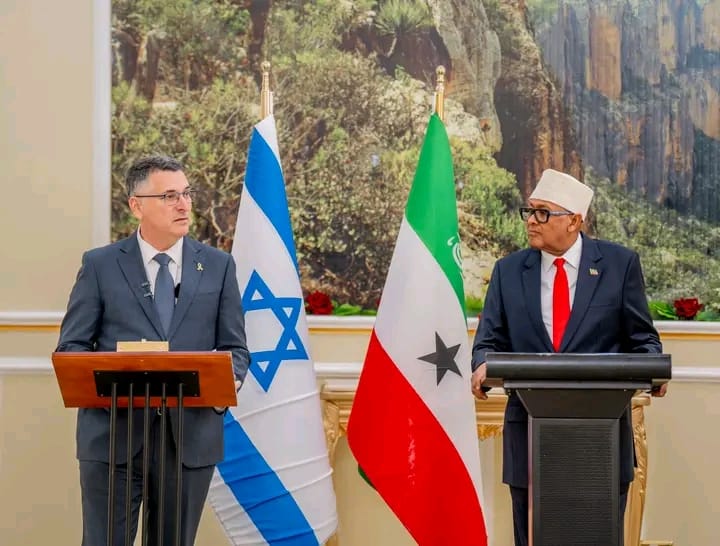
Israel’s Foreign Minister Gideon Sa’ar arrived in Hargeisa on Tuesday morning for talks with Somaliland President Abdirahman Mohamed Abdullahi Irro, where both sides pledged to strengthen ties and finalize multi-sector cooperation agreements. Somaliland also revealed that Israel expressed readiness to support its long-standing bid for international recognition a major symbolic breakthrough for a territory that has sought statehood since 1991 but remains internationally recognized as part of Somalia.
Somalia reacted immediately and forcefully. In a strongly worded press statement, the Federal Ministry of Foreign Affairs condemned the visit as an “unauthorized incursion,” describing it as a violation of Somalia’s sovereignty, territorial integrity, and unity. Mogadishu insisted that Hargeisa remains an inseparable part of Somalia and declared any foreign diplomatic activity conducted without federal approval as legally void. Somalia also called on the United Nations, African Union, Arab League, and Organization of Islamic Cooperation to reaffirm support for its internationally recognized borders.
The African Union echoed this stance, stressing that no external actor has the authority to redraw the borders of a member state, warning that any attempt to do so is invalid under international law. This reflects the AU’s long-standing reluctance to legitimize secessionist claims, fearing ripple effects elsewhere in Africa.
Competing Regional Power Blocs Take Shape
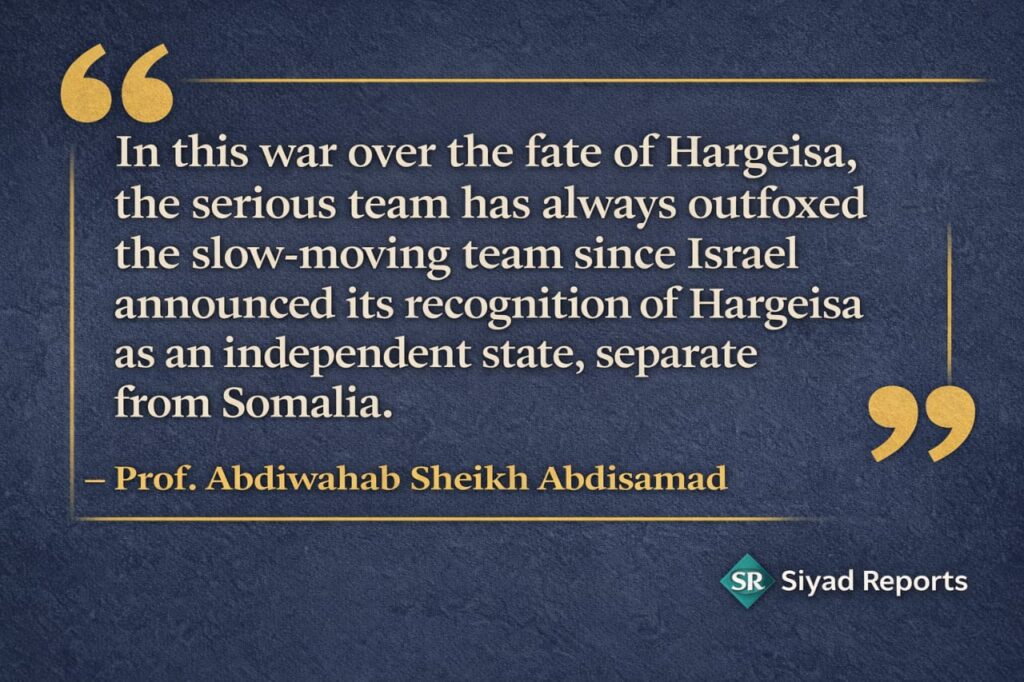
This development exposes a deeper geopolitical contest unfolding in the Horn of Africa. Horn of Africa analyst Prof. Abdiwahab Sheikh Abdisamad described the visit as a “diplomatic earthquake,” arguing that it reflects a rivalry between two competing camps.
One camp assertive, fast-moving, and strategically driven is seen as being led by Israel, the UAE, and Ethiopia. This bloc views Somaliland as a valuable strategic partner along the Red Sea corridor, offering potential security cooperation, intelligence coordination, and economic access. Their engagement suggests a willingness to challenge traditional diplomatic constraints.
On the other side is a second camp influential but reactive consisting of Somalia, Turkey, Egypt, Saudi Arabia, and Djibouti. Prof. Abdiwahab argues that this group has repeatedly been outmaneuvered diplomatically, with the Israeli visit seen as both a humiliation and a strategic warning.
He questions why policymakers in Mogadishu and allied capitals did not anticipate such a high-risk diplomatic move.
The episode highlights how the Horn of Africa has become a chessboard for competing global and regional interests where recognition politics, security influence, and economic stakes intersect.
Airspace Control and the E-Visa System: A Challenge to Somali Authority
The visit also raises uncomfortable questions about Somalia’s control over its airspace and immigration systems. The Federal Government maintains that all aviation oversight and visa entry procedures fall under its authority further reinforced by the introduction of a centralized Somalia e-visa system, requiring travelers to gain federal approval.
Yet the Israeli foreign minister’s smooth entry into Hargeisa suggests either a bypass of these procedures or an increasing willingness by foreign governments to treat Somaliland as an autonomous gateway.
For Mogadishu, this is more than a procedural issue, it is a challenge to state legitimacy and sovereignty enforcement.
It also underscores the legal grey zone Somaliland operates in: unrecognized globally, yet increasingly engaged diplomatically.
What This Means for the Horn of Africa
Israel’s outreach to Hargeisa likely reflects multiple objectives from securing Red Sea influence to countering rival powers already embedded in the region. Somaliland gains international visibility and leverage in its recognition campaign.
Somalia, meanwhile, is expected to intensify diplomatic lobbying among allies such as Turkey, Egypt, Saudi Arabia, and the AU, while strengthening control over airspace governance and federal authority.
But critics warn that Somalia must act with greater strategic speed to avoid being repeatedly outmaneuvered.
Several key questions now hang over the region:
Will Israel take steps toward formal recognition?
Will other states follow its lead?
Can Somalia consolidate international backing?
And will airspace control become a frontline sovereignty dispute?
What is certain is that this was far more than a symbolic visit. It marks a turning point in the regional balance of power, placing Somaliland recognition back on the global agenda while testing the limits of international law on state sovereignty.
The Horn of Africa now enters a period of heightened uncertainty where diplomacy, law, security strategy, and political ambition collide. And as events continue to unfold, it may be the actors who move fastest rather than those with the greatest resources —
who ultimately shape the future of Hargeisa, Somalia, and the wider region.