

A growing political storm has erupted after former Deputy President Rigathi Gachagua appeared to link Somali-owned businesses to alleged financial crimes in the United States, remarks that North Eastern MPs say risk fueling division, mistrust, and hostility toward an entire community.
Led by Dadaab MP Hon. Farah maalim alongside Hon. Mohamed Abdikeir, Major Bashir Abdullahi and Hon. Yusuf Hassan, the legislators delivered a strong rebuttal at the Parliament Media Centre, warning that reckless political rhetoric is reopening painful wounds around discrimination and ethnic profiling in Kenya.
The Heart of the Dispute: Security Narrative vs Community Identity
The MPs accused Gachagua of carelessly tying Somali entrepreneurs to unverified foreign investigations, despite the lack of any evidence implicating Kenyan businesses. They described his words as discriminatory and misleading the kind of language, they argued, that normalizes suspicion toward Kenyans of Somali heritage.
They called on the National Cohesion and Integration Commission (NCIC) to urgently intervene and investigate the remarks, warning that unchecked hate speech could inflame tensions and undermine national unity.
Somali entrepreneurs, the MPs stressed, have contributed enormously to Kenya’s economy. From Eastleigh’s business boom to major real estate investments nationwide, the community is deeply embedded in the country’s commercial growth story. They argued that tarring a whole community with suspicion is not only unjust it destabilizes economic confidence.
One emotional flashpoint was the reference to the owner of BBS Mall, whom the MPs defended as an “innocent, hardworking businessman” unfairly dragged into allegations that have no grounding in Kenyan law. They warned against trial-by-politics, saying livelihoods and reputations were being placed at risk.
“This Is Ethnic Profiling” — Leaders Push Back Hard
Dadaab MP Farah Maalim issued one of the strongest statements yet, accusing Gachagua of normalizing Somali-phobia:
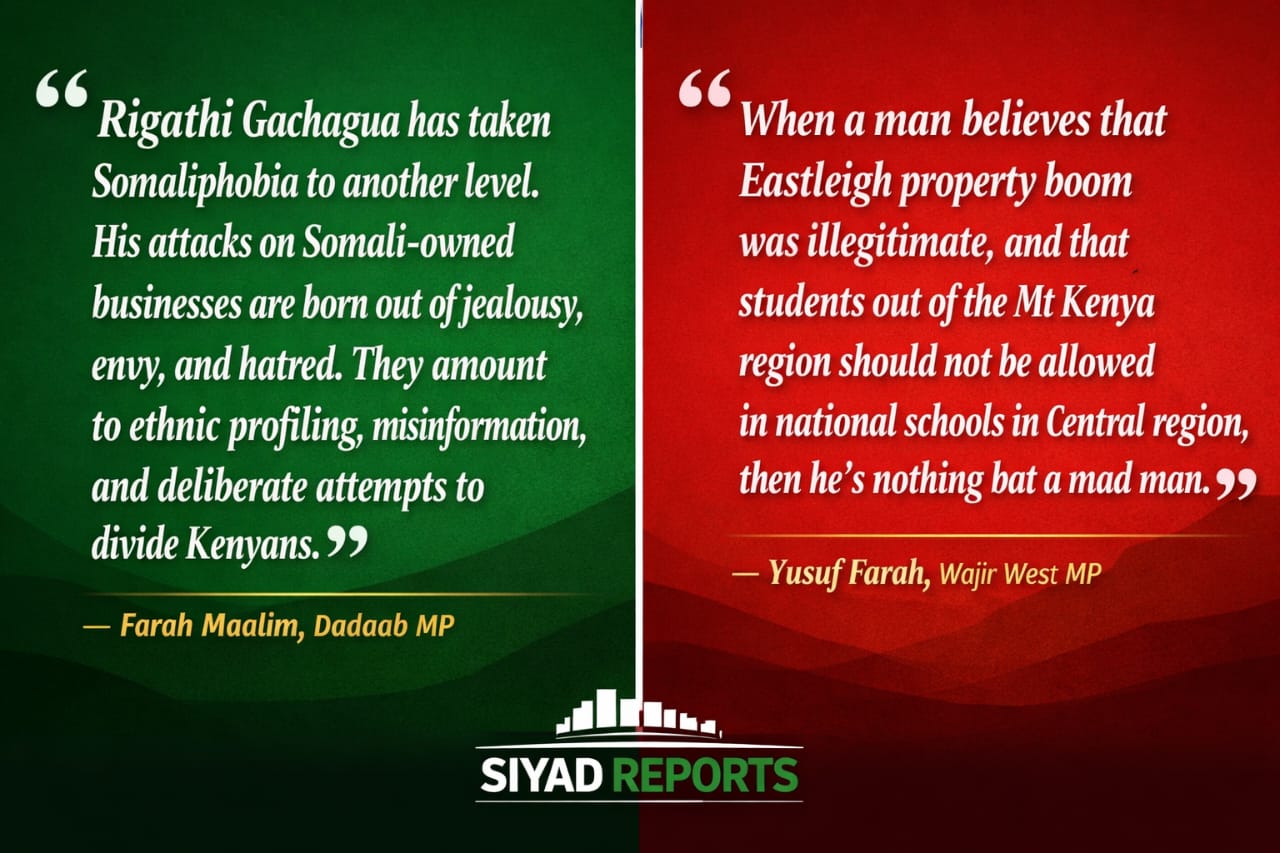
“Rigathi Gachagua has taken Somaliphobia to another level. His attacks on Somali-owned businesses are born out of jealousy, envy, and hatred. They amount to ethnic profiling, misinformation, and deliberate attempts to divide Kenyans,” he said.
He further reminded Kenyans that the Somali community is not a guest population but part of the Kenyan story since independence.
Wajir West MP Yusuf Farah went even further, calling Gachagua’s remarks extreme and dangerous:
“When a man believes that Eastleigh property boom was illegitimate, and that students outside the Mt Kenya region should not be allowed in national schools in Central region, then he’s nothing but a mad man,” he declared.
Their tone signaled frustration but also a refusal to allow silence to be misinterpreted as acceptance.
A History Kenya Knows Too Well
Ethnic profiling is not new in Kenya. Communities in North Eastern and Somali-populated areas have long complained of collective suspicion particularly in periods of heightened security concern.
From Operation Usalama Watch to ID verification crackdowns, Somali-Kenyan citizens have often found themselves needing to “prove” belonging. Critics argue that such measures blur the line between security policy and discrimination.
That is why this latest controversy is hitting a raw nerve.
To many in the North Eastern political class, Gachagua’s framing feeds into a historical narrative where an entire community becomes defined by suspicion rather than citizenship.
The Bigger Question: What Kind of Kenya?
Beyond political exchanges, this debate forces Kenya to confront a deeper national question:
Can security discourse coexist with fairness, dignity, and equal citizenship?
The MPs insist it must and that leadership should unite, not stigmatize. They urged restraint in public messaging, warning that political survival should never come at the expense of national harmony.
Their closing call was clear: Kenya belongs to all its communities. Business owners, workers, families, and students of Somali heritage are as Kenyan as anyone else and deserve the same presumption of innocence.
As the NCIC and wider public watch closely, this moment may prove to be more than just another headline but a test of Kenya’s commitment to justice, inclusion, and unity in diversity.
Trending
- Media Citizens Front Set to Host Third Annual Wajir County Media Summit on Electoral Integrity and Peaceful Elections
- ELDAS AT A POLITICAL CROSSROADS: ABDILLE YUSSUF’S 2027 AMBITION, ADAN KEYNAN’S FUTURE AND THE BATTLE OVER LEADERSHIP RENEWAL
- YOUTHFUL SENATORIAL ASPIRANT SHIMOY KHALIF “KAKA” OPENS UP ON HIS AMBITION, GOVERNANCE AGENDA AND VISION FOR WAJIR COUNTY
- INSIDE NAJMA ISSACK’S POLITICAL AMBITIONS, THE YOUTHFUL LEADERSHIP BID AND THE BATTLE FOR WOMAN REPRESENTATIVE
- INSIDE AFRICA HOUSE: THE SUSPECTED RUSSIAN INTELLIGENCE OPERATION THAT EXPOSES AFRICA’S SECURITY VULNERABILITIES
- ABIY AHMED’S ETHIOPIA AND THE SOMALI COST: MOYALE’S DEADLY CLASHES EXPOSE THE UNRESOLVED CRISIS OF TERRITORY, POWER AND FEDERAL RESPONSIBILITY
- WAJIR 2027: SHIMOY KHALIF ‘KAKA’ AND THE RISE OF A NEW GENERATION IN THE SENATE RACE
- THE FAI POLITICAL POWER GAME: MOHAMED FAI AND UGAS SHEIKH’S SURPRISE SIGNAL, THE TARBAJ MP QUESTION AND DR HASSAN FUJE’S GOVERNORSHIP TEST
Add A Comment