

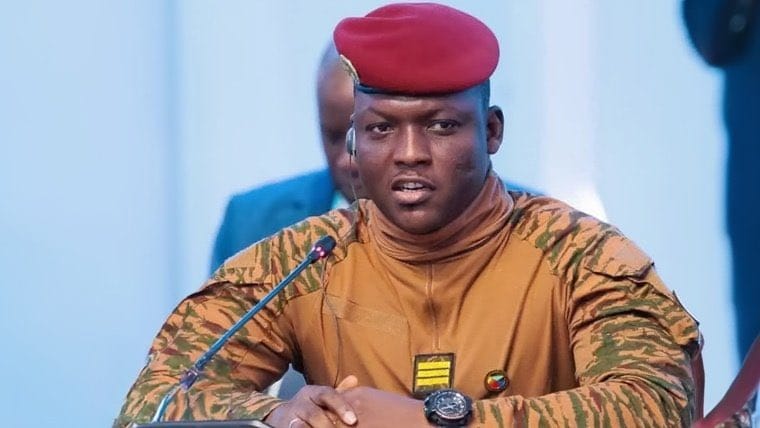
Burkina Faso’s military government says it has thwarted what it calls a major plot to assassinate President Ibrahim Traoré and destabilize the state the latest sign of persistent political tension in the coup-prone West African nation.
Security Minister Mahamadou Sana announced that the alleged conspiracy was orchestrated by Lieutenant-Colonel Paul-Henri Damiba, the former junta leader who was overthrown by Traoré in September 2022 and now lives in exile in neighboring Ivory Coast.
According to the government, the plan involved “targeted assassinations” of senior military and civilian officials, with Traoré identified as the primary target. Authorities allege conspirators intended to kill the president either at close range or by bombing his residence, while also preparing attacks on the presidential palace and other key locations in Ouagadougou.
The junta further claimed that the operation received financial support from Ivory Coast totaling 70 million CFA francs (approximately $116,000). As of early January 2026, neither Ivorian authorities nor Damiba had issued public responses to the accusations.
Officials say multiple arrests have been made and insist the situation is under control. Security forces have increased patrols and operations in the capital to neutralize any remaining threat.
Nineteenth Attempt on Traoré’s Life
Authorities described this as the 19th known attempt on President Traoré’s life since he seized power at age 34, making him one of Africa’s youngest military rulers. His government has portrayed the repeated threats as part of a broader pushback against its nationalist and anti-French agenda, as well as its intensified war against jihadist insurgents.
The allegations emerged against the backdrop of a nationwide state of emergency, as Burkina Faso continues to battle militants linked to al-Qaeda and the Islamic State groups that still control vast rural areas and have displaced millions.
In response to the revelations, thousands of Traoré’s supporters took to the streets of Ouagadougou, rallying in solidarity with the president and praising his rejection of “foreign interference.”
For now, the junta says the plot has been fully contained. But the incident underscores the fragility of power in Burkina Faso a nation now navigating both internal political rivalries and the relentless threat of extremist violence.
Analysis: A Continent Still Wrestling With the Legacy of Coups
Burkina Faso’s turmoil is part of a wider historical pattern across Africa, where coups and military takeovers have shaped political life since independence.
A Brief Historical Context
From the 1960s onward, newly independent African states struggled with weak institutions, contested leadership, and Cold War interference. Military officers often justified coups as necessary to restore order, fight corruption, or realign the state but many ended up cementing authoritarian rule.
Countries such as:
Nigeria (1966, 1983, 1985, 1993)
Ghana (1972, 1979, 1981)
Sudan (several coups, most recently in 2019 and 2021)
Mali (2020 and 2021)
Niger (2023)
Guinea (2021)
have all undergone repeated military interventions.
Burkina Faso itself has one of Africa’s most turbulent records, with multiple coups since 1966 including the overthrow of revolutionary leader Thomas Sankara in 1987.
Why Coups Persist
Analysts often point to a mix of:
Weak democratic institutions
Economic hardship
Elite power struggles
Security crises
Public distrust of political elites
In the Sahel, worsening jihadist insurgencies have further eroded civilian authority, creating openings for military strongmen who promise stability.
The Human and Political Cost
Frequent overthrows weaken national cohesion, stall development, and sow uncertainty. They discourage investment, disrupt governance, and fuel recurring cycles of instability where one military regime replaces another without addressing root causes.
A New Wave of Military Rule
Africa has recently witnessed a resurgence of coups, especially in West Africa. This trend reflects deep frustrations with corruption, inequality, and foreign influence issues that leaders like Traoré have exploited rhetorically to sustain popular support.
But as history shows, military governments rarely deliver long-term democratic stability. Instead, they often institutionalize power struggles, ensuring that new coups remain a constant threat.
The alleged assassination plot against Ibrahim Traoré highlights the fragile reality of power in Burkina Faso and the broader challenge facing parts of Africa still locked in cycles of military rule and political upheaval.
As long as insecurity, weak governance, and public mistrust persist, the continent’s struggle to move beyond coups may continue with deep consequences for democracy and stability across the region.