

Kenya is currently engaged in a heated national debate following remarks by former Deputy President Rigathi Gachagua on leadership, accountability, and development in North Eastern Kenya. The reaction has been predictable outrage, ethnic defensiveness, counter-accusations, and political posturing. But strip away the noise, and what remains is an uncomfortable reality that millions of citizens in Wajir, Garissa, and Mandera have endured silently for over a decade.
This is not a debate about Rigathi Gachagua. It is not about Kikuyu politics, tribal supremacy, or political scores. It is about money, power, betrayal, and the daily suffering of ordinary citizens whose leaders have failed them spectacularly.
Since the advent of devolution in 2013, North Eastern Kenya has received staggering amounts of public money. Conservative estimates put the figure at well over KSh 1 trillion when equitable share, conditional grants, donor-supported programs, and NGCDF allocations are combined. Mandera alone has received over KSh 119 billion, Wajir approximately KSh 99.6 billion, while Garissa County has received well over KSh 100 billion over the same period.
Thirteen years later, the question is simple and brutal: where is the development?
Drive through Wajir town the county headquarters and home to the current Chairperson of the Council of Governors and the answer confronts you immediately. Broken roads. Poor development, Inadequate water supply. No visible transformation befitting a county that has received nearly KSh 100 billion. Entire streets resemble neglected trading centers rather than a devolved unit with fiscal autonomy.
Venture outside the town and the picture worsens. In some constituencies, children still learn under trees, without classrooms, laboratories, libraries, or desks in the year 2026. This is not metaphorical. It is literal. Meanwhile, NGCDF allocations meant for classrooms and learning facilities have flowed uninterrupted for over a decade.
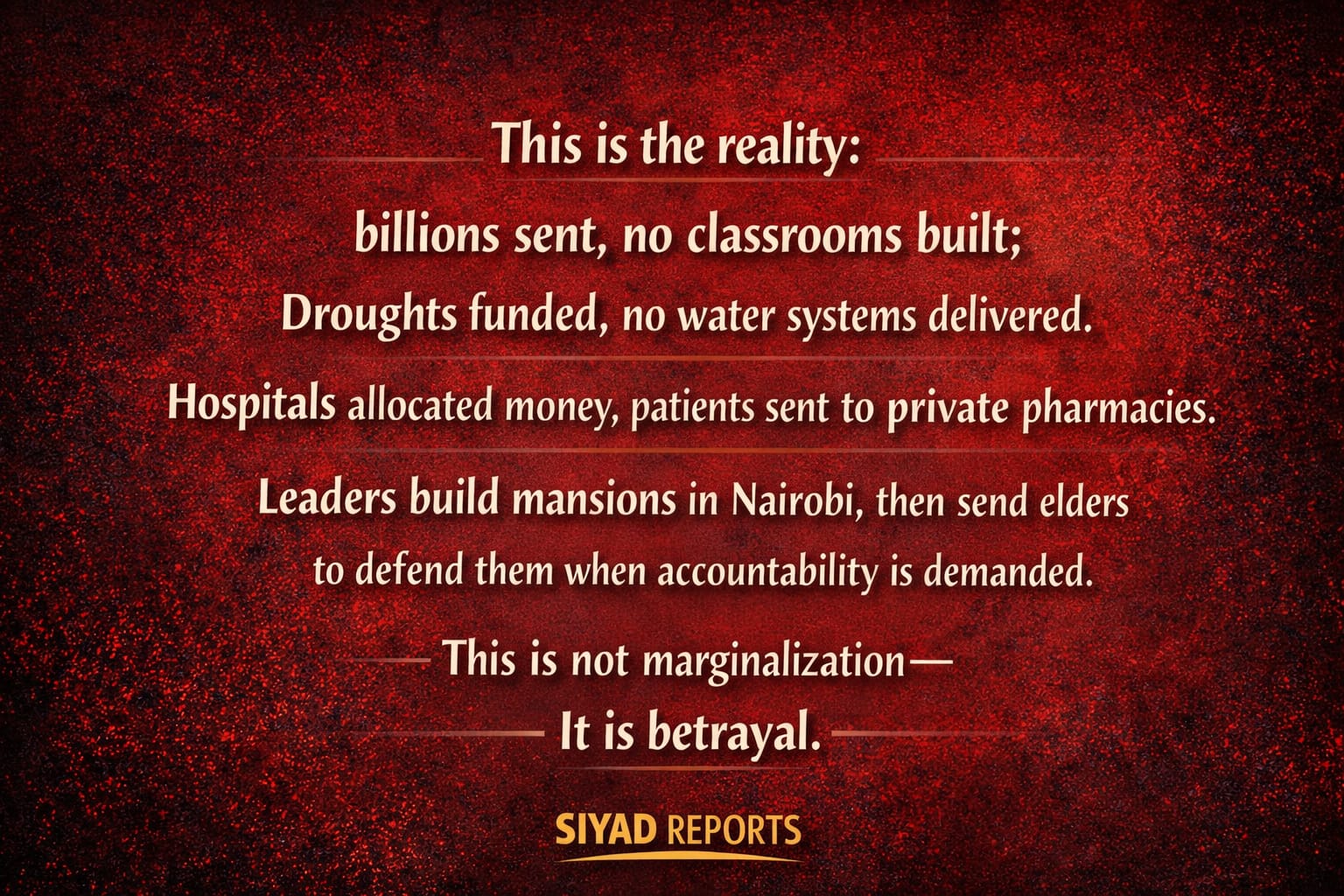
Healthcare tells an equally disturbing story. Counties boast of “referral hospitals” on paper, but on the ground patients are routinely told to buy medicine from private pharmacies because public facilities are empty. Equipment is missing or dysfunctional. Specialists are unavailable. Emergencies often mean risky referrals to other counties or Nairobi. Billions allocated to health have produced institutions that exist more in reports than in reality.
Drought, the region’s most predictable challenge, exposes the deepest failure. Despite billions allocated for water projects, livestock protection, climate resilience, and disaster preparedness, every drought still descends into crisis. Relief food replaces planning. Fundraisers replace foresight. The question keeps returning: what happened to the money meant to prepare for this?
Former Deputy President Rigathi Gachagua ignited this debate when he bluntly told North Eastern leaders to “leave Eastleigh and South C”, Nairobi neighborhoods where many have invested heavily and return home to build proper schools, hospitals, and roads. He questioned how counties could receive tens of billions and still lack world-class institutions. He challenged the continued use of marginalization as an excuse after 13 years of devolution.
The reaction from regional leaders was swift and defensive. Accusations of tribalism and ethnic profiling followed. Calls were made for the National Cohesion and Integration Commission to intervene. Yet notably absent from many responses was a detailed, transparent account of how public funds have been used and why results remain so poor.
Wajir Governor Ahmed Abdullahi responded by daring Gachagua to compare Wajir’s use of devolution funds with any county of his choice, arguing that allocations should be prorated and that devolution was never meant to equalize Kenya in just over a decade. He also claimed that Gachagua had never visited Wajir during his tenure as Deputy President.
The governor’s response raises an important point but it does not answer the core question. Even without comparisons to other counties, what exactly has nearly KSh 100 billion achieved in Wajir? Why does the county headquarters itself reflect neglect? Why do schools lack classrooms? Why do hospitals lack medicine? Why do residents still travel long distances for basic services? These are not theoretical questions. They are lived realities.
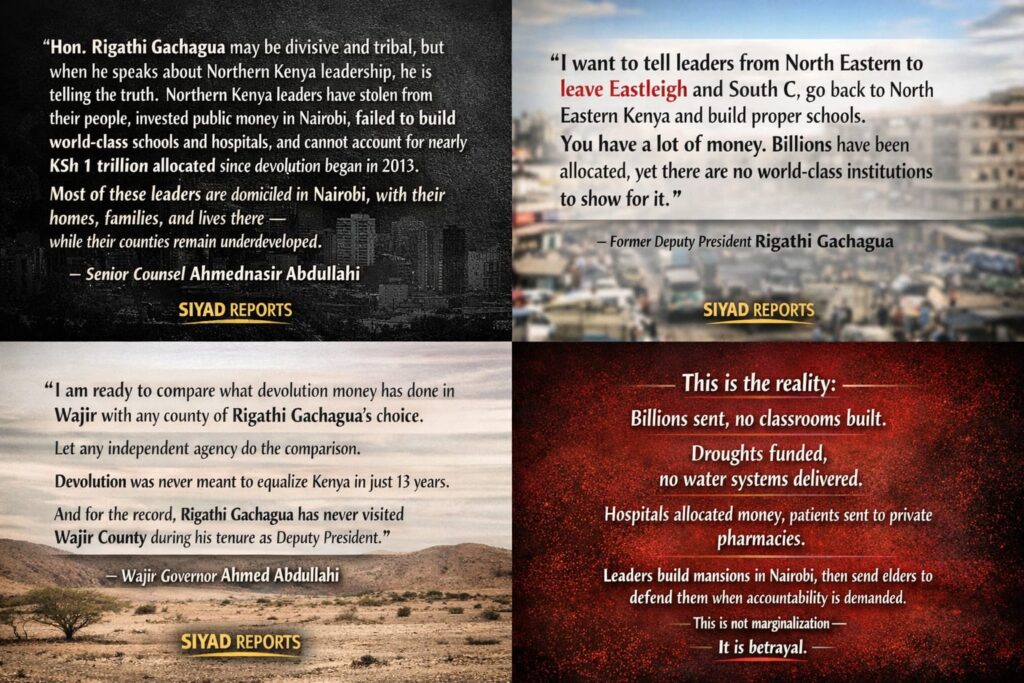
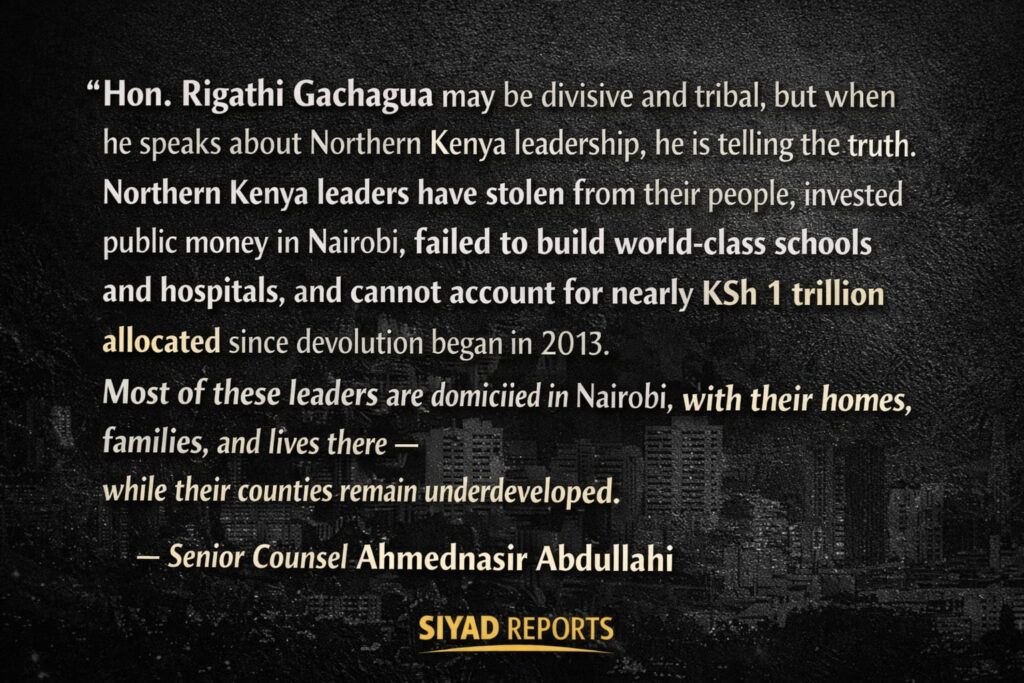
Senior Counsel Ahmednasir Abdullahi took the debate further, stating bluntly that while Rigathi Gachagua may be divisive, his critique of Northern Kenya leadership is largely accurate. Ahmednasir accused leaders from the region of stealing public funds, investing them in Nairobi, failing to build world-class institutions, and being permanently domiciled outside their counties. He questioned how hundreds of billions could be allocated with so little to show for it, citing Garissa and Marsabit as additional examples of chronic failure.
These are heavy accusations but they resonate because ordinary citizens see the evidence daily. Many MPs and MCAs are rarely present in their constituencies. Some have barely visited during droughts or emergencies. NGCDF funds are routinely misused or directed toward politically convenient but low-impact projects. County budgets prioritize workshops, travel, allowances, and vague “consultancies” over classrooms, water, and healthcare.
When citizens ask questions, a familiar script unfolds. Leaders avoid accountability. Tribal elders are mobilized. Critics are labeled enemies of the community. Ethnicity becomes a shield not for the people, but for corruption.
Affirmative action, once a necessary corrective for historical injustice, has increasingly been weaponized to deflect scrutiny. After 13 years of uninterrupted funding, it is no longer unreasonable to ask whether marginalization can still explain total institutional failure. Marginalization did not misappropriate funds. Marginalization did not abandon schools. Marginalization did not relocate leaders permanently to Nairobi.
Other regions, working with equal or even fewer resources, have demonstrated what focused leadership can achieve improved schools, functioning health centers, transparent bursary systems, and visible transformation. The contrast is painful but instructive. The problem is not money alone. It is leadership.
The greatest victims of this failure are not politicians trading insults on national television. They are children learning under trees, mothers turned away from hospitals, pastoralists losing livelihoods every drought, and youth trapped without skills, jobs, or hope.
Calling this out is not hate. It is not tribalism. It is not political incitement.
It is a demand for accountability.
North Eastern Kenya does not need more sympathy speeches, more ethnic mobilization, or more excuses. It needs honest audits, prosecutions where necessary, leaders who actually live among their people, and development that can be seen, touched, and measured.
Until then, the trillion-shilling question will continue to haunt those entrusted with power and history will judge them harshly.
This article reflects ongoing public debate and documented realities on the ground. Accountability is a constitutional obligation, not an ethnic attack.