

Life inside the Orange Democratic Movement (ODM) after Raila Odinga is no longer theoretical. It is lived, contested, negotiated, and, increasingly, openly questioned. For decades, Raila Odinga was not just the party leader; he was its ideological anchor, electoral compass, and unifying force. His exit from frontline party leadership has left behind more than a vacancy it has exposed unresolved tensions about authority, direction, democracy, and succession.
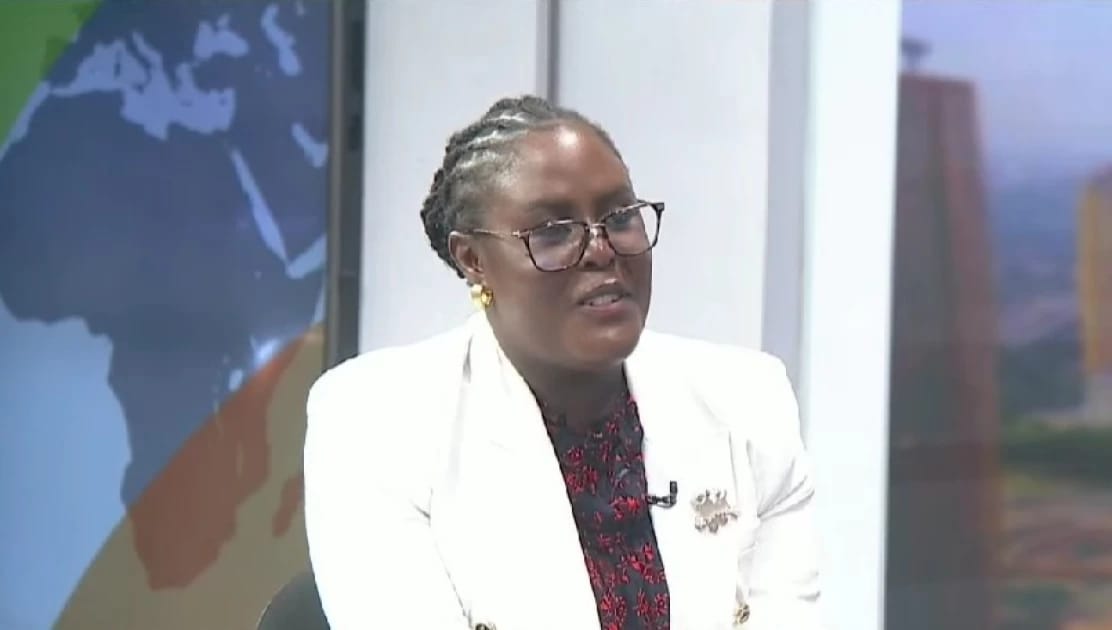
It is within this fragile and transitional moment that EALA MP Winnie Odinga stepped forward to speak, granting Citizen TV’s Yvonne Okwara her first major interview since Baba stepped aside. The interview was significant not merely because of who she is, but because of what she chose to address the growing habit of speaking for Raila, the question of ODM’s 2027 ambitions, internal intimidation, generational power struggles, and the delicate balance between party unity and internal democracy.
Winnie’s intervention marked a clear departure from silence and speculation. It was an attempt to reclaim the conversation from whispers and private briefings and return it to the public, collective political space that ODM has historically claimed to defend.
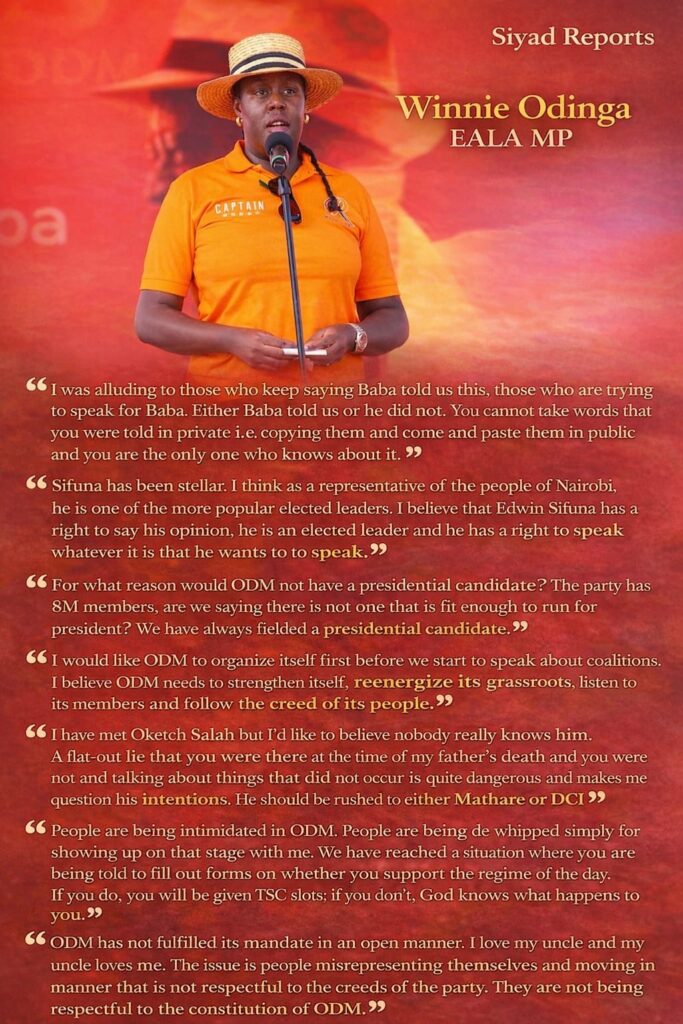
At the heart of her message was a firm rejection of political ventriloquism individuals claiming authority by alleging private instructions from Raila Odinga. “I was alluding to those who keep saying Baba told us this, those who are trying to speak for Baba. Either Baba told us or he did not,” she said, drawing a sharp line between legitimate collective decisions and unverifiable private claims. Winnie warned against the dangerous trend of turning personal conversations into political mandates, adding, “You cannot take words that you were told in private, and come and paste them in public and you are the only one who knows about it.”
This statement directly challenges a growing narrative within ODM that Raila Odinga quietly endorsed certain political directions before stepping back including claims that the party should avoid fielding a presidential candidate in 2027. Winnie flatly dismissed this interpretation. “Baba did not say he left ODM in government,” she stated, before recalling his last public words on the matter.
“The last thing he said during an ODM PGM was ‘Who told you ODM will not field a candidate in 2027?’”
Her argument was simple but powerful, Raila Odinga governed through public forums and collective dialogue. “Everything he said, he used to say in front of all of us,” she insisted, suggesting that secret instructions contradict both Raila’s leadership style and ODM’s democratic ethos.
ODM at a Crossroads: Power, Fear, Democracy and the Road to 2027
Beyond succession narratives, Winnie’s interview revealed deeper fractures within the party particularly around internal democracy and political intimidation. She painted a troubling picture of a movement drifting away from its founding principles of openness and dissent.
“People are being intimidated in ODM,” she alleged. “People are being de-whipped simply for showing up on that stage with me.” This was not framed as an isolated incident but as part of a broader pattern of coercion designed to enforce conformity. Winnie went further, describing what she portrayed as politically motivated patronage and punishment. “We have reached a situation where you are being told to fill out forms on whether you support the regime of the day. If you do, you will be given TSC slots; if you don’t, God knows what happens to you.”
Such claims strike at the ideological heart of ODM, a party born out of resistance politics and popular mobilisation. Winnie openly questioned whether the party is still living up to its mandate. “ODM has not fulfilled its mandate in an open manner,” she said, carefully distinguishing criticism of systems from attacks on individuals. Her concern, she explained, lies with those “misrepresenting themselves and moving in a manner that is not respectful to the creeds of the party, not being respectful to the constitution of ODM.”
At the same time, Winnie defended internal pluralism and outspoken leadership, notably praising Nairobi Senator Edwin Sifuna. “Sifuna has been stellar,” she said, highlighting his popularity and legitimacy as an elected leader. “I believe that Edwin Sifuna has a right to say his opinion, he has a right to speak whatever it is that he wants to speak.”
This defence was not merely personal loyalty, it was a statement of principle. Winnie’s position suggests that ODM’s survival depends on its ability to tolerate internal criticism rather than suppress it.
The interview also addressed the strategic question dominating ODM’s future, coalitions versus self-rebuilding. Winnie rejected premature coalition talk, arguing that a weakened party cannot negotiate from a position of strength. “I would like ODM to organize itself first before we start to speak about coalitions,” she said. According to her, the priority should be reconnecting with the grassroots, listening to members, and reclaiming ideological clarity. “ODM needs to strengthen itself, reenergize its grassroots, listen to its members and follow the creed of its people.”
That position naturally fed into the debate about ODM’s presidential ambitions. Winnie dismissed suggestions that the party lacks credible candidates. “For what reason would ODM not have a presidential candidate?” she asked pointedly. “The party has 8M members, are we saying there is not one that is fit enough to run for president?” Her conclusion was unequivocal: “We have always fielded a presidential candidate.”
Here, Winnie reframed the issue not as one of leadership scarcity, but of confidence and political will.
Her remarks also touched on the politicisation of personal tragedy, particularly claims made by Oketch Salah regarding Raila Odinga’s private moments. Winnie did not mince her words. “A flat-out lie that you were there at the time of my father’s death and you were not, is quite dangerous,” she said, questioning his motives and credibility. Her call that he be taken to “either Mathare or DCI with immediate effect” underscored her belief that such fabrications cross ethical and moral boundaries.
Equally significant was her response to narratives of a supposed Odinga family feud. Winnie dismissed the claims outright. “There is no family feud,” she said, injecting humour and cultural clarity. “Mambo ya nyumbani tunaongea kinyumbani, but mambo ya chama is not to be discussed at home.” She emphasised that political disagreement should never be conflated with personal conflict, adding that “Dr Oburu would be the first person to defend my right to have different opinions.”
Indeed, Winnie’s praise for Dr Oburu Oginga the party’s acting leader was consistent and deliberate. “I think Dr Oburu Oginga is a wonderful acting party leader in this transition period and he is steadying the ship,” she said, acknowledging the complexity of the moment. “This is not a very easy ship to steady, but he is weathering the storm.”
She also highlighted Oburu’s transitional mindset, noting that he has expressed willingness to create space for younger leaders. Winnie framed this not as weakness, but as wisdom protecting legacy while allowing renewal.
Perhaps most striking was Winnie’s rejection of calls for her to assume ODM’s top leadership role. In a political culture often defined by ambition, her response was unusually restrained. “I believe ODM, needs an experienced leader,” she said, before adding, “I don’t believe my feet has grown that big yet to fit in those shoes.”
Rather than positioning herself as a successor, Winnie cast herself as a guardian of values and process.
She concluded by reflecting on Raila Odinga’s own democratic philosophy. “Raila Odinga was alive to the fact that after his time, people may feel differently and want to take different directions,” she said. “He believed in the right to do so because it is a democracy.”
That reflection may be the most important takeaway from the interview. Winnie Odinga’s message was not about rebellion, entitlement, or dynasty. It was a warning that ODM’s future will not be secured by invoking Baba’s name, but by honouring his principles.
The post-Raila era is no longer approaching it is here. Whether ODM thrives or fractures will depend on whether it chooses fear or freedom, whispers or transparency, convenience or democracy.