

For decades, Northern Kenya existed at the far edge of the Kenyan state politically distant, economically sidelined, and developmentally frozen. Roads thinned out and disappeared, public hospitals were scarce and under-equipped, access to clean water was unreliable, and education infrastructure was minimal. Where the state did appear, it was often through security operations rather than service delivery. When devolution was introduced in 2013, it did not deliver instant equality to Northern Kenya; it delivered an opportunity to begin correcting a history of deliberate neglect.
It is this historical context that Wajir Governor and Council of Governors (CoG) Chair Ahmed Abdullahi insists must frame any serious discussion about development in the region. Responding to recent comparisons between Northern Kenya and other parts of the country, Abdullahi has rejected the notion that underdevelopment in the north reflects poor leadership or misuse of public resources.
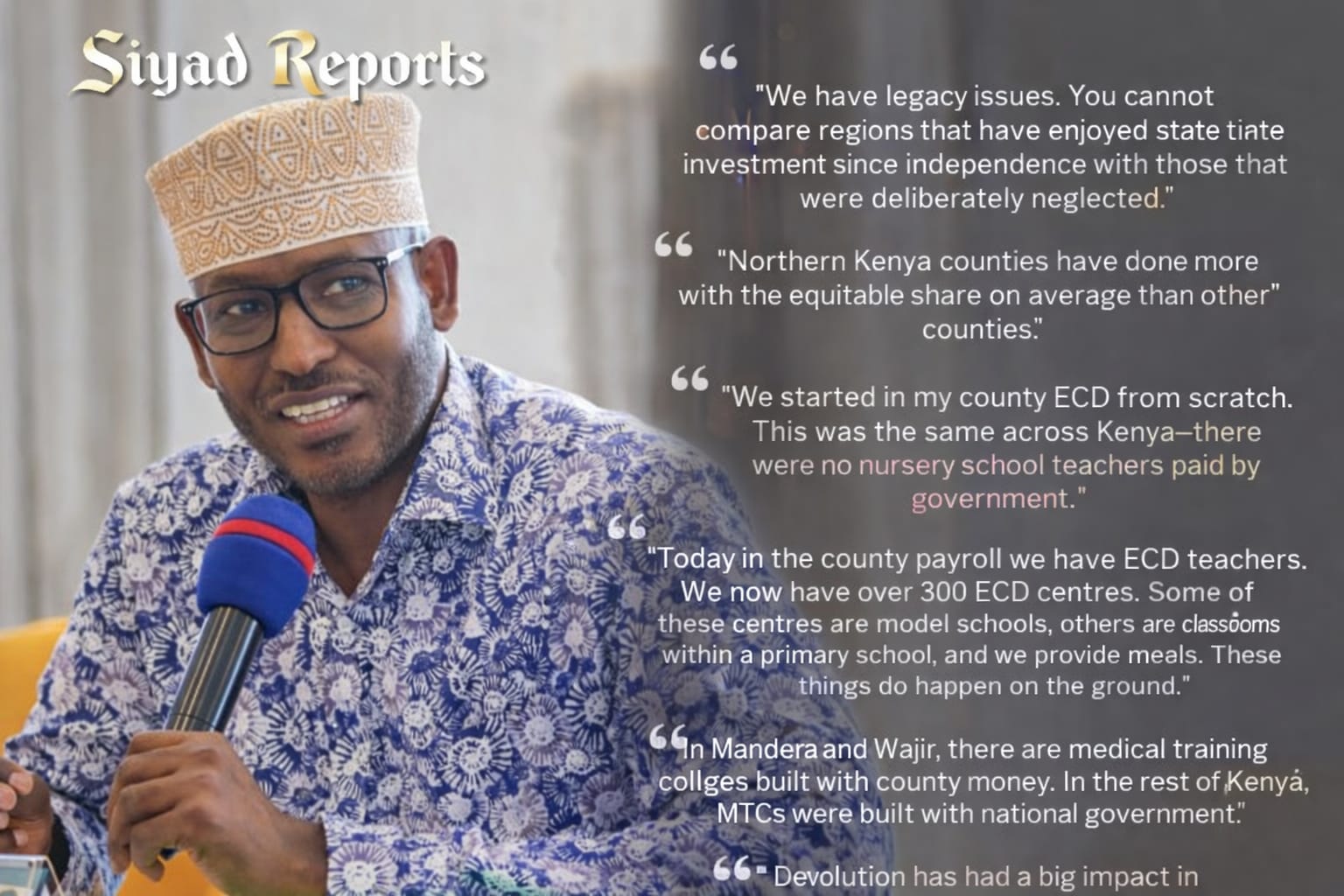
“We have legacy issues. You cannot compare regions that have enjoyed state investment since independence with those that were deliberately neglected,” Abdullahi said.
According to the governor, such comparisons ignore the structural inequalities embedded in Kenya’s post-independence governance model. While other regions inherited roads, schools, hospitals, and agricultural systems built during the colonial and early post-independence period, Northern Kenya inherited almost nothing. Devolution therefore did not come to equalize already functional systems; it came to build systems that never existed.
Devolution, Delivery, and the Reality on the Ground
Abdullahi’s defense of devolution is grounded in service delivery rather than political rhetoric. He argues that, on average, Northern Kenya counties have stretched their equitable share of national revenue further than many better-endowed regions.
“Northern Kenya counties have done more with the equitable share on average than other counties,” he stated.
The reason, he explains, is simple: counties in the region use their allocations to provide basic services that other parts of Kenya have taken for granted for decades. One of the most telling examples is Early Childhood Development (ECD). Before devolution, ECD was not institutionalized by government, and in Northern Kenya it was almost entirely absent.
“We started in my county ECD from scratch. This was the same across Kenya there were no nursery school teachers paid by government,” Abdullahi said.
In Wajir, the county had to construct the entire ECD system from the ground up. Today, ECD teachers are formally employed by the county, learning centres have been established across wards, and school feeding programmes are in place to support children from food-insecure households.
“Today in the county payroll we have ECD teachers. We now have over 300 ECD centres. Some of these centres are model schools, others are classrooms within a primary school, and we provide meals. These things do happen on the ground,” he noted.
In pastoralist communities where drought, migration, and poverty historically disrupted early learning, these investments represent more than infrastructure. They mark a shift toward long-term human capital development in a region that has lagged behind national education indicators for generations.
Healthcare offers another illustration of how counties have filled gaps left by decades of state absence. Abdullahi points to the establishment of medical training colleges in Wajir and Mandera facilities constructed using county funds.
“In Mandera and Wajir, there are medical training colleges built with county money. In the rest of Kenya, MTCs were built with national government money,” he said.
This approach has enabled counties to train nurses and clinical officers locally, improving staffing levels in county hospitals and health centres. In regions where attracting and retaining skilled health workers has long been a challenge, local training has strengthened continuity of care and reduced dependence on short-term national deployments.
Water access, a persistent challenge in arid and semi-arid lands, has also seen progress under devolution. Counties have invested in boreholes, water pans, and reticulation systems to reduce the distances communities travel in search of water. While climate shocks and prolonged droughts continue to strain these systems, the improvements since 2013 are evident across Northern Kenya.
Despite these gains, Abdullahi is careful not to overstate the impact of devolution.
“Devolution has had a big impact in Northern Kenya, but it has not yet equalised us,” he acknowledged.
The depth of historical neglect, he argues, means that bridging the gap will require sustained investment over many years.
Equalisation is not a short-term political project but a generational commitment.
Beyond social services, Abdullahi has raised structural economic issues affecting pastoralist livelihoods. Livestock remains the backbone of Northern Kenya’s economy, yet pastoralist communities remain excluded from international markets due to weak disease surveillance systems and the absence of strategic feed reserves. The governor has called for the establishment of a national livestock feed reserve and standardized disease control mechanisms to enable access to markets in the Middle East and Europe.
On governance, Abdullahi has rejected the claim that devolution itself is failing. Instead, he argues that the narrative of failure is often deployed selectively.
“The narrative of failing devolution is sometimes used to hide corruption at the national level,” he said.
While acknowledging that counties are not immune to governance challenges, he warns that undermining devolution would disproportionately harm regions that are only now beginning to experience meaningful state presence.
Politically, Abdullahi has been explicit about the region’s current alignment. He says Northern Kenya leaders have made a deliberate choice to support the broad-based government and back President William Ruto’s re-election bid in 2027. He frames this position not as blind loyalty but as strategic engagement aimed at safeguarding devolution and ensuring the region’s priorities are represented in national decision-making.
On the ground, the realities of Northern Kenya remain complex. Vast distances still separate communities from essential services, infrastructure gaps persist, and drought cycles continue to disrupt livelihoods. Yet the contrast with the pre-devolution era is unmistakable. Where there were once no county hospitals, there are now referral facilities; where children once learned under trees, there are classrooms and ECD centres; where water was accessed through seasonal wells, boreholes and reticulation systems now exist. These developments do not erase hardship, but they reinforce Abdullahi’s central argument:
progress in Northern Kenya must be measured against where the region started, not against regions that benefited from decades of uninterrupted state investment.
If devolution has enabled marginalized counties to build institutions from nothing, stretch limited resources to deliver basic services, and restore state presence in forgotten communities, then the more uncomfortable question Kenya must confront is this was the problem ever devolution, or was it the long national habit of ignoring Northern Kenya until comparison became politically convenient?