

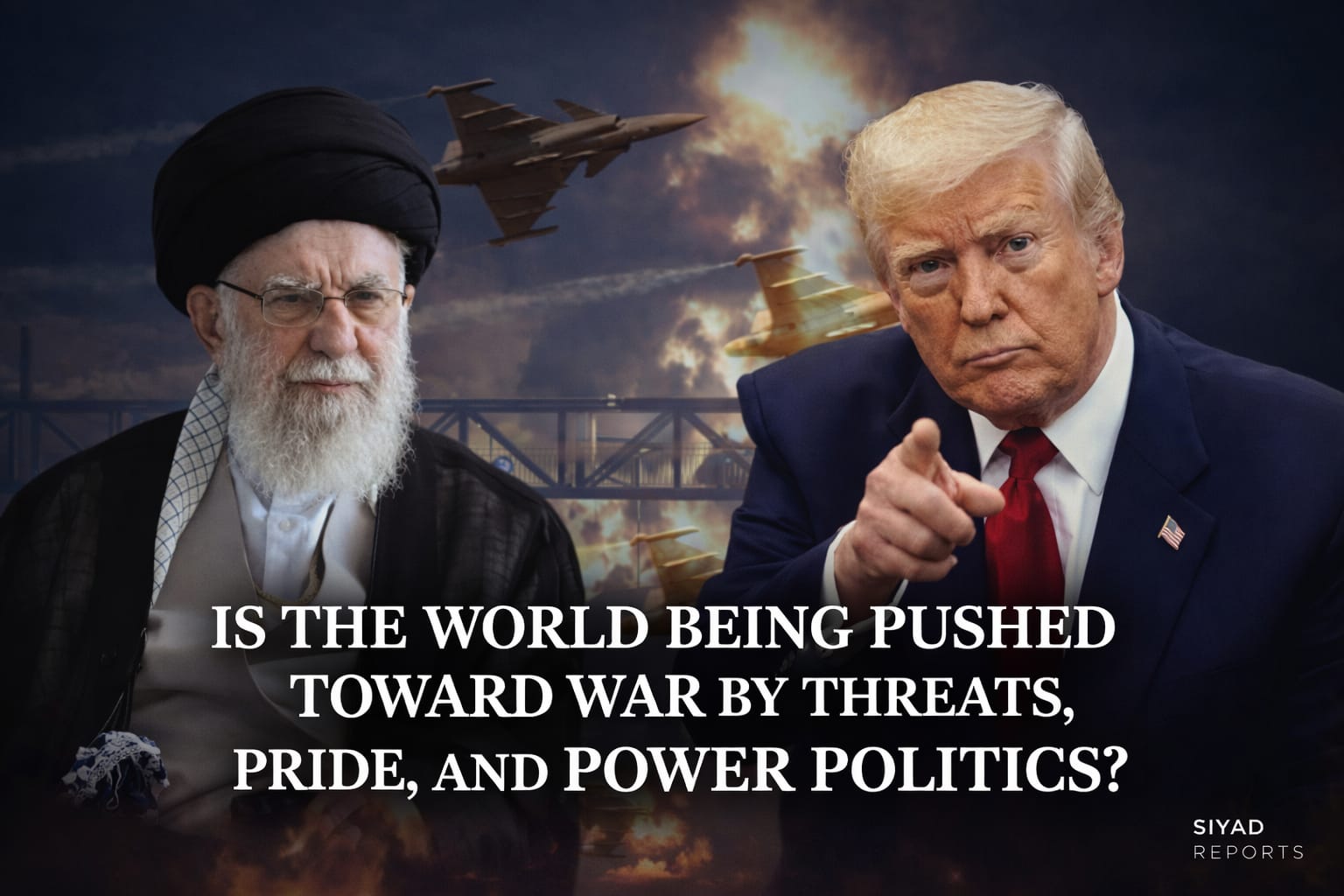
When Donald J. Trump publicly announced that a “massive Armada” was heading toward Iran armed, energized, and prepared to unleash “speed and violence” if necessary the world was reminded of how fragile global peace can be when diplomacy is replaced by spectacle and threats. This was not merely another social media post. It was a strategic message wrapped in political bravado, delivered in a moment of deep mistrust, unresolved history, and raw geopolitical tension. In international politics, words matter especially when spoken by a sitting president of the world’s most powerful military.
Trump’s message carried multiple layers. On the surface, it was framed as a warning and an invitation, Iran was told to “come to the table” and negotiate a deal that would permanently bar it from acquiring nuclear weapons. Beneath that, however, lay something more consequential an assertion of dominance. The reference to a previous military operation and the promise that “the next attack will be far worse” was not designed to persuade; it was designed to intimidate. And intimidation, in geopolitics, often produces the opposite of cooperation.
Iran’s response was as revealing as Trump’s post. Tehran flatly denied seeking talks with the United States and warned that continued provocative language would eliminate any possibility of negotiation. This was not posturing for domestic audiences alone, it was a strategic rejection of coercive diplomacy. Iran’s message was clear: negotiations under threat are not negotiations they are surrender. For a state whose political identity has been built around resistance to external pressure, accepting such terms would undermine its internal legitimacy.
What makes this standoff particularly dangerous is not only the content of the threats, but the context in which they are being made. U.S.–Iran relations are burdened by decades of hostility, broken agreements, sanctions, proxy conflicts, and military confrontations. Trust between the two sides is virtually nonexistent. When trust is absent, even defensive actions are interpreted as offensive, and deterrence begins to resemble preparation for war.
The deployment of a U.S. naval armada, led by an aircraft carrier, is a powerful symbol. In military terms, it is a flexible tool capable of deterrence, surveillance, and, if ordered, devastating force. In political terms, however, such a deployment communicates resolve, impatience, and readiness for escalation. Combined with Trump’s rhetoric, it narrows diplomatic space and raises the stakes of every subsequent move.
Iran’s leadership understands this dynamic well. To Tehran, U.S. military movements near its borders are not neutral signals,they are existential threats. Iran’s history shaped by foreign intervention, war, and sanctions has created a strategic culture that views external pressure as a precursor to regime destabilization. That perception explains why Iranian officials warn that any attack would be treated as an all-out war. This is not bravado; it is deterrence rooted in fear of survival.
Yet it would be a mistake to assume that Iran is eager for war. A direct confrontation with the United States would be catastrophic. Iran’s economy is already strained, its society under pressure, and its regional position contested. What Tehran seeks is not war, but strategic endurance the ability to withstand pressure without conceding core demands. Trump’s approach, however, appears designed to collapse that endurance through urgency and fear.
This is where the danger lies. Coercive diplomacy relies on the assumption that the weaker party will blink first. But history shows that when national pride, sovereignty, and regime survival are at stake, states often choose resistance over compromise even at great cost. Iran’s refusal to engage under threat is consistent with that logic. Each new warning from Washington hardens Tehran’s position, not softens it.
The absence of visible diplomatic channels makes the situation even more volatile. There is no clear evidence of active back-channel negotiations or trusted intermediaries capable of de-escalating tensions. Public ultimatums, delivered via social media, replace quiet diplomacy. In such an environment, miscalculation becomes more likely. A military exercise, a naval encounter, or an incident involving regional proxies could rapidly spiral into a broader confrontation.
Regional actors understand what is at stake. A U.S.–Iran war would not remain confined to two states. It would reverberate across the Middle East, disrupt global energy markets, inflame existing conflicts, and draw in allies and adversaries alike. That is why some countries are urging restraint and incremental diplomacy. But restraint requires political will and political will is often the first casualty in moments of heightened rhetoric.
Trump’s strategy reflects a belief in strength as leverage, in pressure as persuasion. It is a worldview that treats international relations as a contest of wills rather than a system of interdependence. While such an approach may appeal to domestic audiences seeking decisive leadership, it risks reducing complex geopolitical realities into zero-sum calculations. Iran is not Venezuela. It is a regional power with deep networks, strategic depth, and a leadership accustomed to operating under pressure.
The central question, then, is not whether war is inevitable, but whether it is becoming more likely by default. Neither Washington nor Tehran appears to want a full-scale conflict. Yet both are behaving in ways that increase the probability of one. This is the paradox of modern geopolitics, wars are often started not because they are desired, but because pathways to avoid them collapse.
Trump’s warning has shifted the psychological terrain of the crisis. By publicly setting deadlines and issuing threats, he has constrained future options for both sides. Iran, unwilling to appear weak, must respond with defiance. The U.S., having signaled readiness, must now consider how to maintain credibility without crossing the threshold into war. Each side is trapped by its own messaging.
At its core, this confrontation is about more than nuclear weapons. It is about power, respect, and the rules of international engagement. It is about whether force and fear can still dictate outcomes in a world increasingly shaped by complexity and interdependence. And it is about whether leaders can step back from the edge once rhetoric has pushed them there.
History offers sobering lessons. Major conflicts rarely begin with a single decision, they emerge from accumulated choices, hardened positions, and missed opportunities for dialogue. Today’s U.S.–Iran standoff fits that pattern uncomfortably well. The armada may be a signal, but signals can be misread. Warnings may be intended as deterrence, but deterrence can fail.
For now, the world watches not because war has begun, but because it has not yet been ruled out. The coming weeks will reveal whether reason can re-enter the conversation, whether diplomacy can regain ground lost to threats, and whether leaders can recognize that the cost of escalation far outweighs the illusion of victory.
Until then, one truth remains unavoidable: when global powers communicate through ultimatums instead of understanding, the line between peace and conflict grows dangerously thin.