

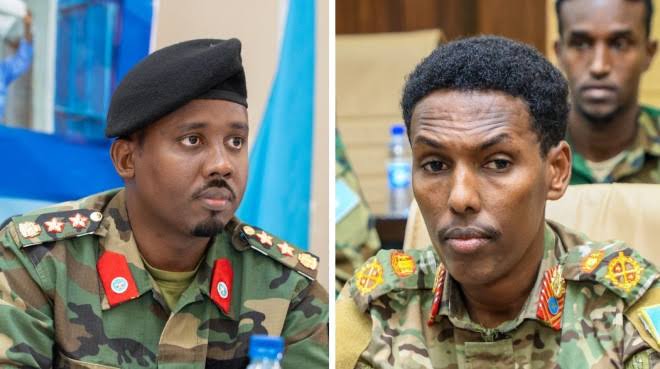
The decision by Somalia’s Council of Ministers to remove General Odowaa Yusuf Raage as Commander of the Somali National Army (SNA) and replace him with Turkey-trained General Ibrahim Mohamed Mohamud is far more than a routine military reshuffle. It is a political signal, a geopolitical statement, and a strategic turning point that reflects the evolving balance of power inside Somalia’s fragile state architecture. While the official narrative frames the move as an internal administrative decision aimed at strengthening security, the broader context suggests a deeper convergence between Somalia’s military leadership and Ankara’s long-term strategic ambitions in the Horn of Africa.
General Odowaa’s removal, notably the second time in four years he has been dismissed from the same position, underscores the persistent instability within Somalia’s civil-military relations. His tenure was marked by friction with President Hassan Sheikh Mohamud, particularly over counter-terrorism strategy, command autonomy, and the pace of security reforms. Odowaa was widely viewed as an independent figure, not fully aligned with external military patrons, a trait that increasingly became a liability in a political environment where foreign partnerships are central to state survival. His resistance to certain presidential directives, especially on how to confront Al-Shabaab and manage internal deployments, reportedly widened the rift between the presidency and the military high command.
Yet the political dimension alone does not fully explain the timing and significance of the decision. The appointment of General Ibrahim Mohamed Mohamud a senior officer trained extensively by Turkey and previously in charge of the SNA’s logistics and support division signals a clear preference for officers molded within Ankara’s military doctrine. This is not accidental. Over the past decade, Turkey has invested heavily in Somalia’s security sector, building the TURKSOM military base in Mogadishu, training thousands of Somali soldiers, and embedding itself as Somalia’s most influential defense partner. Control over training, logistics, and now top command positions allows Turkey to move from being a supporter of Somali security to becoming a structural pillar within it.
The political implications of this shift are profound. In fragile states like Somalia, the army is not merely a security institution; it is a political actor. Whoever shapes its leadership indirectly shapes state power. By endorsing a Turkey-trained general at the helm of the SNA, President Hassan Sheikh Mohamud appears to be consolidating power through a trusted external ally at a time of mounting domestic pressure. Somalia is approaching a highly contentious period marked by constitutional disputes, debates over electoral models, and strained federal-state relations. In such moments, control over the military becomes not just a matter of national defense but also regime stability.
Turkey’s growing influence must also be understood within a broader geopolitical contest in the Horn of Africa. The region has become a strategic chessboard involving Gulf states, Western powers, China, and increasingly, middle powers like Turkey. Ankara’s approach differs from traditional Western security assistance. It combines military training, economic aid, infrastructure development, and political loyalty into a single package.
Unlike partners who emphasize institutional reforms and conditionality, Turkey offers speed, visibility, and personal relationships with political elites. For Somali leaders operating under constant security threats, this model is attractive.
The reported arrival of Turkish F-16 fighter jets in Mogadishu just days before the military reshuffle further amplifies the geopolitical message. While officially framed as part of defense cooperation, the optics are unmistakable: Turkey is signaling its readiness to project hard power in defense of its Somali interests. For a country that still struggles to control its own airspace and territory, the presence of advanced foreign military hardware raises uncomfortable questions about sovereignty. At what point does partnership blur into dependency? And who ultimately sets the strategic direction of Somalia’s armed forces?
Supporters of the leadership change argue that General Ibrahim’s appointment could professionalize the SNA, improve logistics, and enhance coordination with Turkey trained units such as Gorgor and Haramcad. They point to Turkey’s relative success in building disciplined forces compared to previous international efforts that resulted in fragmented units loyal to clans or political patrons. From this perspective, aligning the entire command structure under one training doctrine could reduce fragmentation and improve battlefield effectiveness against Al-Shabaab.
However, critics warn that such alignment risks creating a mono-dependency that undermines national cohesion. Somalia’s security sector has historically suffered from external overreach, whether from Cold War patrons or post-9/11 counter-terrorism alliances. When one foreign power gains disproportionate influence, internal balances are disrupted. Officers trained by other partners may feel marginalized, deepening divisions within the army. Federal member states, already suspicious of Mogadishu’s centralization drive, may interpret the reshuffle as an attempt to militarize political disputes using externally backed forces.
There is also the question of civilian oversight. A military leadership closely aligned with a foreign patron may prioritize external strategic interests over domestic accountability. Turkey’s goals in Somalia securing maritime access, expanding regional influence, and projecting itself as a Muslim power broker do not always perfectly align with Somalia’s internal reconciliation needs. While Ankara presents itself as a benevolent partner, its expanding footprint inevitably reshapes decision-making dynamics in Mogadishu.
Ultimately, the removal of General Odowaa and the rise of General Ibrahim reflect a broader transformation underway in Somalia: the gradual outsourcing of state authority to external allies in exchange for short-term stability. President Hassan Sheikh Mohamud appears to be betting that deeper integration with Turkey will strengthen his hand against both armed insurgents and political rivals. Whether this gamble pays off will depend on how the new military leadership navigates the delicate balance between professionalism, national loyalty, and foreign influence.
If the SNA becomes a unified, effective force capable of degrading Al-Shabaab while remaining subordinate to civilian authority, the decision may be vindicated. But if it becomes perceived as an extension of Turkish strategic interests or a tool for internal political control, the long-term consequences could further erode trust in state institutions. Somalia’s history offers a cautionary lesson: security built without broad legitimacy rarely endures.
In this sense, the sacking of General Odowaa is not merely the end of one man’s career, but a defining moment in Somalia’s struggle to reclaim sovereignty while navigating a world where power increasingly flows through foreign alliances.
Turkey’s rising role may bring resources and expertise, but it also tests Somalia’s ability to remain master of its own destiny.
Trending
- Drone Diplomacy: How Turkey’s Bayraktars Are Reshaping Somalia and Africa’s New Wars
- Ethiopia’s Somalia Ambassador Leaves Mogadishu After Just Over a Year, Raising Fresh Questions Over Diplomatic Ties
- Somalia and Qatar Move to Deepen Strategic Ties as Hamza Holds Talks in Doha
- “I Want to Declare Equalisation as Dead”: Keynan’s Explosive Attack Collides With Ahmed Abdullahi’s Case for More Resources to Kenya’s Periphery
- WHEN SOMALIA’S SUPREME COURT MOVES, POLITICS SHIFTS: The Galmudug Ruling and the Return of an Old Constitutional Fault Line
- WHEN THE WATCHDOG BECOMES THE CAMPAIGN MACHINE: THE QUIET COLLAPSE OF JOURNALISM IN NORTH EASTERN KENYA
- MOGADISHU’S EVICTION CRISIS: WHEN THE STATE TURNS ITS GUNS ON ITS OWN PEOPLE
- “THE KING OF THE NORTH?” THE WAR OVER ADEN DUALE’S POLITICAL EMPIRE AND WHY RUTO SHOULD BE WATCHING
Turkey, Power, and the Somali Army: What the Sacking of General Odowaa Really Means
Keep Reading
Add A Comment
Siyad Reports
Quick Links
Subscribe to Updates
Get the latest news from Siyad Reports about world, sports and technology.
© 2026 Siyad Reports. Designed by Okumu Collince.