

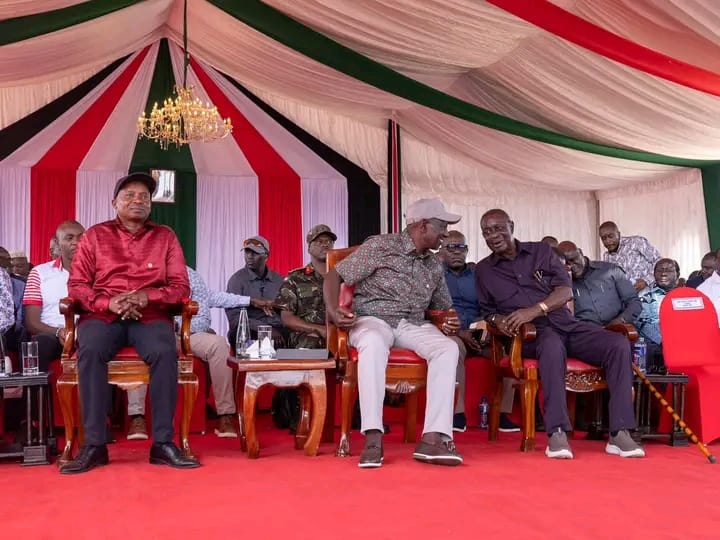
Kenyan politics rarely moves in straight lines, and the events witnessed in Kisumu on February 2, 2026 once again confirmed that alliances, assurances and internal rivalries are unfolding simultaneously, often contradicting each other in tone and intent. As President William Ruto, Deputy President Kithure Kindiki and ODM party leader Oburu Odinga shared a public platform during the NYOTA Programme startup capital disbursement at Jomo Kenyatta International Stadium, the optics alone sent strong political signals ahead of the 2027 General Election. But it was Oburu Odinga’s carefully chosen words, delivered partly in Kiswahili and partly in English, that have now ignited intense debate within and beyond ODM.
“Lakini, Deputy President (Kithure Kindiki), usifikirie kwamba tunataka kiti chako au tunataka kukufukuza. Please, you are our friend,” Oburu declared, a statement that on the surface sounded conciliatory, reassuring and even personal. Yet beneath that reassurance lies a layered political message that speaks to power-sharing, negotiation leverage, and ODM’s long-term calculations in a post-Raila political environment.
By publicly assuring Kindiki that ODM is not targeting his seat, Oburu appeared to calm growing speculation that ODM-UDA talks were designed to destabilize the Deputy President or engineer a leadership reshuffle before 2027. In a political climate where silence is often interpreted as strategy, the explicit reassurance was significant. It suggested that ODM, at least for now, is prioritizing dialogue over confrontation and stability over disruption. Referring to Kindiki as a “friend” was not accidental; it framed the relationship as cooperative rather than adversarial, softening ODM’s image after years of opposition politics defined by resistance.
However, Oburu’s remarks did not stop at reassurance. He made it clear that the ongoing negotiations between ODM and UDA are fundamentally about inclusion and entitlement within the national framework. His emphasis that talks are about ensuring “everyone secures their rightful share of the national cake” reflects ODM’s long-standing argument that political participation must translate into tangible power and resources. This is not merely about political friendship; it is about structured bargaining. ODM is signaling that while it may not be coming for Kindiki’s seat today, it is very much interested in a renegotiated political settlement that recognizes its electoral weight and historical influence.
The timing of these statements is also crucial. Oburu explicitly linked ODM’s current cooperation with the government to national interest and the period following the loss of his brother, Raila Odinga. This framing positions ODM’s engagement with Ruto’s administration as both pragmatic and transitional. Without Raila as the central mobilizing figure, ODM is recalibrating its role from a protest-driven opposition to a negotiating political force seeking relevance through inclusion. This shift, however, is neither universally accepted within the party nor clearly defined in terms of leadership succession.
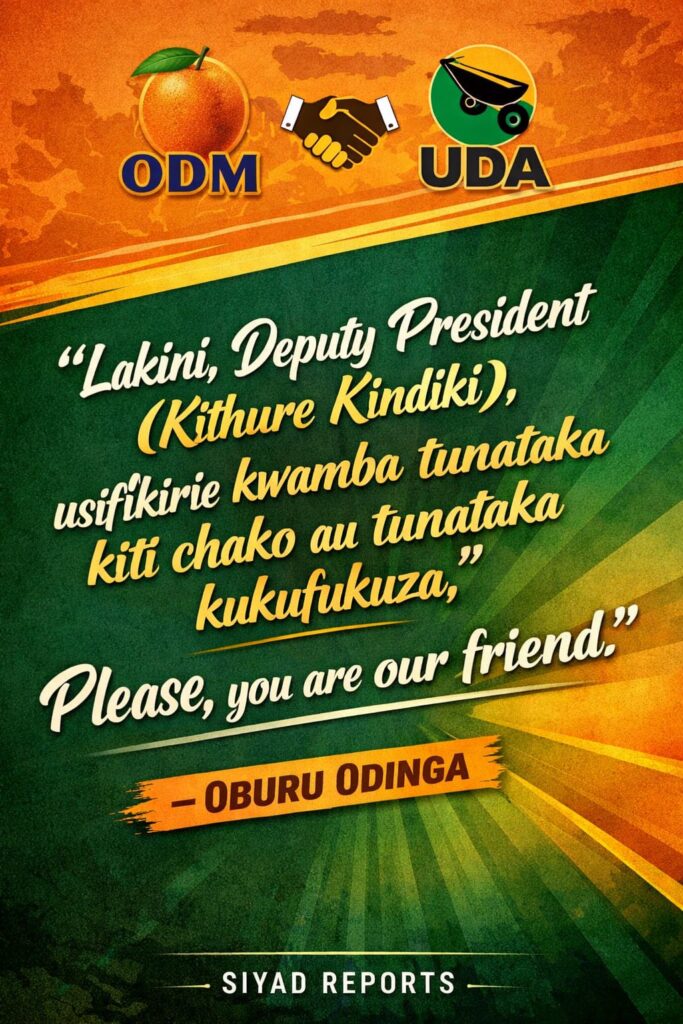
While Oburu downplayed any immediate threat to Kindiki, his earlier assertion that ODM would expect “a stake no less than the Deputy President position” in any 2027 coalition cannot be ignored. That statement lingers like an unresolved clause
in an otherwise polite conversation. It reveals that ODM’s long-term ambition remains firmly anchored at the highest levels of executive power. In this sense, the assurance to Kindiki is tactical rather than ideological. It buys time, keeps channels open, and avoids early confrontation, while leaving the door wide open for hard bargaining closer to the election.
Yet even as ODM leadership projects unity and strategic calm on the national stage, deep internal cracks are becoming increasingly visible. The sharp response from Embakasi East MP Babu Owino has exposed simmering tensions within the party that ODM can no longer afford to ignore. “The Last Boss I had kwa siasa was Raila Amolo Odinga. Lazima round hii pia mimi nikuwe kiongozi. Hao wenye wako sahii pia wanaweza nifuata!” Babu stated, in a defiant message that directly challenges the current ODM leadership structure.
Babu Owino’s words are more than emotional rhetoric; they represent a generational and ideological contest within ODM. By declaring that Raila Odinga was his “last boss” in politics, Babu is rejecting the authority of emerging power centers within the party, including the Odinga family itself. His assertion that “round hii pia mimi nikuwe kiongozi” signals an ambition that clashes head-on with attempts to manage ODM through elite consensus and negotiated cooperation with the ruling party.
This internal rebellion complicates ODM’s external strategy. While Oburu Odinga speaks the language of stability, negotiation and friendship with state power, Babu Owino articulates a populist, confrontational vision rooted in individual leadership and generational change. His warning that current leaders “wanaweza nifuata” flips the traditional hierarchy on its head, suggesting that legitimacy will no longer flow from family name or historical status but from personal political capital.
The contrast between Oburu’s assurances to Kindiki and Babu’s defiance exposes ODM’s central dilemma: can the party simultaneously pursue elite-level negotiations with UDA while containing grassroots dissatisfaction and leadership ambition within its own ranks? Cooperation with the government may deliver short-term relevance, but it risks alienating a base that has long defined ODM by its oppositional identity.
Moreover, ODM’s internal wrangles weaken its bargaining position externally. A party negotiating for a “rightful share of the national cake” must first demonstrate internal cohesion and clarity of leadership. The more ODM appears divided, the easier it becomes for UDA to engage selectively with its leadership while sidelining dissenting voices. In this sense, Babu Owino’s rebellion is not just a personal power play; it is a stress test of ODM’s post-Raila survival strategy.
Ultimately, the Kisumu appearance symbolized a moment of transition in Kenyan politics. Oburu Odinga’s reassurance to Deputy President Kindiki was an attempt to stabilize relationships and manage perceptions, but it also revealed ODM’s unresolved ambitions and internal contradictions. As 2027 approaches, the party is walking a tightrope between cooperation and confrontation, legacy and renewal, unity and rebellion.
Whether ODM can reconcile these competing forces will determine not only its place in the next coalition but its very identity in a rapidly evolving political landscape.