

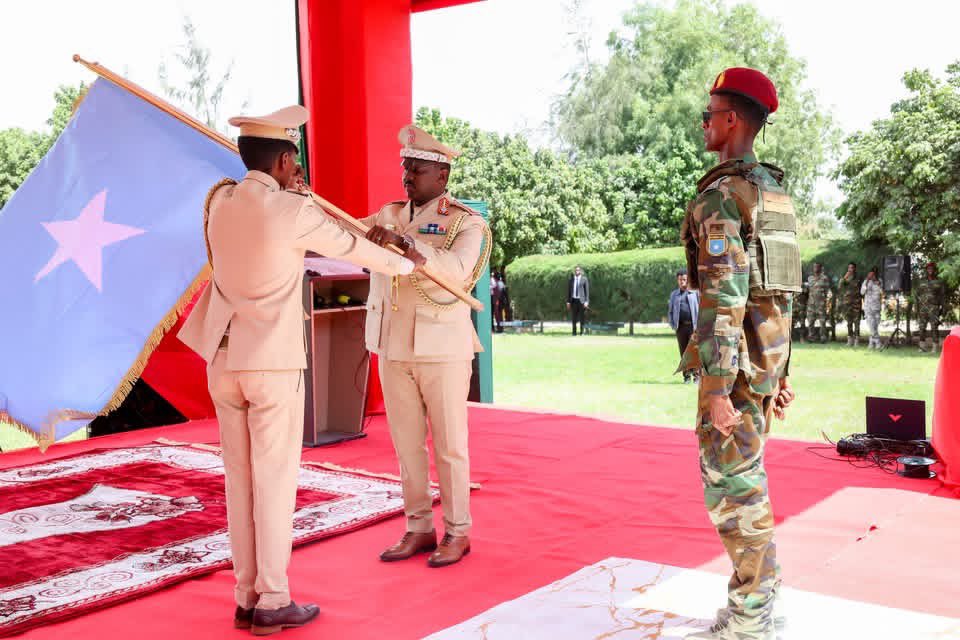
Somalia marked a significant moment in its security and military operations on Wednesday as Brigadier General Ibrahim Mohamed Mahamud officially assumed command of the Somali National Army, replacing Major General Odowaa Yusuf Rage. The handover ceremony, held at the Ministry of Defence in Mogadishu, was presided over by Prime Minister Hamza Abdi Barre and attended by senior military officials, ministers, members of parliament, ambassadors, and other distinguished guests.
The change in leadership comes at a critical time for Somalia, as the government presses forward with its declared “total war” against Al-Shabaab, the Al-Qaeda-linked militant group that continues to threaten stability across central and southern regions of the country. The leadership reshuffle reflects both a strategic move to bolster military operations and an effort to maintain momentum against insurgent activities that have long plagued the nation.
General Mahamud, a Turkey-trained officer who previously served as the commander of the army’s logistics division, assumed the role with a clear commitment to intensify the fight against militants. In his first public remarks as commander, he declared, “I will focus on the liberation of the country and the duties imposed on me.” The statement underscores his dedication to a frontline role in ongoing operations and signals a continuity of the government’s aggressive stance against insurgent forces.
Prime Minister Hamza Abdi Barre highlighted the importance of the transition while reaffirming the government’s security priorities. He praised the achievements made under the outgoing leadership of Major General Rage but emphasized that the nation’s progress is inseparable from its security gains. “If our country is not liberated from the enemy, progress cannot be achieved,” Barre said, adding, “The priority is liberating the areas where the Kharijites are present.” The term “Kharijites” is used by Somali authorities to describe Al-Shabaab militants, reflecting a historical context of rebellion and extremism.
The handover ceremony, attended by Defence Minister Ahmed Moallim Fiqi and other high-ranking officials, was both formal and symbolic. It demonstrated the government’s resolve to maintain institutional continuity and public confidence in the Somali National Army’s ability to carry out its mission. Major General Rage, who led the army during a period of strategic gains, pledged his full support to the incoming commander, signaling unity within the military ranks as operations continue. His endorsement was a clear message that despite the leadership change, the military campaign will maintain its focus and intensity.
Observers note that the appointment of General Mahamud brings both fresh energy and technical expertise to Somalia’s military. His training in Turkey, a key partner in Somalia’s security sector, has equipped him with advanced knowledge in military logistics and operations management, which are critical for sustaining long-term campaigns against highly mobile insurgent forces. Analysts suggest that Mahamud’s leadership could enhance coordination between various military units and improve operational efficiency, especially in areas where Al-Shabaab has entrenched itself over the past decade.
The Somali government’s “total war” strategy, reinforced by this leadership change, emphasizes coordinated military pressure, intelligence-led operations, and regional collaboration. Over the past year, Somali forces, often supported by international partners, have carried out numerous operations aimed at reclaiming territories and disrupting militant networks. However, despite these efforts, Al-Shabaab remains a persistent threat, frequently conducting attacks in rural and urban centers alike, which has heightened the urgency for decisive military leadership.
Prime Minister Barre’s comments during the ceremony also highlighted the broader political and strategic dimensions of the handover. By framing military success as inseparable from national development, he linked security operations directly to Somalia’s broader aspirations for stability, economic growth, and governance. “The liberation of our territories is not just a military objective,” he said, “but a prerequisite for enabling communities to thrive and for the government to deliver essential services effectively.” This approach reinforces the narrative that defeating insurgency is foundational to the country’s overall progress.
The ceremony itself was carefully orchestrated to showcase solidarity and legitimacy. It included the attendance of ambassadors, signaling international recognition and support for Somalia’s military leadership. The presence of parliamentarians and ministers highlighted the importance of civilian oversight and the integration of military leadership within the broader framework of state governance. Such displays are crucial in a country where maintaining public confidence in national institutions is essential for both security and political stability.
In assuming command, General Mahamud inherits ongoing military campaigns in central and southern Somalia, where Al-Shabaab has maintained strongholds. His focus on logistical support and operational coordination will likely play a pivotal role in sustaining offensives in these regions. Military experts note that effective leadership in such contexts requires not only strategic planning but also the ability to motivate and unify troops under high-stress conditions. Mahamud’s experience and training position him to meet these demands while reinforcing morale among soldiers and officers.
The outgoing commander, Major General Odowaa Rage, leaves behind a record of several tactical successes that have weakened Al-Shabaab’s operational capacity in key areas. His willingness to publicly endorse Mahamud and pledge continued cooperation ensures that there will be no disruption in ongoing operations. This smooth transition is critical, as any gaps in leadership could be exploited by militants seeking to regain lost territory or disrupt government operations.
Somalia’s military leadership change is also emblematic of the government’s broader commitment to reform and modernization. By appointing a younger, internationally trained officer, authorities signal a forward-looking approach that values professional development and strategic innovation. This approach aligns with efforts to strengthen national institutions, enhance security capabilities, and foster greater resilience against insurgent threats.
As General Ibrahim Mohamed Mahamud officially takes command, the Somali National Army faces a defining period. The combination of his expertise, the government’s strategic vision, and the continued support of national and international partners will be tested against the enduring threat posed by Al-Shabaab. For the people of Somalia, the change in leadership offers hope for renewed momentum in the campaign to reclaim territories, restore security, and lay the foundation for long-term peace and stability.
The appointment of General Mahamud represents both continuity and renewed energy in Somalia’s fight against insurgency. With Prime Minister Barre emphasizing the link between military success and national progress, and with the outgoing commander offering his full support, Somalia’s military leadership stands at a critical juncture.
How effectively General Mahamud navigates the challenges ahead will have a direct impact not only on the Somali National Army’s operational successes but also on the broader goal of securing a stable and prosperous nation.