

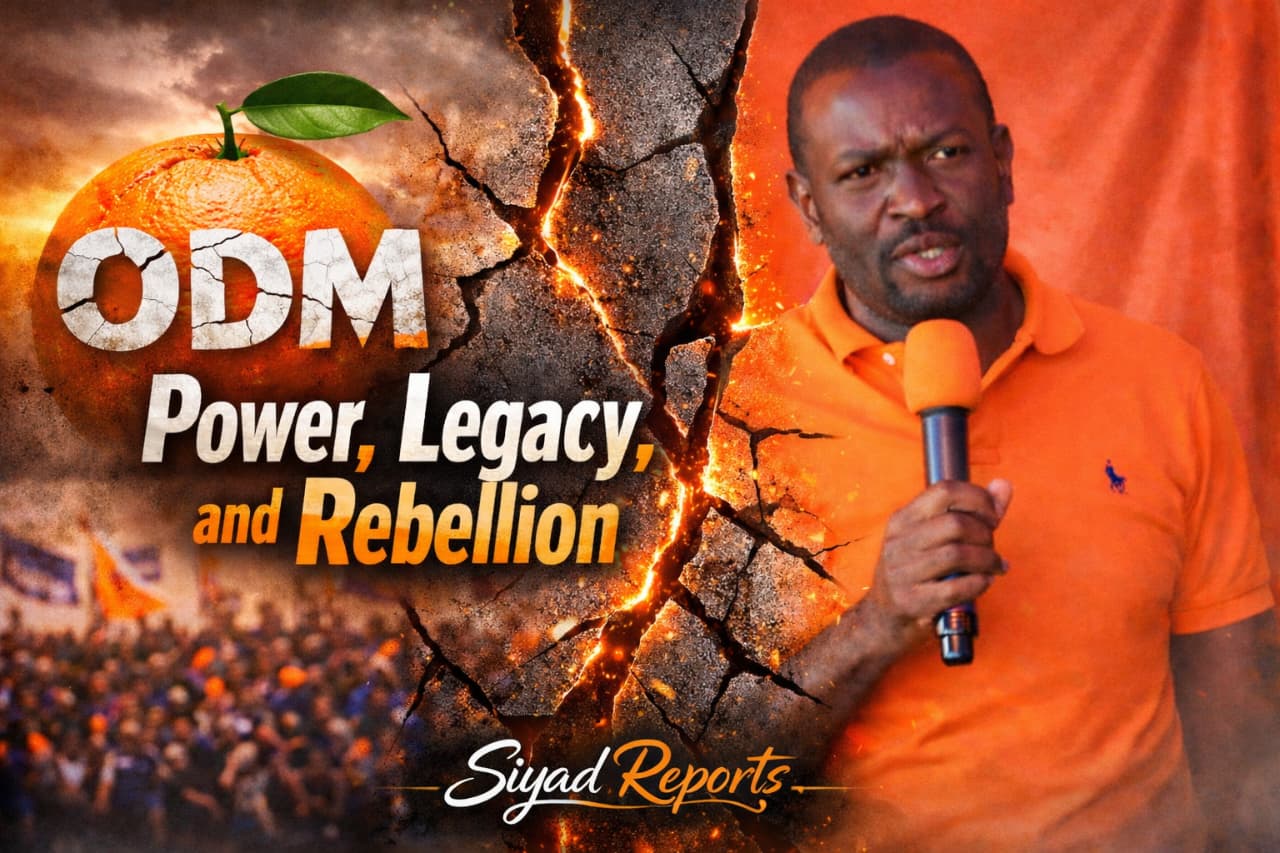
The removal of Nairobi Senator Edwin Sifuna as Secretary General of the Orange Democratic Movement (ODM) marks one of the most significant internal political shake-ups within the party in recent years. More than a leadership reshuffle, the decision exposes underlying tensions, ideological divisions, and succession uncertainties that have intensified following the death of ODM’s long-time leader, Raila Odinga. As the party prepares for its National Delegates Convention (NDC) scheduled for March 27, 2026, the unfolding developments point to a broader struggle over ODM’s identity, leadership structure, and political direction heading into the 2027 General Election.
The National Executive Committee (NEC) resolution to remove Sifuna, appoint Catherine Omanyo as acting Secretary General, and initiate steps toward exiting the Azimio coalition represents a decisive attempt by the party’s current leadership under Dr. Oburu Oginga to consolidate authority during a fragile transition period. However, Sifuna’s immediate political response and the reaction from key party figures, including East African Legislative Assembly (EALA) MP Winnie Odinga, suggest that ODM may be entering one of its most complex internal confrontations since its formation.
Sifuna’s removal did not produce political silence. Instead, it triggered a swift grassroots mobilisation strategy. Within hours of his ouster, the Nairobi Senator announced a major rally in Kitengela under the banner of the “Linda Mwananchi Tour,” signalling that he intends to challenge his removal through political engagement rather than internal administrative processes. The move highlights a strategic shift from institutional power battles to public political legitimacy, a tactic that has historically shaped Kenya’s opposition politics.
The leaders expected to attend the Kitengela rally including Siaya Governor James Orengo, Embakasi East MP Babu Owino, and several legislators aligned with reformist and opposition politics suggest that Sifuna’s challenge may evolve into a coordinated faction within ODM. Their presence reflects deeper ideological alignments centred on preserving ODM’s traditional image as a reform-driven political movement rooted in social justice, democratic accountability, and grassroots mobilisation.
Sifuna has increasingly positioned himself as a defender of ODM’s historical values. His public messaging has consistently invoked Raila Odinga’s legacy, framing himself as part of a younger generation entrusted with maintaining the party’s reformist identity. His statement during a previous rally in Busia, where he declared that Raila “did not raise cowards but leaders ready to stand for justice,” underscores his attempt to anchor his political legitimacy within ODM’s founding narrative.
Yet, within political circles, Sifuna’s removal is increasingly being interpreted as more than an internal disciplinary action. Several analysts and allies have framed the decision as a political crucifixion for boldness, arguing that his ouster represents the price he paid for openly questioning internal party negotiations and raising concerns about alleged backroom dealings.
This narrative has gained traction particularly among opposition-aligned leaders who believe Sifuna’s confrontational public stance against the perceived quiet rapprochement between ODM and President William Ruto’s United Democratic Alliance (UDA) placed him at odds with emerging political realignments. According to this interpretation, Sifuna’s vocal resistance to any potential ODM-UDA engagement positioned him as a symbol of ideological resistance within the party, ultimately making him politically vulnerable.
Supporters advancing this argument portray Sifuna as a casualty of deeper internal wrangles linked to ODM’s evolving political strategy ahead of the 2027 elections. They argue that as ODM explores new coalition pathways and recalibrates its national positioning, voices perceived as resistant to strategic compromise may increasingly face marginalisation. In this context, Sifuna’s removal is being framed not merely as a leadership conduct issue but as part of a broader contest between ideological purity and pragmatic political survival.
For Sifuna, the grassroots strategy carries both opportunity and risk. If successful, it could elevate him into a broader national opposition figure capable of influencing party direction or future coalition negotiations. However, if the mobilisation fails to attract sustained political support, it could weaken his influence and reinforce the authority of the current party leadership.
ODM’s Post-Raila Transition and the Battle for Institutional Control
The removal of Sifuna must be analysed within the larger context of ODM’s transition following Raila Odinga’s death. For over two decades, ODM’s political cohesion largely revolved around Raila’s personal authority, ideological direction, and electoral influence. His absence has created a leadership vacuum that is now being contested through institutional restructuring and factional political mobilisation.
Dr. Oburu Oginga’s leadership approach appears focused on stabilising the party through centralised decision-making and organisational discipline. The NEC’s justification for removing Sifuna cited concerns regarding leadership conduct and adherence to party constitutional procedures. By emphasising collective decision-making structures, the leadership is attempting to project institutional authority over individual political influence.
The decision also reflects strategic electoral calculations. ODM is repositioning itself ahead of the 2027 General Election and reassessing its coalition alignments.
The move to begin disengaging from the Azimio coalition signals an attempt to redefine ODM’s independent political strength. Removing a prominent internal critic during such negotiations may be viewed as a strategy to streamline party messaging and negotiation leverage.
However, centralisation carries political risks. Sifuna served as one of ODM’s most visible national communicators, frequently articulating party positions in media and public forums. His removal could create communication gaps and weaken the party’s engagement with younger and urban political audiences who viewed him as a symbol of generational leadership transition.
More significantly, the decision risks reinforcing perceptions of internal democratic suppression if grassroots members interpret the removal as politically motivated rather than constitutionally grounded. Political parties transitioning from founder-led movements to institutional organisations often struggle to balance unity with internal debate, and ODM appears to be navigating this delicate transformation.
The reaction from Winnie Odinga adds another layer of complexity to the unfolding power struggle. Her brief but politically loaded social media statement, “It is not well,” has generated significant political interpretation. As both an EALA MP and a prominent figure associated with the Odinga political legacy, Winnie’s public expression of concern carries symbolic and strategic significance.
Her earlier criticisms regarding the legality of major party decisions without NDC ratification reflect constitutional and procedural anxieties within sections of ODM’s leadership. By suggesting that the NEC and Central Committee cannot lawfully implement major restructuring without delegates’ endorsement, she raises questions about the legitimacy of recent decisions, including Sifuna’s removal and coalition realignments.
Winnie’s statement may also reflect internal elite divisions within ODM. Political parties with strong historical leadership families often experience tensions during succession periods, particularly when questions arise about ideological continuity and legacy preservation. Her remarks suggest that sections of ODM’s founding political network are closely monitoring how the party navigates its post-Raila identity.
The upcoming National Delegates Convention is therefore emerging as a critical political battleground. Traditionally serving as ODM’s highest decision-making organ, the NDC now carries heightened significance as it will likely determine whether the party endorses the NEC’s recent decisions or opens space for renegotiation of leadership and strategic direction.
The convention is expected to address fundamental questions shaping ODM’s future. These include the balance between generational leadership transition and experienced political stewardship, the party’s coalition positioning within Kenya’s evolving political alliances, and mechanisms for managing internal dissent without fragmenting organisational unity.
Beyond ODM, the dispute carries broader implications for Kenya’s opposition politics. ODM has historically served as a central pillar of opposition mobilisation and coalition formation. Internal instability could weaken opposition coordination, create space for emerging political movements, or trigger realignments that reshape national electoral competition ahead of 2027.
Conversely, if ODM successfully manages the transition through institutional consolidation and negotiated internal compromise, it could emerge more structurally organised and electorally prepared. However, such consolidation may also redefine the party’s internal culture, potentially reducing ideological pluralism that has historically characterised ODM’s political identity.
Ultimately, Edwin Sifuna’s removal represents more than the exit of a party official. It symbolises a generational and ideological crossroads within ODM. His grassroots mobilisation strategy reflects a contest for political legitimacy outside formal party structures, while the NEC’s actions reflect an effort to strengthen institutional authority during a sensitive transition.
Winnie Odinga’s warning signals that the debate is not merely administrative but deeply tied to ODM’s historical identity and political legacy. The March National Delegates Convention will likely serve as the decisive arena where these competing visions confront each other.
As ODM navigates its most defining transition since its formation, the party faces a delicate balancing act between unity and internal democracy, institutional control and grassroots legitimacy, legacy preservation and generational evolution.
The outcome of this struggle will not only determine the future of Edwin Sifuna and ODM’s leadership structure but could significantly shape Kenya’s opposition politics and electoral landscape in the years leading to the 2027 General Election.